Why do London Universities rank higher for social mobility than other regions in England?
The Social Mobility Commission recently released – Who gets in? University Benchmarks for better social mobility. This report shares rankings for English universities based on how well they are enrolling socio-economically disadvantaged students, and one region stands out more than the rest.
Our findings show that universities in London are particularly successful at recruiting students from lower socio-economic backgrounds. With this pattern being consistent across both lower and higher-tariff institutions.
We see two potential explanations for the strong performance across the capital:
- There are lots of highly qualified disadvantaged students living in London.
- Proactive recruitment of disadvantaged students by lower-tariff institutions
Social mobility coefficient:
This new metric measures how effectively a university recruits socio-economically disadvantaged students based on the available students who meet the university’s entry requirements:
- A positive score indicates the university recruits a higher proportion of disadvantaged students.
- A negative score indicates the university recruits a lower proportion of disadvantaged students
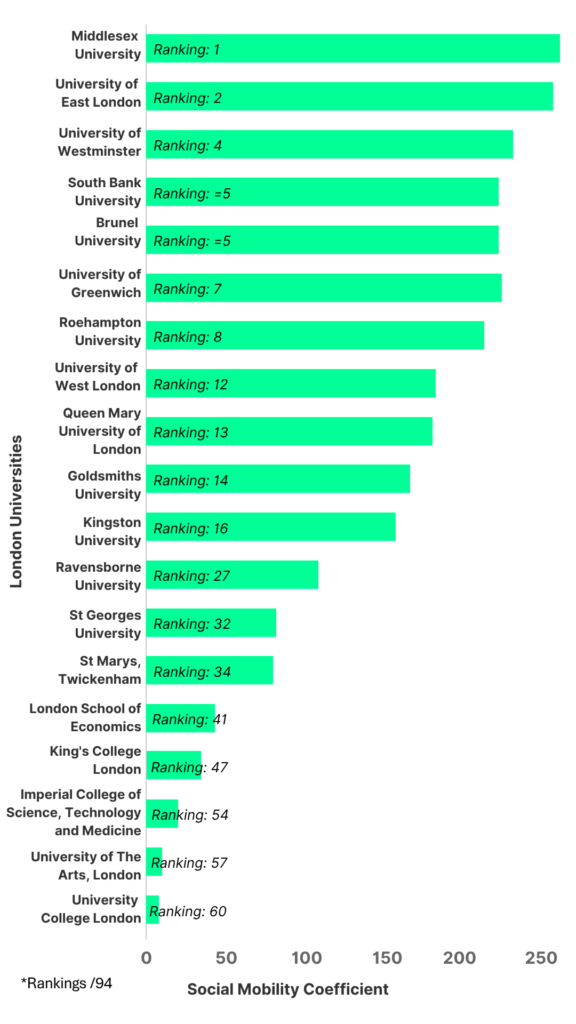
When looking at the social mobility coefficient we see London’s universities are strong performers across the board. The London universities with lower entry requirements dominate the top spots of the national rankings, led by Middlesex University (+257), the University of East London (+253), and the University of Westminster (+228). Even more selective, higher-tariff providers in London have positive scores, a trend that is not shared by most other regions across England.
Part of this standout performance may be explained by the high concentration of qualified, socio-economically disadvantaged young people living in close proximity to these London universities. To gain a more accurate picture of institutional performance, and understand recruitment success locally, it is essential to also take into account the location-adjusted social mobility coefficient, explained below.
Location-adjusted social mobility coefficient:
The location-adjusted social mobility coefficient applies geographical weighting by giving greater weight to prospective students who meet entry requirements and live closer to the university.
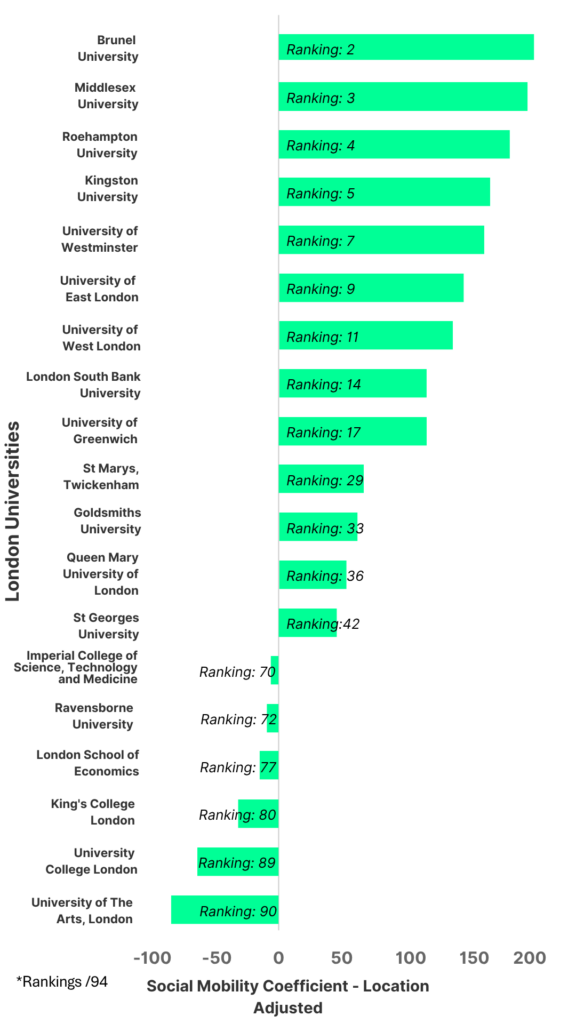
When looking at the location-adjusted coefficients, London’s lower-tariff universities maintain high scores, with Brunel University London (+187), Middlesex University (+184), and Roehampton University (+175) remaining near the top of the national rankings, allowing London to retain six of the top ten positions overall.
However, six selective London universities saw their social mobility scores drop into negative territory once local geography was factored into the calculations. This could be due to a variety of factors:
- London has a particularly high concentration of qualified, lower-income students living near these campuses.
- The geographical model expects institutions to draw from the talented, disadvantaged candidates right on their doorstep.
- These high tariff universities that fell below 0 primarily enrol students from across the country rather than drawing from their immediate community.
A Spotlight on Middlesex University
Middlesex University, in North-West London, achieved a social mobility coefficient score of 257, ranking top out of the 94 universities included in the report. They similarly scored 184 in the location adjusted social mobility coefficient, ranking them third.
To assist students from disadvantaged backgrounds, Middlesex University provides a variety of initiatives, including the Living Costs Fund, which offers financial aid for unforeseen expenses to help alleviate students’ financial anxieties.
Additionally, the university has established the Barnet Lifelong Learning agreement to support local students from Key Stage 3 to Key Stage 5. This agreement ensures a guaranteed interview or offer for all prospective students at a Barnet school or college who meet the institutional course criteria. This scheme also funds workshops and delivers critical support and employability resources to guide students through the university application process. Schemes such as these are likely contributors as to why Middlesex is so successful in representing disadvantaged students.
Professor Shân Wareing, Vice-Chancellor of Middlesex University said:
“We are delighted that the Social Mobility Commission has recognised Middlesex University as the leading university in England for recruiting students from disadvantaged backgrounds. Creating opportunity through education is at the heart of everything we do. This recognition reflects years of working alongside schools, colleges and communities across North London to ensure that talent and ambition, not background or circumstance, determine who can benefit from higher education.
“Our responsibility to widening access does not end when students arrive on campus or even when they graduate. We are committed to helping every student thrive and build a successful career. As one of London’s leading providers of nurses, midwives, teachers and social workers, we are not only transforming individual lives but strengthening the communities our students go on to serve. We prepare our students to lead and shape their professions and society. This is what social mobility looks like in practice.”
Further reading on our Report:
Read more about our national findings and trends here
Reach our full report and recommendations in Who gets in? University benchmarks for social mobility, you can also read a summary report.
Look at our ranking tables on our online Data Explorer Tool here
Related content

Do postcodes drive privilege?
There is frequent discussion of how your socio-economic background, parent’s occupation and school determine your academic achievements, job prospects and future income. But what happens when you keep climbing the… read more
Topics
A local divide: Why are Universities in the same city recruiting such different demographics?
Creating fairer access and reducing admission barriers is a shared aspiration across the higher education sector, and while some universities are already making great strides, others still have some progress… read more
Topics

Social Mobility Symposium: Speech highlights from Angela Rayner, Helen Whately and Lord Blunkett
Today, Tuesday 23rd June, the Social Mobility Commission hosted our 2026 Social Mobility Symposium in Westminster. Three keynote speakers, four panels and more than 20 panelists – from across the… read more