Local Innovation and Economic Dynamism index
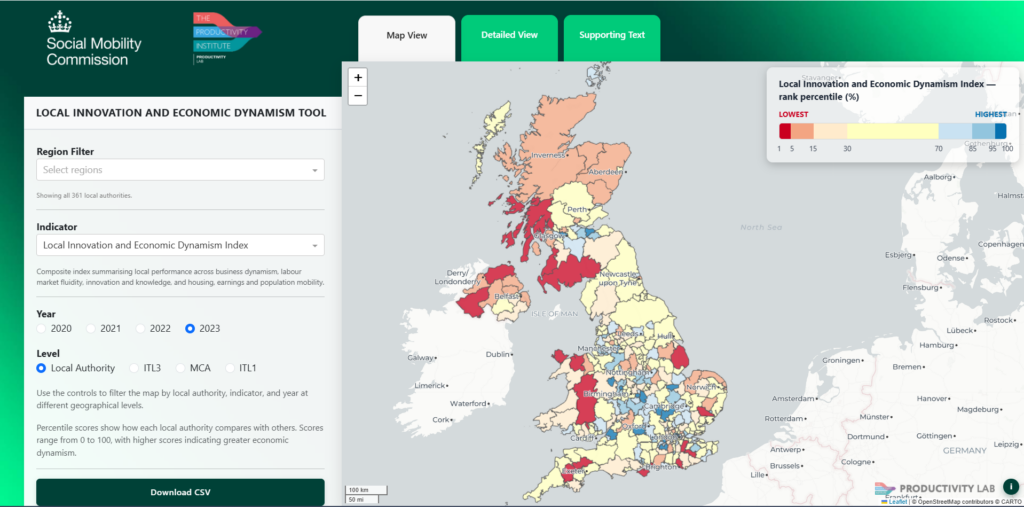
The Local Innovation and Economic Dynamism index is a tool to help understand the barriers to entry, innovation, and upward social mobility across different parts of the UK.
The tool combines data from ONS, Orbis and the UK Research and Innovation Gateway to provide detailed breakdowns across 361 local authorities, all 11 Mayoral Combined Authorities and every UK region and nation.
Rather than giving a static picture of wealth it gives a dynamic picture of progress in closing gaps between different parts of the UK. This can be explored through 16 different indicators across four themes
- Business dynamism – Measures business creation, growth and renewal, together with changes in local productivity
- Labour market fluidity – how active and adaptable local labour markets are, including employment, youth employment, skills and economic inactivity
- Housing and earnings – Captures housing supply, earnings growth and the movement of people into and out of local areas.
- Innovation and knowledge – Captures local capacity for innovation and knowledge creation.
Studies have shown that business and economic dynamism can unlock opportunities for social mobility by generating higher productivity, faster growth and better-paying jobs.
The UK faces severe regional economic inequality and remains one of the most geographically unequal economies in the G7, with vast disparities in wealth, infrastructure, and opportunity.
Which means that all too often people’s prospects for social mobility are limited by where they grew up and where they live.
Explore the Local Innovation and Economic Dynamism index.
Alun Francis, Chair of the Social Mobility Commission said:
The UK’s regional inequality is a profound barrier to social mobility. If we want to expand opportunity, we cannot just look at where wealth currently sits; we must look at where new opportunities are being created. This is why the Social Mobility Commission has prioritised place based approaches to innovative economic growth.
“However, these approaches need targets and measures. This index provides a vital new lens for local leaders and policymakers. By focusing on dynamism the tool points out where progress is being made and encourages healthy competition between regions to demonstrate best practices in building the type of economies capable of fostering social mobility”.
Ricky Bell, leader of Glasgow City Council said:
“In Local Government, it can be hard to focus on the interventions that really make a difference to our citizens, especially when doing so meaningfully the local context can often mean swimming against a national tide. Doing that requires having a grasp of the data to help inform citizen engagement – so this tool adds to our capacity to keep doing that.
“The Social Mobility Commission has therefore helped strengthen the incentives for others in roles like mine to keep taking the decisions we think are best to help particularly our young people live healthy, productive lives – contributing to their local communities and increasing prosperity for cities like Glasgow.
Helen Godwin, Mayor of the West of England said:
“The Index provides new insight as we continue to deliver our regional Child Poverty Action Plan, endorsed by Gordon Brown, to tackle poverty and increase opportunity for communities across the West. We know that in parts of our region, including east and south Bristol, social mobility is among the lowest in the country.
“Social mobility remains a real priority for us as the birthplace of Kids Go Free. This summer, our offer went national and saw 14 million free bus journeys – opening up whole new worlds for young people, with the most journeys taken by children from the West Country’s lowest-income neighbourhoods.
Craig Beaumont, Executive Director at the Federation of Small Businesses said:
“This Index rightly recognises that social mobility depends on business dynamism, not just education. Where firms are starting up, taking on staff and growing, opportunity follows, and small businesses are where most people get their first foothold.
By mapping dynamism down to the strategic authority level, the Index shows policymakers which parts of the country are struggling to generate the entry, growth and renewal we need, and where others are succeeding. That evidence should shape how local growth plans, skills funding and business support are targeted.”