Do postcodes drive privilege?
There is frequent discussion of how your socio-economic background, parent’s occupation and school determine your academic achievements, job prospects and future income. But what happens when you keep climbing the education ladder, but the promised job at the top, is geographically out of reach?
Samuel grew up in a small village, Skewen, in South Wales, Neath Port Talbot. He worked hard to secure a place at the University of Warwick hoping to pursue a career in STEM.
In this article, Samuel shares his experience of where is from – determining where he could end up.
“When I read the Commission’s observations that the national conversation about young people not in education, employment or training fails to address the regional inequality and entrenched disadvantage behind the figures, it resonated with me immediately. It’s a gap that I don’t think gets nearly enough attention.
“I was studying for a masters in Physics at the University of Warwick in 2016. I didn’t really think about internships in my first year. But when I came back for second year, some of my friends had spent the summer doing placements, and it was clear straight away how much it had done for them – in terms of on-the-job experience and the contacts and networking it provided. Suddenly, despite my summer of studying and revising at home for exams, I felt I was behind. I started looking at what was available near my family home in South Wales. And honestly, there was nothing. Certainly nothing in STEM that was going to give me any skills, experience or connections that would help me into the kind of career I wanted.
“I widened my search radius – London, Birmingham, Manchester – suddenly there were hundreds of opportunities. The overwhelming majority of roles in my field were concentrated in major cities, and particularly in London. I applied for a few and got through the interview processes. But then that’s where it fell apart. I was a student, there was no way I could afford, or have time, to commute daily from South Wales nor could I afford the rent and deposits needed for short-term accommodation in these major cities. I already had looming student debt and was in my overdraft and most landlords wanted six to twelve month tenancies.
“There was simply no way I could pull together three months’ rent and bills in a city where I knew nobody, for an internship paying minimum wage – which wouldn’t have come close to covering those costs. That’s when I realised that my friends that had done these internships weren’t a step ahead of me academically, their family homes were just in the right postcode. They went back home for the summer, slept in their old bedrooms, rent free, and commuted in – maybe 45 minutes on the tube. For me, it just wasn’t possible.
“I started to see a divide between my peer group, those already living in or near London could access opportunities that were effectively closed to equally able students from elsewhere. Because internship experience counts for so much in graduate recruitment, the knock-on effect became really apparent in our final year when everyone was applying for jobs. The people getting responses and offers were the ones who’d done the internships – even when their grades weren’t as strong as mine. I made that financial sacrifice to go to university, to get the qualifications, because I believed that would open doors. But when it came to it, geography stopped those qualifications from doing what they were supposed to do.
“I’ve since moved to Birmingham, because the jobs I want in STEM don’t exist where I’m from, so I had to uproot my life and move away from my family. That shouldn’t be the price of ambition. I now work as a researcher – but the path here was longer and more precarious than it needed to be, and it involved a fair amount of luck. It worked out – but it shouldn’t have had to depend on a fortunate near-miss.
“I wish there had been a more affordable option like universities in these cities offering up subsidised accommodation for the summer or more widespread internships. If I’d been able to afford to live in a city for three months as an undergraduate, I’d have been in exactly the same position as my peers, on a fast track grad scheme. The only difference was where I grew up.”
Samuel, 29
What the data says
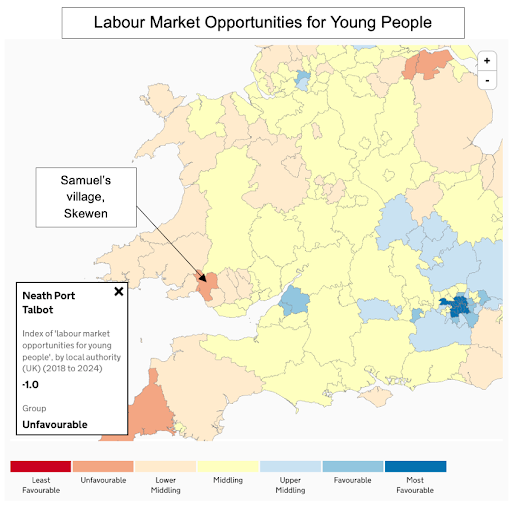
The Social Mobility Commission’s annual State of the Nation report is the most comprehensive analysis of social mobility in the UK. Our indices combine data on the multiple drivers behind binary stats, to paint a picture on a local level.
The experience of places like Neath Port Talbot (the authority in which Samuel’s village sits) is typical of the effect of deindustrialisation on former mining and industrial areas across Wales, the North East of England, Yorkshire and the Humber, the West Midlands, and Scotland.
While Neath Port Talbot has made some progress improving certain social mobility measures, our Labour Market Opportunities for Young People index classed Neath Port Talbot as “unfavourable”.
You can look up any area and various social mobility measures on our Data Explorer Tool.
State of the Nation 2026 – Travel to Work Areas
To gain a deeper understanding of local job markets, our State of the Nation report will analyse Travel To Work Areas (TTWAs) for the first time. TTWAs (or commuting zones) are different from traditional local authority boundaries which can mask opportunity when people are travelling to a neighbouring LA for work – especially in big cities. This analysis means we can identify where major cities are positively influencing neighbouring areas, as well as disparity within a local authority.
Related content

Young and NEET in Blackpool: upcoming research on their realities
Next week, the Social Mobility Commission will be releasing our in-depth research into the daily lives and experiences of young people not in education, employment or training (NEET) in Blackpool…. read more
Topics

Why do London Universities rank higher for social mobility than other regions in England?
The Social Mobility Commission recently released – Who gets in? University Benchmarks for better social mobility. This report shares rankings for English universities based on how well they are enrolling… read more
Topics
A local divide: Why are Universities in the same city recruiting such different demographics?
Creating fairer access and reducing admission barriers is a shared aspiration across the higher education sector, and while some universities are already making great strides, others still have some progress… read more