Meet the finalists in the first AI and Social Mobility Challenge Prize
Eight ventures have been announced as finalists in the inaugural AI and Social Mobility Challenge Prize, a new programme exploring how AI and emerging technology can widen access to opportunity and improve social mobility for young people across the UK.
This cross-sector Challenge Prize, delivered by the EY Foundation and Social Tech Trust in partnership with the Social Mobility Commission, and supported by Microsoft, HSF Kramer, EY, Fieldfisher and LinkedIn, aims to help new ventures put social mobility at the forefront of AI innovation.
AI is already reshaping daily life, learning and careers. But the opportunities created by these technologies are not automatically equal. The Challenge Prize was created to explore AI’s potential while embedding a critical requirement: that it expands opportunity and reduces barriers for young people from lower socio-economic backgrounds.
A competitive application and selection process, launched in June, identified AI solutions spanning different stages of a young person’s journey, from learning and skills development to pathways into employment. The selected finalists all demonstrate how technology, when designed responsibly, can offer new ways to make opportunities more accessible and tackle existing barriers.
The 2026 cohort
- AVA, founded by Yusuf Ben-Tarifite – An AI-powered platform helping young people discover career pathways and navigate opportunities for education, skills and employment.
- Breakthrough, founded by Sobanan Narenthiran – A social enterprise helping young people excluded from the digital economy build applied AI and digital skills, access one-to-one coaching and connect with employers who are hiring.
- FIIT Learning, founded by Dionne Jude – An AI-powered learning platform providing personalised education and wellbeing support that adapts to each learner’s needs, pace and circumstances.
- HopeHub, founded by Amani Simpson – A 24/7 digital youth-support platform featuring Jords, an AI goal coach that helps young people achieve their goals, sustain inspiration and access local opportunities.
- Louno Space, founded by Mirko Viviano – A space-education platform combining hands-on activities with Nova, an AI learning companion offering personalised STEM missions to children aged 7–11, particularly in underserved communities.
- MyPocketSkill, founded by Matthew Harker and Zara Ransley – An AI-enabled platform connecting young people with paid opportunities while providing personalised financial education, skills development and support through PokitAI.
- Tangent, founded by Gary Izunwa – An AI-native talent network making professional connections, personalised career support and pathways into employment accessible to everyone.
- Ultra Education, founded by Julian Hall – An AI-powered entrepreneurship mentor providing personalised, age-appropriate guidance to help young people build confidence, develop ideas and take practical steps towards education and employment.
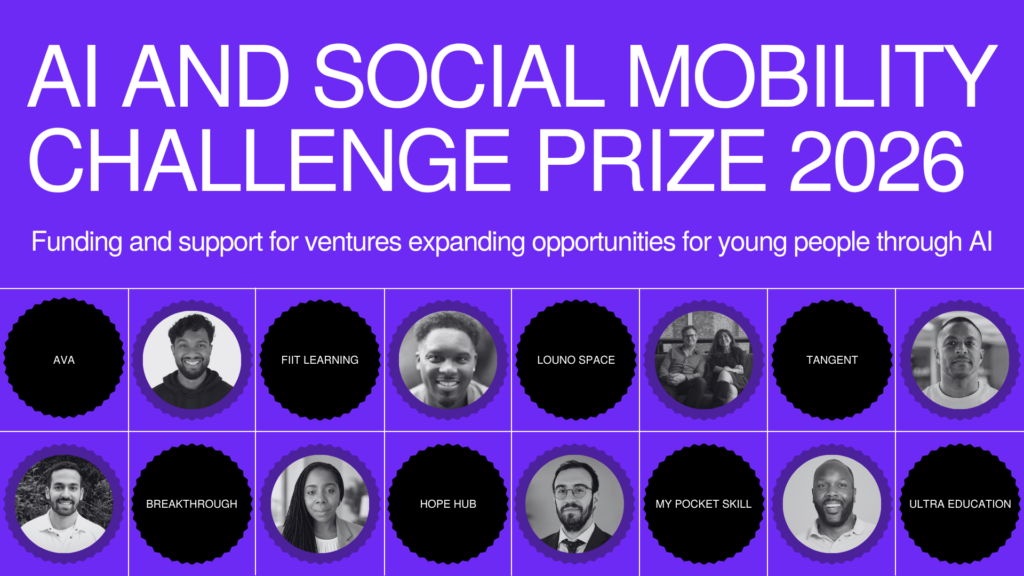
Members of the EY Foundation Youth Voice Forum have already contributed to the venture selection process. Throughout the programme, the cohort will be encouraged to consider accessibility, trust, accountability and participation, and to demonstrate how young people’s perspectives influence what they build.
All eight finalists now begin developing their ventures with expert support from across the programme partnership, including one-to-one mentoring and office hours, peer learning, and connections to investors, advisers and the wider ecosystem. Expert learning sessions will explore technology, responsible AI, commercial growth, legal and structural considerations, and social mobility.
Each venture will receive a £3,125 non-dilutive participation grant. At the end of the programme, an independent judging panel will award a further £10,000 to the winner and £5,000 to the runner-up, bringing the total funding available through the Challenge Prize to £40,000.
The Challenge Prize will run through to October, culminating in an event at Parliament, further information is available on the Social Tech Trust website.
Related content

Disadvantaged students miss out on top universities – despite getting the grades
New rankings from the Social Mobility Commission show nearly one third of English universities are underrepresenting students of a lower socio-economic background – even when they meet the entry requirements…. read more
Topics
Who gets in? University benchmarks for social mobility
While academic attainment plays a fundamental role in access to higher education, even when comparing university student intakes to those who have already met the entry requirements, socio-economic representation still… read more
Topics

Lord Blunkett: “We must not patronise and paternalise”
At this year’s Social Mobility Commission Symposium, the Rt Hon Lord David Blunkett gave a keynote address on how society and the state must work alongside young people to support… read more