How the West Midlands Combined Authority is utilising our data to drive impactful and inclusive interventions for residents
The West Midlands is one of the most diverse regions in England. It also has some of the highest levels of deprivation in the country, with our annual State of the Nation 2025 report describing some post-industrial areas in the West Midlands as facing ‘entrenched disadvantage’ across multiple social mobility measures.
For policymakers at the West Midlands Combined Authority (WMCA), this presented a challenge – how do you understand and improve the day-to-day lives of residents with a diverse range of circumstances when ‘traditional’ social mobility measures can be one-dimensional, disconnected from lived experience and not account for different communities definitions of a ‘good’ life’.
In the ‘Creating Truly Inclusive Communities’ WMCA strategy, Mayor Richard Parker said:
“We need everyone – residents, community organisations, local authorities, businesses, and policymakers – to come together, working as one to make the West Midlands a place where everyone feels included and can achieve their full potential.”
The WMCA identified four groups of social factors that drive inclusive communities: social capital, social infrastructure, social inclusion and social mobility. The inclusive communities team, that sit within the Employment, Skills, Health and Communities directorate began developing a more holistic framework, setting four interconnected goals:
- A socially connected region
- A supportive region
- An inclusive region
- An equitable region
Creating an equitable region is where the Social Mobility Commission’s data proved particularly valuable. As part of this goal, WMCA set out for residents this would mean “being part of communities that enable people to fulfil their potential no matter what their background or circumstances, and don’t inhibit personal growth.”
The WMCA used the Commission’s four composite indices of social mobility as barometers for monitoring progress towards this goal. Each index has 7 categories ranging from ‘least favourable’ to ‘most favourable’:
- Promising Prospects index was set as the key barometer. It looks at 25 – 44 year-olds over time and is measured by levels of education, professional work, and earnings. It measures how well young people from similar socio-economic backgrounds do in education and the labour market in each local authority.
- Conditions of Childhood index looks at the earnings, qualifications and occupation levels of parents and shows whether the conditions children grow up in are good for promoting social mobility.
- Labour market opportunities for young people index looks at labour market opportunities for 16 – 29 year-olds measured by their occupation level and unemployment rate over time.
- Innovation and growth index shows the conditions to help promote innovation and economic growth and is measured by area’s productivity level, ‘new economy’ jobs and economically-active residents with postgraduate qualifications.
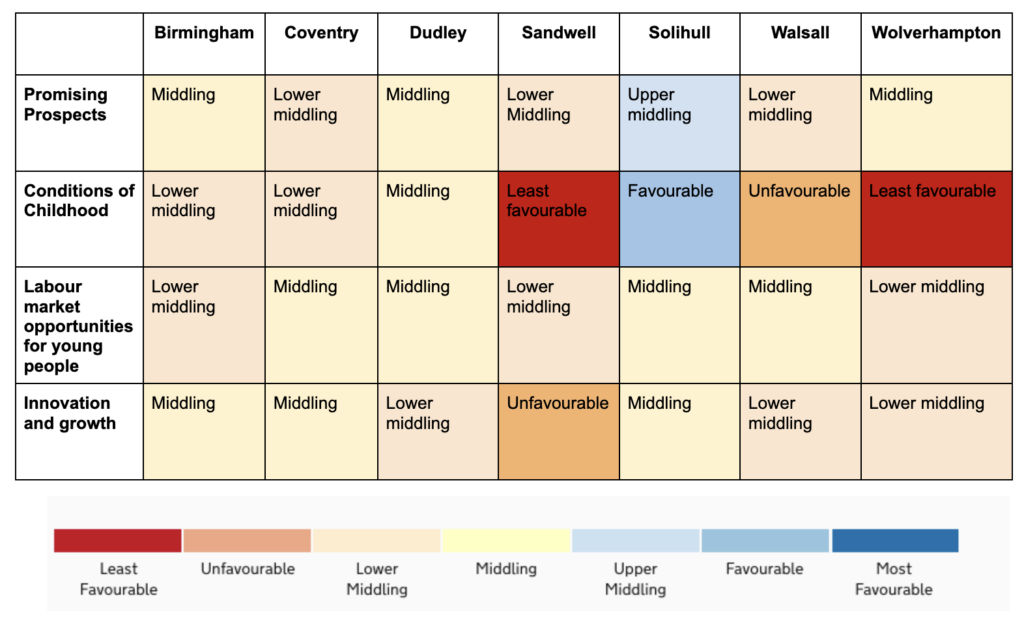
Within the WMCA region Solihull was the only local authority to have one ‘favourable’ and one ‘upper middling’ rank, the other Local Authorities’ were all classed from ‘middling’ to ‘unfavourable’.
The WMCA investigated further by speaking with residents and found that where opportunities in the region existed, the accessibility of these could sometimes be a problem, because of inadequate infrastructure and a lack of services in place to support the differing needs of residents.
The Commission’s various metrics helped bridge a gap the WMCA had identified in its own evidence base. While the WMCA held a great deal of policy-specific data, the Commission’s broad indicators of social mobility helped them build a picture of an individual’s whole life.
Using this richer evidence base, the WMCA can shift towards a more preventative model – one focused on creating the conditions for change rather than just focussing on investing in new initiatives. This means asking harder questions – like are we reaching the right people?
The local authority level data from the Commission recognises that obstacles facing communities in Dudley can look very different from those in Sandwell. To build on this work, the WMCA is now in its second year of an annual household survey, with an expanded social mobility section designed to understand the metrics residents themselves use to make sense of their own lives.
To ensure this work genuinely reflects the communities it serves, the WMCA takes time to identify trusted voices, such as faith leaders, and work with them to meet people where they are rather than where policy assumes them to be. This helps residents to contribute their own perspectives on what social mobility means for them.
Further work with the WMCA
The WMCA is passionate about embedding social mobility into all aspects of its policy design. It wants to connect the challenges around skills and deprivation with the aspirations and strengths that exist across the region. By bringing together the inclusive communities agenda and the skills and education agenda, the Authority is building a more coherent, resident-centred approach to improving life chances.
The Commission met with the West Midlands Combined Authority team to hear their perspectives on improving social mobility in the West Midlands and beyond, which fed into our Regional Insights report.
In a foreword to the publication, Mayor of the West Midlands, Richard Parker, said:
“Social mobility is about opening-up new opportunities and my approach to economic growth is about unlocking as many of these opportunities as possible – for people and places in the West Midlands that have been denied them for far too long.
“By aligning these findings with our Growth Plan and West Midlands Works, we are reinforcing a shared mission: to make the West Midlands a region where everyone has a fair chance to succeed, wherever they start. This report strengthens that case and provides valuable evidence to guide the next phase of delivery.”
Look up social mobility measures in the West Midlands and beyond on our Data Explorer Tool.
Related content

Disadvantaged students miss out on top universities – despite getting the grades
New rankings from the Social Mobility Commission show nearly one third of English universities are underrepresenting students of a lower socio-economic background – even when they meet the entry requirements…. read more
Topics

Lord Blunkett: “We must not patronise and paternalise”
At this year’s Social Mobility Commission Symposium, the Rt Hon Lord David Blunkett gave a keynote address on how society and the state must work alongside young people to support… read more
Topics
Applications launch for AI and Social Mobility Challenge Prize
Today, Monday 22nd June, applications have opened for the first AI and Social Mobility Challenge Prize to encourage using technological innovation to drive forward social mobility in the UK. The… read more