Understanding the experiences of young people not in education, employment or training (NEET) in Blackpool
Foreword
The Social Mobility Commission (SMC) has long argued that traditional social mobility narratives have spent a great deal of time encouraging young people to follow the university route, particularly those who are academic high achievers, while very little attention has been given to those who are not in education, employment or training (NEET). Recently, this has begun to change. In response to the rising number of 16–24 year-olds who are NEET, the Department for Work and Pensions appointed Alan Milburn to lead a national independent review. His team published their initial diagnostic report earlier in the year and will shortly publish their recommendations.
This process has done a huge amount to raise the profile of our “NEETs crisis”. It has also emphasised the complexity of the problem. Not all young people are NEET for the same reason and different groups require different solutions.
There are distinct patterns by age, gender, ethnicity and geography. Socio-economic background also matters. As our State of the Nation 2025 report highlighted, the rate of NEETs from lower working-class backgrounds (22%) is higher than any other socio-economic group and more than double the rate of those from higher professional backgrounds (9%). There is also a strong correlation with levels of educational attainment: not having a qualification above Level 1 is a primary risk factor for becoming NEET, and the proportion of disadvantaged pupils failing to achieve this has increased from 5.1% in 2020/21 to 7.5% in 2023/24.
These are all well-established patterns. But additionally, we are witnessing a significant and new problem of disengagement, mainly characterised by high levels of labour market inactivity. This trend is intertwined with disability and health challenges, with mental health concerns emerging as an especially prominent and defining factor.
The Government has introduced the Youth Guarantee as a way to get more NEETs into education and training, but there is a risk that the package of measures proposed will mostly help those that are already close to getting into work. Or they will have limited impact, because the NEETs crisis is a result of a broader group of problems in the labour market for young people, linked to the welfare system, job creation and growth across the country. Our assumption is that the Milburn Review will make recommendations to address these challenges.
Furthermore, even under optimal conditions, some young people are going to require a great deal more attention. Some young people are particularly at risk of becoming NEET because of factors beyond the immediate labour market, and some places, such as Blackpool, have particularly high numbers. Our research was motivated by a desire to bring the perceptions and experiences of this group into sharper focus, while simultaneously developing a methodology that other places can adopt to better understand how to help young people in their community.
This is challenging and difficult work. A fundamental obstacle within existing NEET provision is the absence of clear institutional “ownership” and the lack of a singular, reliable, and comprehensive data source to monitor these young people across regions or areas. Further, the lack of coordinated case management presents significant challenges to any robust inquiry or research. While there are many young people who are at risk of becoming NEET, finding those who are currently NEET and persuading them to participate in research is no easy feat. Our research team worked collaboratively with local agencies and young people to address these challenges, establishing a methodology that can now be replicated in other areas of the country.
It is important to emphasise that the findings of this research capture the way that young people who are NEET see their own situation, subjectively, and in a local context. And it includes their own assessment of the agencies they work with, and of the labour market.
Reading the perceptions of the young people we spoke with, it is hard not to conclude that public services, including schools,colleges and employment services have not worked for them. But this is not the whole story. There are two themes which stand out from this research which may not be receiving sufficient attention in the current debate about NEET reduction. The first is families and the second is the psychosocial aspect of disengagement and low achievement.
Family circumstances are referred to in a wide range of settings, including the extent to which families are able to give good advice about careers and work, the problem of family instability (including moving house, relationship breakdowns and social isolation), the challenge of unpaid caring responsibilities, and the problem of family estrangement. There is also reference to the stress which parents experience in holding down employment themselves, and to the problems of engaging in employment and training when families are dependent on benefits.
There is a strong local backdrop to many of the issues which our interviews highlight, particularly around housing instability, adult labour market inactivity, and the nature of employment opportunities, to be found in parts of Blackpool. This corroborates our view that place-based solutions are required. But there is also sufficient evidence to suggest that families and NEETs are an issue which needs considerably more attention nationally. We simply do not know enough about the way in which family circumstances make NEET status more likely, and the extent to which NEET status is part of intergenerational cycles.
The same can be said for the phenomenon which the Youth Futures Foundation refers to as the psychosocial aspect of becoming NEET and disengaged. This concept encompasses the personal attributes (such as confidence, resilience, and self-belief) and social capabilities (like communication and teamwork) that help individuals navigate their personal and professional lives. Highlighting these areas in their Youth Employment Toolkit underlines the value of targeted support in helping young people build these strengths and achieve positive outcomes. It may be time to think beyond youth work to a much more comprehensive education and skills strategy, based on what we know and understand about the frame of mind which develops among the most disengaged.
This aspect of the NEETs crisis received some attention in the Young People at Work: Interim Report (2026) which explores how low confidence, anxiety and related experiences intersect with health and mental health, educational outcomes, transitions and labour market participation. Building on these important insights, there is a clear opportunity to deepen our understanding of how negative lived experiences shape long-term mindsets, offering even richer context on how to support and unlock a young person’s capacity for change.
This point is worth elaborating. “Inside the Mind of a Young NEET”, which is the research underpinning much of the “Young People at Work” report, challenges assumptions and stereotypes about young people and does so successfully. It questions simplistic narratives which associate NEETs with being lazy, work-shy, unambitious or uninterested in work or learning. And it demonstrates that young people have hopes, ambitions and aspirations. While the report rightly shines a light on institutional challenges, there is also a rich opportunity to complement this focus by examining how individual and group agency shape these outcomes
There is a substantial body of research into the factors which shape underachievement and low performance. And a great deal relates to the way institutions and systems can reinforce poor outcomes through labelling, setting low expectations, establishing institutional narratives, and undermining belonging – among other things. These are all incredibly important factors. While these systemic influences are crucial, it is equally valuable to consider how long-term adversity influences individual and group attitudes, mindsets, and self-perceptions over time.
Our findings corroborate the Young People at Work conclusion that young people have ambitions and positive long-term hopes. At the same time, broader research suggests that many young people navigate significant uncertainty around the practical pathways to realise these hopes. Supporting them to recognise how their own decisions and choices shape these journeys is a vital part of helping them achieve those aspirations.
In our research, young people build narratives about their outcomes in which their own agency is diminished. Careers advisors were criticised for highlighting to young people that they did not have the qualifications for their desired career pathways. Neither the advisors nor the young people had the power or authority to change the requirements of the job. But the alternative, which was that the young people acquired the qualifications needed, seemed unattainable to them. So an impasse was reached and the young people became frustrated.
In other settings young people indicated that their own behaviour was a factor in shaping outcomes, but presented it as a matter of immutable fact, rather than dynamics within their control. For example, in some instances, young people attributed the loss of ambition to external factors. Others similarly attributed major setbacks – such as school exclusion, family breakdown or involvement with the criminal justice system – to ongoing peer conflict, substance use or unmanaged emotional distress, describing these challenges as external facts of life rather than moments where alternative choices felt available.
There are undoubtedly complex issues that require support attached to all of these individual cases, but they do show that the psychosocial disposition of young people is a factor in its own right. This accords with wider research literature.
We know from that literature that some young people face greater challenges in setting goals, planning ahead and managing their feelings. They may also have weak self reflection where their own learning is concerned (metacognition), leading them to explain their outcomes in negative terms, such as being “not academic” or “not brainy” or not suited to school or college. They may have limited experience of successful learning and assume that effort and engagement will be unproductive or embarrassing. They may well fear the shame and humiliation of not doing well. They may experience feedback as judgemental rather than constructive, and may associate criticism with failure not improvement. And they may build a narrative that the system and its benefits are “not for them” and will too easily accept that “it does not work”.
These are not irrational responses. They are perfectly reasonable ways of making sense of a world in which you never appear to do very well. But they do need to be addressed and unlocked if those young people are going to make progress. And the starting point of a remedy, is to acknowledge that there is a problem to be solved. At the moment, this aspect of the NEETs crisis is not receiving enough attention.
This is not to say that there are no institutional and “system” changes needed to manage our current NEETs crisis. Our research corroborates the view that the system is not working for them and our recommendations reflect the need for changes in institutions. But they also advocate that the issue of agency is considered more assiduously.
Our first recommendation relates to the need to fund local partnerships which can “own” the NEETs crisis, and caseload individuals efficiently. Public agencies need to know young people much better than they do. This is only feasible at a local level, and requires a multi-agency approach, bringing together all relevant services that are not currently coordinated. In part, it is a problem of data – we simply do not have a full picture of the numbers at the moment. But it is also a question of relationships, qualitative knowledge of individual circumstances and solutions which build on that.
Our second recommendation is that while the public sector has a responsibility to take ownership of the issue of NEET management and caseloading, the primary solutions will come from the private sector, driven by stronger economic growth and a more robust youth labour market. Without this broader context there can be no sustainable solutions. It is also important to note that, when this is a general problem for all young people, there is a substantial risk of divisive interventions, which privilege “NEETs” over others.
In designing interventions it is also important, as the Young People and Work report has done, to acknowledge that there are significant differences within the NEET group. In designing effective interventions, policy must move beyond a one-size-fits-all approach and recognize that young people who are NEET form a deeply heterogeneous group. To capture these distinct experiences and pathways, our research utilises specific NEET personas. This typology allows for a tiered strategy: delivering swift, streamlined support where the route back to work or learning is relatively direct, while reserving more targeted, sustained resources for young people facing complex, multi-layered barriers.
If we listen to young people who are NEET, families are the stand out factor. Families shape ambitions, they share knowledge, provide guidance and support, and shape identity and self efficacy. The role that families play in shaping outcomes for children and young people is well established and is consistent with the Commission’s previous work. But the specific role that families play in pathways to NEET needs considerably more analysis.
Finally, our third recommendation, we need to combine an analysis of institutional and system reform, with work to address the psychosocial issues which add to the difficulties of some young people in terms of engagement and achievement. This is the most difficult but important challenge for public policy. Far too often, the policy response will focus on efforts to make people feel more included and/or to give them goals that are easier to achieve. Both of these responses are understandable, but they may just reinforce the problem rather than change the situation. We need an evidence-based approach to help the most disadvantaged, particularly young people, regain confidence in their own agency, and the belief that investing time and effort in developing their capabilities is worth it. All our other initiatives will either fail or be partially successful if we lose sight of this challenge.
- DWP (2026), Young people and work: interim report
- SMC (2025), State of the Nation 2025: The evolving story of social mobility in the UK.
- National Centre for Social Research (2023), Risk factors for being NEET among young people.
- SMC (2025), State of the Nation 2025: The evolving story of social mobility in the UK.
- Youth Futures Foundation (2026), NEET Dashboard.
- National Centre for Social Research (2023), Risk factors for being NEET among young people.
- Youth Futures Foundation (2025), Educational and Psychosocial Factors Associated with Increasing the Risk of Becoming Not in Education, Employment or Training (NEET) Among Young People in England: A Rapid Evidence Assessment.
- Ibid.
- Youth Futures Foundation (2026), Youth Employment Toolkit
- DWP (2026), Young people and work: interim report.
- Hyman and S. Gamote (2026), Inside the Mind of a Young NEET.
- McLeod (2024), Labelling theory in education.
- Gillborn and D. Youdell (2000), Rationing education: policy, practice, reform and equity.
- Jussim and K. Harber (2005), Teacher expectations and self-fulfilling prophecies: knowns and unknowns, resolved and unresolved controversies.
- Wigfield and J. Eccles (2000), Expectancy-value theory of achievement motivation.
- B Weiner (1985), An attributional theory of achievement motivation and emotion.
- Zimmerman (2002), Becoming a self-regulated learner: an overview.
- Pintrich (2004), A conceptual framework for assessing motivation and self-regulated learning in college students.
- Education Endowment Foundation (2025), Metacognition and Self-Regulated Learning.
- Elliot and H. McGregor (2001), A 2 x 2 achievement goal framework.
- DWP (2026), Young people and work: interim report.
- SMC (2026), The role of families in the educational outcomes of children and young people.
Executive summary
Introduction
Recently published 2021 Census data shows that Blackpool had the highest rate of 16-24 year olds not in education, employment or training (NEET) for males (22.2%) and females (20.4%). The situation has not improved since. Blackpool still has one of the highest rates in England of young people at risk of becoming NEET in 2026. According to the Youth Futures Foundation, the most critical NEET risk factors include achieving no GCSEs, eligibility for free school meals (FSM) and having special educational needs (SEN). Blackpool ranks high in all 3: in the 2024 to 2025 academic year, 6.9% of pupils in Blackpool did not achieve any GCSEs (the sixth-highest rate in England) and 46.4% of Key Stage 4 (KS4) pupils were eligible for FSM (the eighth-highest in England). In the 2025 to 2026 academic year, 7.3% of pupils held an Education, Health and Care (EHC) plan – one of the highest rates in England. This shows that Blackpool is home to a uniquely vulnerable youth population, where risk factors converge to drive high rates of individuals becoming NEET.
To better understand the local factors behind these statistics, the Social Mobility Commission commissioned this research to provide an in-depth exploration of the experiences of young people who are NEET in Blackpool. The study sought to understand the factors influencing pathways into NEET status, the lived experiences of young people with NEET status, and the forms of support most likely to help young people engage in education, employment or training (EET).
The research combined a rapid evidence review, systems mapping workshops and qualitative fieldwork with young people. We embedded a co-production approach throughout, involving a panel of young people with lived experience of being NEET in the design, interpretation and validation of the research. Fieldwork included semi-ethnographic methods such as ‘walk-and-talk’ discussions and WhatsApp check-ins, alongside extensive discussions with young people. This rigorous methodological approach represents a unique contribution to the wider debate and provides in-depth insights into the topic.
A total of 31 young people aged 16 to 24 took part in discussions, including 25 who were currently NEET and 6 who had successfully transitioned into education, employment or training. We recruited participants through a range of routes, including local voluntary and community organisations, Blackpool Council services, Blackpool Jobcentre Plus, and professional recruitment agencies, helping us to capture a diverse range of experiences. The study was further informed by systems mapping workshops involving local stakeholders and employers and a deliberative workshop that brought together young people and representatives of local organisations to co-design recommendations.
By adopting a place-based approach, this study addresses key gaps in the literature, examining the complex interaction between individual and structural factors that drive and sustain NEET status in Blackpool. Integrating the accounts of young people with the perspectives of local employers, education leaders and third-sector stakeholders offers a multifaceted view of local support needs. However, interpreting these findings through a broader systems lens requires a recognition that these qualitative findings capture subjective, lived experiences and perceptions. These narratives are vital for grounding policy in real-life experiences, but they should be interpreted alongside an understanding of the wider, dynamic network of institutional and structural forces across Blackpool.
Together, the findings provide an evidence base to support future policy, service development and partnership working across Blackpool.
23 – Office for National Statistics (ONS) (2026), Young people not in education, employment or training (NEET), UK: August 2026. This analysis accounted for age differences.
24 – Youth Futures Foundation (2026), NEET prevention through early risk identification: Methods report.
25 – Department for Education (DFE) (2026), Percentage of pupils achieving any passes at GCSE or equivalent.
26 – DfE (2026), Number of pupils at the end of KS4 for ‘Local authority district data’ for FSM eligible and school location. To get the percentage, we divided the number of FSM-eligible pupils by the total number of pupils at the end of KS4.
27 – DfE (2026), Percentage of pupils for ‘Pupils in all schools, by type of SEN provision – 2016 to 2026.
Chapter 1: Pathways to becoming NEET
Chapter 1 explores the factors which young people and local stakeholders perceived as influencing their pathways to being NEET. This includes family, education, health, and other personal or social circumstances.
Blackpool is characterised by a tourism-led economy, though active efforts are being made to diversify the local commercial landscape. A significant number of entry-level jobs in tourism remain seasonal. Some of these are lower paid and offer limited opportunities for progression, but the sector also provides well-paid professional and management roles. The wider Fylde Coast and Lancashire regions offer a broader range of skilled opportunities, such as in advanced manufacturing and engineering, that are accessible to Blackpool residents without the need to relocate. Securing stable local employment nonetheless remains challenging for many young people, against a backdrop of wider educational and socio-economic disadvantages.
Stakeholders involved in the systems mapping highlighted how educational and socio-economic disadvantage could put young people at greater risk of instability during childhood. Many of those who took part in discussions told us they had experienced disadvantage from early on in their lives, such as adverse childhood experiences, lack of role models or trusted adults, family instability, or taking on caring responsibilities.
Many also had health conditions that had affected them from an early age. Just over half of the young people who took part in discussions said they had a health condition. Of these young people, half said they had been diagnosed while just under half had suspected but undiagnosed conditions. Both groups felt that their health issues had affected how they engaged at school and perceived that they had been met with a lack of support from schools and wider services, affecting their behaviour and motivation to engage with traditional learning.
Poor attendance, caring responsibilities, unmet health needs, family instability and disruption to schooling often contributed to lower attainment and reduced access to further education and training opportunities. Low literacy and learning gaps created barriers that continued beyond school. This could also explain why young people felt schools overemphasised academic attainment over other routes to employment.
Young people often described leaving school with limited understanding of how to engage with future education and employment. They also lacked exposure to a range of different jobs, and their aspirations were usually limited to roles visible in family or adult networks.
Finally, the lack of local opportunities and restricted transport options were perceived to have exacerbated young people’s situation further. Even young people who had not faced severe barriers in other areas were affected.
Chapter 2: Understanding the daily lives of young people who become NEET
This section explores the daily lives of young people who are NEET and how this impacts their overall wellbeing and progress towards EET.
Young people who are NEET in Blackpool are not a homogeneous group. Their experiences, wellbeing, and readiness to engage in education, employment or training are shaped by a range of personal, social and structural factors. The research identified 4 distinct personas characterising 4 different groups of young people who are NEET in Blackpool, each representing different levels of readiness to engage in EET and requiring different forms of support. These personas are illustrative rather than definitive, and individual young people’s experiences may not align fully with any one persona.
- More intensive support needs: These young people were the furthest from EET. They were facing acute and immediate challenges such as homelessness, insecure housing, caring responsibilities, family breakdown, experience of care or involvement with the criminal justice system. Their daily lives were focused on meeting basic needs and managing crises, leaving limited capacity to engage with work, learning or training. Low wellbeing and poor mental health were common.
- Health issues constraining ambition: This group was primarily held back by physical health conditions, mental health difficulties or neurodivergence. Many had achieved GCSEs and had clear aspirations for employment or further study, but difficulties accessing appropriate support and managing symptoms, and negative experiences within education, often restricted their participation. Their daily lives were frequently shaped by their health needs, confidence levels and ability to cope in unfamiliar environments.
- Lack of pathway awareness: These young people were actively looking for work and wanted to progress but lacked clear pathways, confidence and awareness of opportunities. They often spent significant time applying for jobs with little success, leading to frustration and declining motivation. While some had experienced disrupted education or perceived that their additional needs were unmet, the barriers these young people faced were generally less severe than the more intensive support needs or health issues identified for other personas. They typically aspired to work or further learning but needed guidance, encouragement and support to translate aspirations into achievable steps.
- Qualified but misaligned: This group was generally closest to entering EET. They often had higher qualifications, relevant experience and clear career ambitions, alongside stronger family support networks. However, they faced a direct mismatch between their skills and local employment opportunities. Many were actively pursuing work or further qualifications but struggled to find suitable roles locally that aligned with their experience and long-term goals.
Chapter 3: Forms of support perceived as most helpful by young people
Experiences of support varied greatly across the 4 personas. In part, this was driven by the perceived quality of the support. However, there was also great variation in young people’s circumstances, readiness to engage in education, employment or training, and ability to engage with the support on offer. For some, this was because they faced significant disadvantages that prevented them from accessing or benefiting from support (e.g. housing insecurity or health barriers), while those closer to EET described having been ‘failed’ by early support, lessening their motivation to take up what was on offer.
Across all personas, young people frequently said that the careers advice they received, starting at school, was limited or poor and did not prepare them with the necessary skills or confidence to seek work or further education. Those with greater disadvantage and for whom more intensive support needs or health issues constrained ambition (e.g. serious health conditions, mental health conditions, housing insecurity) also said there was insufficient help in school to accommodate their needs, which left them feeling overlooked or left behind. Among those with more positive experiences, this was often because of a single individual who was seen as compassionate or understanding rather than a structure in place to support them.
Outside of school, experiences and views of Jobcentre Plus were generally poor, with young people saying that they were mostly encouraged to apply for a certain number of jobs a week rather than being helped to submit strong applications. Many said that this left them in a cycle of applications and rejection, with little sense of how to improve their chances.
Some had more positive experiences of a specialist service for young people who are NEET called The Platform. Young people who had used this service felt it provided practical advice (e.g. CV writing) and tried to understand and accommodate their specific circumstances.
When thinking about their priorities for future support services, young people across all personas consistently emphasised the importance of support that is practical, empathetic and tailored to individual circumstances. They valued support that recognises the wider challenges affecting their lives rather than focusing solely on employment outcomes. This includes help to build confidence, develop practical skills, access education and training opportunities, overcome financial barriers, and navigate services. Young people felt that support is most effective when delivered by trusted individuals who take time to understand their circumstances and provide consistent, personalised guidance.
Young people with more intensive support needs facing acute challenges such as homelessness, family breakdown or full-time caring responsibilities often required support with housing, financial security and basic needs before they felt able to engage with education, employment or training. Those with health conditions constraining their ambition had often received some form of support but felt that it was not tailored to or reflective of their specific needs and circumstances. Young people who lacked pathway awareness valued practical guidance, confidence-building, and clearer pathways into work or learning. Qualified but misaligned young people – those closest to entering EET – wanted support to access opportunities that matched their qualifications, skills and aspirations.
Conclusion and recommendations
The insights in this report suggest that some young people in Blackpool face multiple barriers in early life which influence their pathways to becoming NEET.
These barriers are not necessarily unique, but the broader environment of socio-economic disadvantage and tourism-led economy combine to create distinct local realities. Economic inactivity in Blackpool currently stands at 28.4%, while the disability claimant rates (15.1%) and unpaid carer figures (10.9%) sit well above national averages. These indicators reinforce the need for a place-based approach which considers the local context.
Educational metrics reflect similar pressures: during the 2024 to 2025 academic year, Blackpool had England’s second-lowest KS2 reading success rate at 69% alongside an average Attainment 8 score of 37, the fourth-lowest in England. Persistent absence remained high in 2026, affecting more than 1 in 5 children. Taken together, these conditions illustrate the backdrop against which young people experience schooling in Blackpool.
Although many participants in the research expressed a clear desire to pursue further study, their decisions were shaped by earlier school experiences. Missing fundamental qualifications, such as a grade 4/C in GCSE English and maths, forced young people to play educational ‘catch-up’ after leaving school. This restricted their further study options, particularly when pressing financial realities compelled them to prioritise immediate income over training. A perceived lack of institutional support during further education frequently triggered early drop-out before qualifications could be completed. These combined educational hurdles led some young people to focus exclusively on seeking employment rather than further education options.
The research also highlights that young people who are NEET in Blackpool are far from a homogeneous group. Four distinct personas emerged from the analysis, each with varying pathways into NEET status and differing support needs. Universal measures, such as enhanced careers guidance, would offer broad benefits across all groups. However, many young people face specific personal challenges, including housing instability or physical and mental health needs, that require more tailored intervention. Alongside these targeted measures, employers play a pivotal role; greater incentives and more encouragement are needed to expand local youth hiring.
A prime example of how these targeted, multifaceted approaches succeed in practice is seen in Blackpool’s local voluntary sector. Young people consistently praised services such as The Platform, which offers tailored assistance, builds long-term trusted relationships and delivers practical help such as CV support while remaining sensitive to broader life challenges. As a unique local asset, The Platform offers valuable lessons for designing broader youth support services.
If the parts of the local system can be supported to work together more effectively, drawing on good practice, this could improve young people’s journeys through education, employment and training. While this support needs to start early to prevent young people going down a NEET pathway, there is a cohort of young people aged 16 to 24 who are currently NEET and need support now. We make the following recommendations:
- Recommendation 1: Establish local NEET reduction partnerships to realign provision into a joined-up service network.
- Recommendation 2: Central and local government should work together to drive regional economic dynamism, employer engagement and infrastructure reform to match local skills.
- Recommendation 3: Build national and local evidence on complex needs, family dynamics and psychosocial resilience.
28 – Attainment 8 is a school performance measure in England which tracks students’ average grades across 8 subjects (including English and maths) at the end of KS4, usually at age 16.
Introduction
Background and objectives
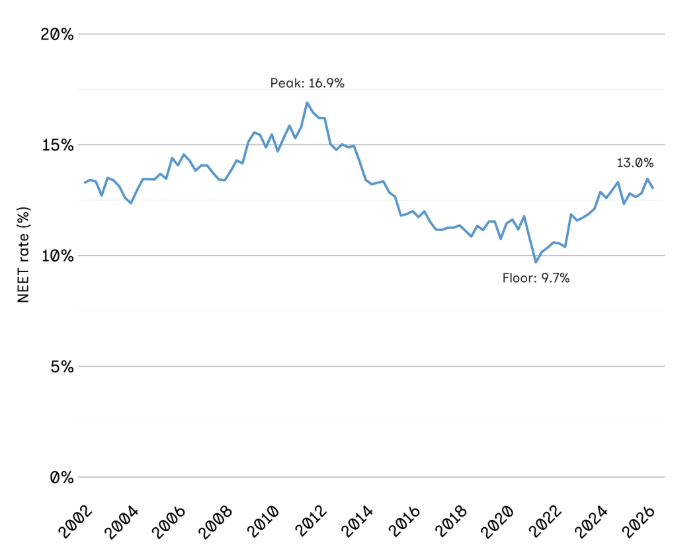
The number of young people not in education, employment or training (NEET) has surged in recent years. Between April and June 2026, just under a million people aged 16 to 24 (13% of people in this age group) were NEET. The proportion had been rising since 2021 and the 2026 figure is the highest since 2014, when 979,000 people in that age group were NEET. This can be seen in Figure 1.
Figure 1: UK-wide NEET rate, seasonally adjusted, 2002 to 2026
Source: ONS (2026), Young people not in education, employment or training (NEET), UK: August 2026.
While young people across the country will certainly face some common challenges to entering education, employment or training, a young person’s likelihood of being NEET differs widely across the UK, shaped by both where they live and the disadvantages they inherit or experience throughout their lives. Research has highlighted the role of intergenerational factors – including low household income, parental unemployment and low parental educational attainment – in increasing the risk of becoming NEET. At the same time, the risk varies considerably across places. Blackpool, for example, has a NEET risk score of 32.2 – the highest of all local authorities in the North West, while by comparison Liverpool scores 17.5 and Manchester 10.1. This is also the second-highest NEET risk score of local authorities across England. Indeed, recently published 2021 Census data, which pre-dates the rise seen in Figure 1, found that after accounting for age differences among young people aged 16 to 24 years the highest percentage of young people who were NEET for both males (22.2%) and females (20.4%) was in Blackpool. There is therefore increasing recognition of the need to understand how place-based factors and intergenerational disadvantage combine to shape social mobility and young people’s pathways into education, employment and training.
This research aimed to fill the gaps in the evidence with a unique, place-based approach, involving perspectives of young people with experience of being NEET as well as those of stakeholders across the system in Blackpool, including education leaders, employers and third-sector workers. It explored the lived experience and perceptions of young people who are NEET in Blackpool, the co-occurring individual and structural factors that led to them becoming and remaining NEET, and their support needs. We used semi-ethnographic methods such as WhatsApp check-ins and ‘walk-and-talk’ discussions to make the approach as engaging for young people as possible.
There were 3 research questions guiding the study:
- What factors do young people perceive as influencing their pathways into becoming NEET? This includes family, education, health, and other personal or social circumstances.
- What are the experiences of young people who are NEET in their daily lives and how does this impact their overall wellbeing and progress towards education, employment or training?
- What forms of support do young people who are NEET perceive as being most helpful for enabling them to re-engage with education, employment or training and preventing other young people from becoming NEET?
29 – ONS (2026), Young people not in education, employment or training (NEET), UK: August 2026.
30 – Data is available from 2001 but this only captures Quarter 4.
31 – National Centre for Social Research (2023), Risk factors for being NEET among young people.
32 – Youth Futures Foundation (2026), Dashboard: NEET. The NEET risk score was developed by Youth Futures Foundation. The scores are indices generated from a wide range of data on key risk factors among young people in the area. Scores do not correspond to the actual or projected NEET rate for any region. Higher scores indicate a higher chance of a young person being or becoming NEET.
33 – ONS (2026), Geographical variation in the prevalence of young people not in education, employment or training (NEET), England: March 2021.
Methodology
We took a Participatory Action Research approach (PAR) to ensure the research was representative of local community voices and disrupted traditional power relations between researchers and researched. This approach was chosen because existing evidence suggests that pathways into becoming NEET are shaped by a combination of local conditions and individual circumstances, highlighting the need for place-based solutions developed with the involvement of those most affected by the issue. This was reflected in the set-up and scoping phase, with the inclusion of a participatory systems mapping workshop with local stakeholders, to situate the research in the local context.
Similarly, in the recruitment and fieldwork phases, a PAR approach was reflected in the way we worked collaboratively with local community-based organisations, who helped to recruit young people and to moderate discussions. This capitalised on the expertise and pre-existing relationships that Blackpool-based youth workers had in working with young people and living in Blackpool themselves, to contrast with discussions conducted by professional researchers. We provided ongoing support and training to voluntary sector organisations to ensure high-quality discussions were carried out.
We embedded a co-production approach throughout all stages by engaging with a panel of 5 youth advisors working with Blackpool Council to ensure the lived experience of young people in Blackpool remained central to the research. We consulted them on research design, fieldwork and workshop plans, and interim and final findings.
Set-up and scoping
Rapid review of existing evidence
We carried out a rapid evidence review and secondary data analysis of various sources to give an overview of the scope and scale of the NEET issue in Blackpool. The findings were used to inform the research, primarily in shaping our sampling design to ensure the research reached those most at risk of becoming NEET. This led us to prioritise the following characteristics in the research sample:
- Neurodivergence: The literature suggested that both physical and mental health conditions and neurodivergence are important risk factors in becoming NEET. We had already planned to speak to some young people who were NEET with a disability or long-term health condition, but based on this we suggested changing this to explicitly include young people with neurodiversity.
- Ethnic minority background: The literature review suggested that NEET rates vary by ethnic background. Therefore, we considered this in sampling to ensure we spoke to at least some young people from an ethnic minority background.
- Not achieving grade 4+ in English and/or maths: Experiences of education such as persistent absence from school or lower educational qualifications were identified as key risk factors in becoming NEET. To capture this, we aimed to speak to young people who both had and had not achieved at least a grade 4 (formerly grade C) in English and/or maths.
- Economic activity: Young people who are NEET were identified as a non-homogeneous group. For instance, the group included economically inactive (unemployed and not looking for work) and economically active (unemployed and looking for work) young people. We therefore actively recruited individuals of varying economic activity to explore experiences of applying and interviewing for jobs. This was particularly important as employment experience was found to be an associated risk factor in becoming and staying NEET.
- Eligibility for free school meals (FSM): Deprivation during childhood, linked to geography, was identified as a risk factor to becoming NEET. This is often indicated by eligibility for FSM, so we factored this into the sampling.
- Previously NEET but currently in education, employment or training (EET): The literature also highlighted the value of the experiences of young people who have moved into EET, to understand their transitions out of NEET status. We therefore included a few young people in EET to help us understand the local support factors that could prevent young people becoming NEET in the future.
Appendix 1 sets out the main findings from the rapid review of existing evidence.
Systems mapping workshops
We delivered 2 online participatory systems mapping workshops, with 11 stakeholders in total. These brought together professionals across a range of sectors to discuss the youth employment system in Blackpool, to create a map of how different factors and services/policies interact, and to explain why young people become and stay NEET. Stakeholders included 8 employment, education and third-sector representatives in workshop 1 and 3 employers in workshop 2.
The mapping built on work already done by the Connected Futures Blackpool Partnership (funded by Youth Futures Foundation). The Connected Futures map identified important system factors and actors in Blackpool. The IFF-led workshops provided an opportunity for local stakeholders to build on this work by linking the key issues, establishing cause and effect between various factors. The local context informed our research design, particularly the topics we explored with young people in discussions, and helped us to place their experiences within the context of the wider system. Local issues identified by stakeholders in systems mapping workshops included:
- intergenerational disadvantage between parents and young people in educational attainment or employment experience
- lack of opportunities for educational catch-up from low reading age in Key Stage 2 (KS2)
- unmet psychosocial needs, with long waiting times for mental health support
- post-16 transitions hindered by limited careers support, an attainment-focused education system and employer risk-aversion, leaving many young people without the skills, experience or guidance needed to appear work ready
- the hyper-competitive job market as a result of Blackpool’s seasonal economy
- prolonged economic inactivity leading to a feeling of failure, reinforced by Jobcentre Plus processes
Appendix 2 details the main findings from the systems mapping.
Co-production approach
We worked with 5 young people from Blackpool Council’s panel of youth advisors (originally convened as part of the Connected Futures programme) to co-design our research approach. They were aged 16 to 24, living in Blackpool and had all experienced a period of being NEET themselves. We did not collect demographic data on panel members, but some shared that they had experience of the care system and mental health issues. The panel was engaged at 3 points:
- Workshop 1: Young people were onboarded onto the project. They co-shaped the research materials used for discussions, including who we spoke to, what we spoke to them about and where we spoke to them.
- Workshop 2: Young people reviewed the interim findings, validating them, adding additional context or challenging findings. Their views have been incorporated into this final report. Young people also co-designed materials for the deliberative workshop, inputting into how to run the session, possible locations and other considerations.
- Workshop 3: Young people reviewed the final findings. They also co-produced the creative output to be published alongside this report.
Appendix 3 provides more information about the young person panel.
Recruitment and sampling
We used multiple recruitment routes to maximise representativeness in a short time frame. We recruited 25 young people aged 16 to 24 who had been NEET for at least 3 months at the time of the discussion. We also recruited 6 young people aged 16 to 24 who were in EET after having had a period of at least 3 months being NEET, to help identify the factors that contribute to successful transition.
We identified the threshold of 3 months as those who have been NEET for a shorter period of time may be in a natural break period between education and employment opportunities. All young people had to be living in Blackpool at the time of the research.
We trained 2 voluntary sector organisations (Better Minds Blackpool and Empowerment Charity) to recruit young people and complete discussions. This was part of the PAR approach; it allowed us to centre the local knowledge of professionals who are deeply embedded in the community. It also allowed us to engage particularly vulnerable young people who had pre-existing relationships with community organisations, in an ethical and sensitive way.
We also collaborated with wider local services to recruit young people. This included Blackpool’s Jobcentre Plus to reach young people receiving Universal Credit (UC) and Jobcentre Plus support. Similarly, Blackpool Council’s The Platform service (a free employability centre for young people) supported us with recruitment, allowing us to speak to young people who were receiving employment support
Finally, we completed the sample by engaging a professional research recruitment agency to ensure we had an avenue to reach those not engaged in any services
Table 1 shows the profile of the young people who took part in discussions.
Table 1: Sample characteristics
| Characteristic | Category | Number |
| Total | Total | 31 |
| NEET status | NEET | 25 |
| Successful transition from NEET to EET | 6 | |
| Length of time NEET | NEET for 3 to 12 months | 13 |
| NEET for more than 12 months | 18 | |
| Age | 16 to 18 | 11 |
| 19 to 24 | 20 | |
| Gender | Male | 20 |
| Female | 9 | |
| Identify another way | 2 | |
| Long-term health condition | Physical health condition | 3 |
| Mental health condition | 9 | |
| Neurodivergence | 3 | |
| None/prefer not to say | 16 | |
| Ethnicity | White | 27 |
| Ethnic minority | 4 | |
| Educational attainment | Has GCSE Grade 4 in English and Maths | 15 |
| No GCSE Grade 4 in English and Maths | 15 | |
| Don’t know | 1 | |
| Economic activity | Economically active | 19 |
| Economically inactive | 12 | |
| Socio-economic background | Not eligible for FSM for a period at school | 4 |
| Eligible for FSM for a period at school | 22 | |
| Don’t know | 5 | |
| Has caring responsibilities | Yes | 11 |
| No | 20 |
Discussions
We held 31 in-person discussions in Blackpool, each lasting up to an hour. The topic guide covered:
- some context and background about the young person, to build rapport between the participant and the researcher and to understand more about how the participant spends their time
- their family life and the main adults in their lives
- their experience of education and training
- their general health and wellbeing, as well as clinical mental and physical health
- their experience of employment and job-searching
- their experience of support
The topic guide was used flexibly to encourage a natural discussion flow. Appendix 4 contains the full guide.
IFF carried out 21 of the discussions while staff working at local voluntary sector organisations carried out the other 10, in line with our PAR approach. We gave young people the option to choose where discussions took place, including at a fixed location of their choice in the community, such as at a local cafe or at The Platform (which the majority of young people chose), or as a walk-and-talk discussion taking place while walking around a park or other outdoor area. Young people could bring a supporter to the discussion, such as a family member. As a result, we have also included within the findings a small number of observations and quotations attributed to family members.
On the days leading up to the discussion, the young people were also invited to check in with a researcher via WhatsApp to build rapport in advance. This covered their hobbies, what mattered to them and their routines, providing insight into their daily lives. They were able to respond to a range of prompts with words or photos. While the purpose of these check-ins was to build rapport before the discussions, the topics covered were revisited at the start of discussions, with evidence feeding into the overall findings.
Appendix 5 provides more information about our approach to the analysis of various materials.
Deliberative workshop
IFF Research also conducted an in-person deliberative workshop in Blackpool which lasted around 3 hours. This brought together 8 young people who had taken part in discussions or the panel as well as representatives from 5 local organisations across different sectors, including health support, family support, employment support, secondary education and employers. The purpose of the workshop was to co-design recommendations to re-engage young people in Blackpool who are NEET into pathways to EET. This was part of the PAR approach taken to ensure that the young people and communities who may be affected by the research were involved and represented in its conclusions. The workshop was structured to create an inclusive environment where young people and stakeholders could work together to identify priorities and develop recommendations for action.
Appendix 6 provides more information about the deliberative workshop.
Ethics
We embedded ethical considerations throughout the research to minimise the risk of harm to participants. We provided all young people with clear information about the research, what participation involved and their right to withdraw at any time. We did this a written document and an informational video, and verbally at the start of discussions. Experienced researchers or familiar people at local voluntary organisations conducted discussions sensitively, reminding young people that they could decline to answer any question or stop the discussion if they became uncomfortable.
Where discussions raised distressing issues, researchers provided appropriate signposting to support services. We put in place a safeguarding and disclosure protocol for situations in which young people disclosed information indicating a risk of harm to themselves or others. At the outset, we informed young people of the limits of confidentiality, and we managed any disclosures requiring action in line with organisational safeguarding procedures and escalated them to the designated safeguarding lead where necessary.
34- PAR is an approach to research that emphasises collaboration, reflection and action. It seeks to generate knowledge through partnerships between researchers and community members, enabling those affected by an issue to contribute to investigating that issue and developing solutions. For more information, see J. Howard (2024), Participatory methods: Participatory action research.
35 – Youth Futures Foundation, Connected Futures systems ‘iceberg’ (accessed 3 March 2026).
36 – The Youth Futures Foundation defines psychosocial factors as including, but not limited to, attitudes, engagement, aspirations, transitions, attainment and other psychosocial dimensions potentially related to the risk of becoming NEET for young people.
37 – Better Minds Blackpool provides emotional and practical support for young people (aged 0 to 25) and families navigating mental health, special education needs/disability and neurodiversity pathways; Empowerment Charity supports marginalised and vulnerable people across Blackpool and local areas by supporting them in getting their voices heard, providing peer mentoring and delivering advocacy services.
38 – The Platform is a free youth employment and skills hub run by Blackpool Council. It helps young people aged 16 to 24 to move into education, employment or training.
This report
This report outlines the final findings from the research, structured by research question. Chapter 1 explores pathways to becoming NEET, including family background and circumstances, health, education, and local opportunities. Chapter 2 focuses on the daily lives of young people who become NEET. In this chapter, we identify 4 personas that characterise the range of experiences and journeys faced by young people. Chapter 3 then explores forms of support that young people perceived as being most helpful for them to re-engage with education, employment and training. Finally, Chapter 4 covers the research conclusions and recommendations.
Chapter 1: Pathways to becoming NEET
This chapter explores the factors which young people and local stakeholders perceived as influencing young people’s pathways to becoming NEET in Blackpool.
It explores the role of family circumstances, health needs (including mental and physical health and neurodivergence), educational experiences and local labour market conditions and considers how these interact to shape engagement with education, employment and training. It does so by examining evidence from secondary literature, the systems mapping workshop and discussions with young people. The evidence demonstrates that pathways into NEET are complex and are often characterised by the cumulative impact of disadvantage over time.
How to interpret these findings
The findings in this chapter centre on the accounts and perceptions of young people, local employers, education leaders and third-sector stakeholders. These personal narratives are vital for grounding policy in real-life perspectives, yet they represent subjective viewpoints within a broader, dynamic ecosystem. Young people operate within a complex interplay of personal agency, institutional factors and individual circumstances; their accounts therefore offer crucial insights into how the system is experienced, but they represent only part of a larger picture.
The explanations provided throughout the report naturally reflect individual interpretations, offering a window into local experiences rather than a definitive assessment of local services. Consequently, these narratives should be understood as Blackpool-based place-specific insights that may not fully translate to other geographic areas or every young person who has become, or who is at risk of becoming, NEET.
Family background and circumstances
Family experience of work
Employment and educational attainment rates among adults in Blackpool are significantly lower than the national average. There is evidence that parental education is one of the strongest predictors of children’s education attainment, highlighting how educational disadvantages can be intergenerational.
Moreover, in Blackpool, 28.4% of 16- to 64-year-olds are economically inactive, compared with 21.1% in Great Britain. The employment rate is 69.7%, lower than the rate of 73.8% across the North West. Furthermore, 15.1% of Blackpool residents receive either Personal Independence Payment (PIP) or Disability Living Allowance (DLA) – the highest claimant rate in the Lancashire area and substantially above both the England (8.4%) and the North West (10.6%) averages. This indicates that young people in Blackpool may be more likely to live in households where one or both parents are unemployed or economically inactive and that there is likely to be a high level of unemployment in their wider networks.
Stakeholders involved in the participatory systems mapping corroborated this, highlighting that low levels of parental educational attainment and employment experience were felt to be a distinctive feature of Blackpool. This was felt to increase a young person’s risk of becoming NEET, as they would have limited access to trusted adults who could provide employment and educational guidance.
Young people involved in discussions often felt that family members were not a useful source of advice and guidance on EET, as their family networks often lacked helpful and relevant experiences. For example, it was common for family members to have worked multiple short-term, low-skilled jobs or to have had no employment experience, meaning that they had little insight into the types of jobs and careers which were of interest to the young people who took part in the discussions. As a result, young people often did not talk about their educational or work options and ideas with family members.
“My dad, he’s told me to go for an apprenticeship. He wants me to join the army, but it’s not really something I’m interested in.” (young person)
As a result of the lack of available advice and guidance from their families, young people who did have specific career aspirations often found it difficult to identify how to make progress towards these goals. Though many had wider career aspirations (examples that young people gave included game design, being a mortician or working in fashion), their network of family and friends generally did not have any links with these professions. As a result, young people often struggled to identify routes into these careers or access relevant work experience. While young people did often access work through family or friends, as a result of this misalignment with their aspirations, their experience tended to be limited to low-skilled or unsuitable roles visible in their family or adult network, such as retail, groundwork or working in a call centre. Young people felt that this placed them at a disadvantage compared with other young people with access to wider networks of potential career paths. This reflects wider social mobility evidence showing that personal and professional networks can play an important role in access to information, opportunities and entry-level roles.
“When I left school, I didn’t go to college. I got a job doing groundwork, because that’s what [my uncle] does. He helped me get the job.” (young person)
“My friend’s mum got that job and [my friend] got a job and recommended me in a few others … It was [as] an emergency call handler. I think that job really impacted my mental health stuff as well because I had people on the phones hitting themselves, screaming, shouting, calling me names and stuff. I was like, this isn’t a job for a 16-year-old.” (young person)
For one young person, parents being out of work (often due to sickness or disability) even shaped their decision about whether to engage with school. A parent’s child benefit entitlements are based on their child staying in education until they turn 20, and this young person highlighted how this encouraged them to stay in education so their parent could continue to receive the benefit, which therefore discouraged work.
“[I went to school] mainly to make sure my dad’s benefits didn’t stop because I wasn’t in education.” (young person)
However, despite families often having limited social capital, most young people said their families provided as much support as they could in their journeys towards education, employment and training. This took different forms. In some cases, young people described receiving financial assistance with driving lessons, private tutoring or other opportunities that broadened their options. This seemed to be more common among young people with more stable family backgrounds. Young people felt that this type of support somewhat increased their access to educational or employment opportunities. Many also mentioned receiving emotional support from families, though this appeared to be less likely to translate into educational or employment successes. One young person felt that having parents who were working (in a guesthouse, in this instance) provided them with a positive role model, giving an incentive to continue in education.
“My uncle’s trying to help me. He’s paid for a couple of driving lessons.” (young person)
“I think [having a parent in stable employment] is a positive. It helps enforce the good ideas of being in education.” (young person)
Family instability and lack of strong support networks
In the systems mapping, local stakeholders highlighted that parental unemployment and poverty in Blackpool can make it hard for parents to provide stability for young people. This is corroborated by pre-existing data. As detailed in the previous section, Blackpool experiences higher rates of economic inactivity and disability benefit receipt. Rates of child poverty are also higher than average. For instance, in 2024 to 2025, 30.5% of children in Blackpool were estimated to be living in income-deprived families, compared with 19.8% in England as a whole. According to the Income Deprivation Affecting Children Index (IDACI), 8 out of 21 wards in Blackpool were in the most deprived 10% across England in 2025. Being born into poverty in the England is associated with an increased risk of illness and premature death and negative educational experience and attainment, and it often corresponds to poor quality accommodation and unsafe neighbourhoods.
Broader indicators of family instability are also particularly pronounced in Blackpool. Data from the IFS Deaton Review on Families highlights that, in 2018, over 26% of births in Blackpool were to non-partnered mothers – among the highest rates in England. What is more, 42.6% of adults in Blackpool have never been married or in a civil partnership; one of the highest rates in England. In 2025, Blackpool had the highest rate of looked-after children in England, with 184 children in care per 10,000 children, almost 3 times the national average of 64.
These figures point to the scale of challenges experienced by some families in the area and suggest that a significant number of young people may have experienced instability, disruption or periods without consistent support networks. They also align with wider social mobility evidence which suggests that socio-economic disadvantage can be inherited across generations through unequal access to support networks. Stakeholders in the systems mapping workshop felt that this could partially explain why young people in Blackpool are more likely to experience difficulties engaging in EET compared with other areas of the country.
Local employers involved in the systems mapping felt that the young people they interacted with were not ‘work ready’ in terms of discipline and motivation, which was felt to be connected to instability and lack of structure in many young people’s home environments. This creates a vicious cycle where employers are less willing to hire inexperienced young people, who in turn miss opportunities to build experience, entrenching unemployment.
This relationship between instability and the risk of becoming NEET in Blackpool was also substantiated through the discussions with young people. The majority had experienced an unstable family life and a lack of strong support networks. It was common for them to have encountered at least one (though often multiple) destabilising life events or experiences, such as moving homes and schools while growing up, divorce or relationship breakdown of parents, being a looked-after child, bereavement, family conflict, family health issues, or personal or familial substance misuse. A few had a parent with experience of the criminal justice system.
“Me moving back and forward, that made me worse. That just baffled my brain too … then school to school, it just … I was here one minute and there the next minute. It was horrible.” (young person)
Experiences of early family instability and a lack of consistent support often had far-reaching impacts on young people’s lives. This contributed to poor mental health, anxiety and emotional distress, making it harder for some to engage with education and maintain positive relationships. Several young people described instability at home, strained family relationships and difficult caring or family health circumstances as creating emotional pressure that made it harder to attend, concentrate or manage relationships at school. In some cases, this appeared to create a cycle in which underlying distress was expressed through poor attendance or conflict with peers. Further entrenching the impact of these challenges, some young people felt they could not share details of their difficult home life with teachers. This meant that schools’ initially responded by treating these factors as disciplinary issues, leading to a negative feedback loop where young people felt further disempowered to share their challenges and schools continued to see the issue as one of discipline rather than a sign of unmet support needs.
For some young people, this led to dropping out of mainstream education and moving to Pupil Referral Units or Alternative Provision settings instead. While these settings provided support at a difficult time, participants felt they often offered a narrower curriculum, fewer qualification pathways and less continuity in learning. As a result, some felt that attendance at these settings had reduced rather than expanded their opportunities, making it harder to achieve the qualifications needed to progress into further education, training, or employment.
For example, one young person who had moved multiple times due to the breakdown of their parents’ relationship felt that this had resulted in social isolation, as they did not have friends, social networks or good relationships with teachers in their new location. This, they said, had led to behavioural issues and dropping out of school, after which they stayed at home all day alone, which reinforced their social isolation and exacerbated their mental health issues:
“We went back to [other city]. I went in [to school] for 2 days and I just couldn’t do it anymore. I didn’t want to be in school and I’ve never been to school since … I’d just sit downstairs and I’d sit on my phone all day. And I would say I was quite depressed doing that. Because I didn’t know anyone in [city]. So I couldn’t be like, oh I’m going out with my friends today.” (young person)
For another young person, losing a parent made it hard to focus on seeking therapy for his social anxiety, intensifying his mental health issues:
“I did start therapy but that’s when my dad got really ill. So my whole mindset was going from wanting to help myself to holy crap my dad’s going to die soon.” (young person)
Another example shows how parents were not able to effectively advocate for their child in these situations. When one young person whose parent had a range of mental and physical illnesses experienced issues at school, her parent’s way of advocating for her was perceived as threatening by the school and seemed to worsen the situation, leading to conflict with teachers and the young person eventually dropping out:
“One of the teachers, he was on a power trip and so he was sort of targeting [my child] … she rang me crying, she was having a massive panic attack. So I made my way right up to the reception and embarrassed myself in front of all the teachers. At that point, my head had gone all bipolar. I just couldn’t do it, and I threatened him in front of everyone.” (young person’s parent)
For a smaller number of young people, family instability had even more severe consequences. This included engaging in risky behaviours, which could worsen family relations, and conflict which sometimes led to estrangement from family members and periods of homelessness. These experiences created additional challenges beyond education, with young people focusing on securing housing and meeting immediate needs rather than engaging with education, employment or training.
“The entire family have gone from me. Hence why I’m on the streets for the next 2 months … my mother really doesn’t like me, in some ways, because [I] drink and do drugs.” (young person)
Even where family life was more stable and consistent, young people reported that parents working long hours, night shifts or multiple jobs often perceived as being stressful, meaning that young people were still left without support (emotional or practical) or had responsibilities caring for siblings (explored further in the next section). This was more common for young people with parents working in lower-skilled work than those with parents in higher-skilled roles. This reflects wider labour market conditions in Blackpool, where employment opportunities are often concentrated in lower-paid and less flexible sectors such as tourism, health and social care and the police, and elsewhere in the public sector. Encapsulating this, one young person said that they preferred their parent not working to them experiencing a lot of stress in their job, despite the financial difficulties this entailed. Their parent’s demanding job had put a strain on their relationship, leading to the young person feeling less emotionally supported and making their mental health worse.
“Then my mum stopped working. It was nice in one way because she was there … even though it was a bit hard financially … beforehand while she was working, it was a bit harder on us because she’d come home and she’d stress about something, then I’ll stress, so then it’s a huge argument.” (young person)
Caring responsibilities
It was common for the young people involved in discussions to be balancing caring responsibilities. This mirrors the wider context in Blackpool, where in 2021, 10.9% of residents in Blackpool aged 5 years and over provided some unpaid care, compared with 8.8% in England – the ninth-highest rate of unpaid caring responsibilities in England. The lowest rate of unpaid carers (7.8%) is in London.
Caring responsibilities varied considerably in intensity and level of impact on young people’s EET opportunities. Some provided part-time care, such as looking after younger siblings while parents worked. This generally had less impact on their educational and employability journey, particularly for those from more stable families, and for some it even provided them with new skills or an interest in work such as care work or nursing. Others had more substantial responsibilities, including caring for a parent with a health condition, supporting other relatives or caring for their own children. Particularly when combined with other barriers such as diagnosed mental health issues, this made attending school or college or looking for work, more challenging.
“My brother’s autistic … my uncle’s an alcoholic … I’m basically caring for him at this point … So it’s me that cares for food, cares for everything, everyone, and that’s just hard on UC. Like now I haven’t even got a pair of shoes to my name because when you’re on UC your family’s got to come first.” (young person)
These responsibilities often shaped young people’s educational and employment choices. Financial responsibilities meant looking for work was prioritised over pursuing further education to achieve their career aspirations, with some prioritising short-term stability over longer-term career goals. For example, one young person who cared for several family members wanted to go to college but had to prioritise getting a job to support their family, putting their own education on hold. As a result of lack of work experience, they were looking for a low-skilled work job, but they had been unable to find one at the time of discussion.
Such young people reported that their pathways out of being NEET were limited to employment routes, whereas other young people without caring responsibilities had more opportunity to pursue education or training as well. Although this is often not a straightforward choice for young people, this can have important implications for their social mobility, as restricted access to further and higher education not only constrained immediate opportunities but may also limit longer-term prospects for socio-economic advancement among young people with caring responsibilities. On going back to college, one young person commented:
“I’ve got to think about money at the minute. And quite frankly, I don’t need college to start a low-experience job … But I’d love to go to college again. I’d love to have the experience of actually having a place to make friends in there.” (young person)
Caring responsibilities also limited young people’s job searches, restricting them to part-time roles with hours that could accommodate their caring commitments. Caring reduced the time they had available, whether for searching for a job or for studying. Some young people spent 5 or more hours a day looking after their siblings or other family members, and so any work would have to be flexible around this commitment. For some, night shifts were not suitable as they had to be available for family members. For those with their own children, childcare responsibilities heavily restricted their ability to work or study, for example meaning that they could only apply for part-time roles or would have to wait until their child was older. This was particularly the case for young people with less supportive or stable family environments, as they were less likely to have people they could rely on to care for their children, and they could not afford to pay for childcare. For instance, one person’s dad often provided ad hoc childcare support for their baby but had just been diagnosed with dementia, creating uncertainty around who could support with this in the future once their dad’s condition progressed.
“I only wanted to do 16 hours a week to be able to see my little boy but also have that extra bit of money.” (young person)
“I was kind of a carer for my younger siblings. I’d be up at like 5 in the morning, making them breakfast, making sure they’d eat, hairbrush, teeth done, all that stuff. In some cases, I’d be taking them to school. Then during the day I tried to chill, but I used to have back-to-back [health] appointments a lot. Between doctors’ appointments, I was in therapy, and so quite a bit going on. And then when the kids came home from school, I had to be in, I’d be making them tea, I’d be making sure they didn’t fight, and then they’d go to bed.” (young person)
39 – SMC (2026), The role of families in the educational outcomes of children and young people.
40 – ONS (2024), Employment, unemployment and economic inactivity in Blackpool.
41 – Lancashire County Council (2026), Personal independence payment and disability living allowance.
42 -‘Social capital’ refers to the resources, opportunities and support that individuals can access through their social relationships, networks and connections within their communities and families. It is associated with a range of outcomes, including education, employment, health and wellbeing . See R. Chetty and others (2022), Social capital I: measurement and associations with economic mobility.
43 – Joint Strategic Needs Assessment (JSNA) Blackpool (2026), Child poverty.
44 – JSNA (2026), Child poverty.
45 – JSNA (2026), Child poverty.
46 – Crossman and others (2022), Families and inequalities.
47 – ONS (2023), Marriage and civil partnerships status in England and Wales: Census 2021.
48 – DfE (2025) Children looked after in England including adoptions.
49 – JSNA (2025), Economy.
50 – Lancashire County Council (2024), Unpaid care and unpaid carers.
51 – ONS (2023), Unpaid care, England and Wales: Census 2021.
Health
Mental health
Local data indicates that people in Blackpool have poorer mental health than the average for England. For example, in 2024 to 2025 the incidence of diagnosed depression for those aged 18 and over was significantly higher (2.3%) compared with England as a whole (1.4%). The suicide rate is also significantly higher (17.1 per 100,000 population) than in England as a whole (10.9 per 100,000): this is the eighth-highest rate of any upper-tier local authority in England for all persons (aged 10 years and over) during the period 2022 to 2024.
The statistical picture was echoed in the discussions with young people. Many reported problems with their mental health which shaped how they engaged with work and education. While some participants had diagnosed mental health conditions, others described more general experiences of anxiety, emotional distress or low self-confidence that affected their ability to participate in education, search for work or engage with support services. A few mentioned having experienced suicidal thoughts. Health issues often started at a young age and became deeply ingrained, compounding with other barriers, making them difficult to overcome later on.
Some young people perceived that stigma around mental health conditions or problems meant that they were disadvantaged in educational settings, with teachers not able to support them or making assumptions about what they needed without asking. Several young people said that the challenge was not always a lack of support but the fact that support that did not reflect what they felt they needed. Rather than being involved in discussions about the support they wanted, some felt assumptions were made about what they were capable of. For example, the college of one young person with mental health conditions had assumed they could no longer attend even though they felt able to do so, leading them to have to drop out.
“I got into college, and I’d done a few months in there, they were saying, my mental health is bad. And I was like, I’ll do 2 and a half days, I can do it … then they emailed, and said, we’ve seen on the system you’re in therapy, we’re going to give you some space. But that’s not what I wanted either.” (young person)
In addition to the perceived stigma, many young people said that mental health issues impacted the extent to which they were able to pursue pathways towards education, employment or training, with some not able to engage at all and others feeling limited by their condition. Those with a clinically diagnosed mental health condition were more likely to not be engaging in job search or looking for education or training opportunities, as they often felt that they needed to address their mental health needs before they could feel ready to work or study. Some young people looking for work felt their condition restricted the types of jobs they could apply for in a labour market they already perceived as narrow and competitive, leading them to prioritise roles with quieter settings to manage the symptoms of anxiety, for example. Others felt that conditions such as anxiety prevented them from doing their best in stressful situations like job discussions.
“Recently I had a job discussion. I was like, oh. I can do it. I can do this job. It’s easy. But then I actually went to a job discussion and it all just collapsed from there. I’m like, okay, I can’t do it. So it [social anxiety] makes things difficult sometimes.” (young person)
Many young people, despite not having a formal diagnosis, described experiences which suggested they had had challenges with psychosocial resilience from an early age, with these needs often having gone unrecognised and unsupported.
Psychosocial resilience is defined as the ability to successfully adapt to difficult or challenging life experiences through mental, emotional and behavioural flexibility and adjustment to external and internal demands. Lack of this resilience was particularly prevalent for those who also lacked strong relationships or support from family or who had experienced particularly unstable early lives. Such individuals frequently experienced difficulties with school attendance, educational attainment and, subsequently, employment prospects. Although these barriers were often less severe or entrenched than those faced by individuals with a formal diagnosis, they nevertheless had significant impacts on outcomes. These challenges often manifested through anxiety, low confidence, difficulties regulating emotions or negative responses to stressful situations. Some young people said they had developed negative coping mechanisms such as drinking or violent behaviour, further affecting their ability to engage in education, employment or training. For instance, one young person linked their undiagnosed anger issues and anxiety to going to prison for a crime they committed while drunk later in life, hugely affecting the future opportunities available to them.
“I can just blow up … I got sentenced at court for some of the biggest mistakes I’ve ever done … I was just drunk.” (young person)
Neurodivergence
Neurodivergence was also mentioned frequently as a barrier to engagement in and access to education, employment and training. A couple of young people had diagnoses of ADHD (attention deficit hyperactivity disorder), autism or dyslexia, while several others thought that they were potentially undiagnosed. This reflects the statistical data, which shows that the occurrence of special educational needs is higher in Blackpool than the average for England and is increasing annually. For instance, data from the Department for Education shows that the number of young people in Blackpool with an Education, Health and Care (EHC) plan has more than doubled since 2018/19 (from 858, to 1,661 in 2025/26). This reflects a wider national trend, with EHC plan numbers continuing to rise across England since their introduction in 2015.
Young people felt that their neurodivergence contributed to them becoming NEET as it created additional barriers in educational settings, making it harder to maintain engagement, build social connections with peers and achieve qualifications. For example, some autistic young people said they experienced difficulties with new environments and meeting new people such as at a new school or college. They also said they often struggled with social interaction in general, making it difficult to relate to peers or form friendships, and at times experienced bullying for being perceived as different. Other autistic young people also found it difficult to maintain engagement in loud environments such as schools and colleges. Young people with ADHD reported that they sometimes experienced difficulties with maintaining routines, such as going to school or college regularly or on time, and with concentrating in classroom-based settings. Those with dyslexia who did not receive adequate support found it challenging to keep up with schoolwork. These barriers sometimes reduced young people’s confidence in their ability to do well in school, which in turn could reduce their motivation to attend school or college, leading to poor attendance or dropping out.
Even some young people with a formal diagnosis felt that their needs were not recognised, understood or supported by schools or colleges. For instance, several young people felt that the support that was put in place was not adequate despite their having communicated their needs. This led to them falling behind, becoming demotivated or giving up, and according to a parent, feeling punished for their condition. For example, one young person with dyslexia reported that they felt they were not given the extra time for schoolwork and exams that they had requested. Another young person with executive functioning disorder felt that teachers did not try to modify their approach to accommodate the time it took them to process tasks, again leading to them falling behind and feeling frustrated. Ultimately, this led to both young people dropping out of mainstream school and attending alternative provision.
“They did a test as well and they found she needed a little bit more help. So she has a little bit of dyslexia as well. And they found that she needed a little bit more time than everybody else. They never [gave her] that. They literally just expected [her] to keep up with everybody else … It’s like they’ve punished you, isn’t it? Because you couldn’t keep up with everybody else, but they knew that you couldn’t do that.” (young person’s parent)
Often, young people described becoming frustrated when teachers and support staff misunderstood that their neurodivergence meant they did not always process information in the same way as their peers. Their difficulties therefore were not necessarily linked to a lack of willingness to learn but were a result of the fact that learning environments did not always adapt to the way they understood or retained information. In some cases, young people had actively tried to explain what they needed but felt that this was not understood or translated into practical adjustments. This suggests that disengagement was often not necessarily driven by a lack of motivation or aspiration, but by barriers in the way support and learning environments responded to their needs. These accounts suggest that difficulties associated with neurodivergence did not operate in isolation. Where young people repeatedly felt misunderstood or unsupported, this could further impact their psychosocial resilience, leaving them with challenges to their ability to cope with setbacks, advocate for themselves and remain engaged with education.
“People don’t understand that I can’t understand something. It does my head in. I’m telling you I don’t understand what’s going on. I’ve got executive functioning disorder as well … when the teacher tells you to do this, this and this and then you forget what the third thing was because you’re stuck on the second thing even though you’re meant to do the first thing.” (young person)
Others experiencing similar difficulties struggled to articulate how their potential neurodivergence was connected to them, possibly making it harder to identify support needs and overcome barriers.
“School has tried getting me diagnosed for [ADHD] and I just can’t go to my class meetings and stuff like that. I just know I’m different. I just know I’ve got something going on. I can’t make eye contact with someone or talk to people. I’m weird. Something’s going on. But I’m still functioning so it’s fine.” (young person)
Similarly, some young people recognised that barriers as a result of ADHD, autism or dyslexia continued into their job search or in employment settings. Because they found it difficult to meet new people and go to new settings, contexts such as job interviews, job fairs or employability support settings could be difficult for autistic young people. Some who wanted to avoid loud environments felt that their options of jobs to apply for were more limited as a result, as this could rule out many of the types of retail or hospitality roles which are commonly available to those without much work experience.
“I’m currently in the process of attempting to get diagnosed with autism, that has had a massive impact on my life … I find like new spaces and new people make me anxious and bright lights or loud noises. I find it difficult to talk to people as well so it has had some lasting impacts.” (young person)
ADHD could be a barrier to concentrating on job applications. It could also limit the types of jobs young people felt able to apply for, for instance ruling out office-based or non-active jobs. It could also rule out any training route with a classroom-based aspect due to difficulties sitting still, including apprenticeships in practical areas. Some young people felt that their neurodivergence could be a strength in certain types of roles or qualifications. For example, more active roles or practical qualifications were perceived as well suited to those with ADHD, who felt they had lots of energy and a proclivity for hands-on work. However, they were often not able to capitalise on these strengths due to a lack of relevant opportunities and other barriers to accessing them.
As with mental health, some young people felt their neurodivergence was a disadvantage to engagement with and access to education, employment and training as it could be stigmatised, with assumptions made about what they were capable of. For instance, one young person who had ADHD and autism who had attended a special school felt that their education had let them down as it was at too low a level, not providing them with any life skills or qualifications for the future. They also felt underestimated in a voluntary role, with others being given more responsibility than them, leading them to disengage and feel low in confidence about taking on other voluntary or paid work roles in the future.
“Instead of, like, doing proper education and research on, like things we needed to do exams and all that, we did just constant primary school work in high school … I did have a volunteer role at the charity shop. It started to frustrate me a little bit because they were just letting me bag clothes. But I just couldn’t handle it anymore … I get burnt out, I get tired and bored very easily … I have a feeling they just didn’t think I was capable of anything. So just didn’t show me how to do the tills or anything. And then this new person comes in who one of the staff members used to know and she gets to do everything. She got to use the tills. She did everything else I was thinking I was going to do.” (young person)
Lack of formal ADHD or autism diagnosis, whether due to a lack of perceived need for a diagnosis or to long wait times, restricted access to support. Some felt that the process of getting a diagnosis was unnecessarily long or complicated, particularly difficult to navigate for those who may be neurodivergent. But they felt that reasonable adjustments by schools, employers or other institutions such as supported accommodation were not available to them without a formal label.
“I feel like they could have made like accommodations around [my undiagnosed autism], like maybe like moving me to a quieter space for doing tests. But I feel like you don’t really get any help unless you’ve been proved that there’s something wrong with you.” (young person)
“I’ve explored [getting a dyslexia diagnosis], but it’s always like, oh, you have to refer to this person, and refer to this person, and refer to this person, and there’s no actual easy way in which you’re just going through it. So it’s quite difficult. Just so extensive.” (young person)
Physical health
Pre-existing data shows that people in Blackpool experience more physical health challenges than the England average. In Blackpool 12,500 residents were economically inactive due to long-term sickness, representing 52.2% of the economically inactive cohort, which is significantly higher than in the North West (32.3%) and England (27.1%). Musculoskeletal conditions are significantly more common in Blackpool (affecting 25.7% of the over-16 population versus 17.9% in England as a whole) and are among the main health conditions that restrict access to the labour market. Life expectancy for men in Blackpool in 2022 to 2024 was 73.7 years, for women 79.1 years, significantly lower than the England average of 79.5 years for men and 83.3 years for women. On average, people in Blackpool also experience a significantly shorter time in good health and without a disability (50.9 years for men, 10 years lower than the England rate of 60.9 years; 51.8 years for women, 9 years lower than the England average of 61.3 years).
Only 3 young people involved in discussions had a physical health condition, providing limited evidence of how this impacts journeys into and out of education, employment and training. However, these young people highlighted some specific ways in which their health condition created accessibility challenges around education and employment. One young person had a hearing condition which made the school environment unbearably loud for them, leading their attendance to drop significantly and eventually to their dropping out around year 9 (aged 13 or 14). They were also restricted in their job search, as their condition made getting buses too difficult and they were therefore only able to apply for the small number of jobs in their immediate local area. For another young person, experiencing psoriasis and arthritis led to chronic pain, meaning that they were unable to apply for physical or fast-paced jobs such as in hospitality or manual labour – roles which made up a large proportion of the available vacancies in Blackpool.
“I have psoriatic arthritis, which I developed from having long-time untreated psoriasis. It affects my hands, my knees, my shoulders a lot. So you can imagine like there’s a lot of pain to deal with and that did affect a lot of, going out, dealing with trying to find work, because a lot of places that require high speeds, quick abilities, I can’t always follow through on.” (young person)
As with mental health conditions and neurodivergence, some experienced stigma around their condition and assumptions about how it would impact on their ability to work. For example, hospitality jobs requiring a ‘clean appearance’ were negative about the skin condition of the young person quoted above, which the young person perceived as the reason why they did not succeed in getting these jobs, affecting their ability to access lower-skilled jobs and therefore making it difficult to gain any experience.
“I went in looking for jobs when I’ve had psoriasis. The problem is a lot of jobs require a quote-unquote clean appearance … a lot of jobs didn’t like the psoriasis side of stuff, especially in the food industry, which I fully understood that, because if flakes got off in people’s food, that was a problem. But I looked at receptionist jobs and stuff like that, and I got a lot of questions … ‘Oh, do you have a skin condition? Are you contagious?’” (young person)
52 – JSNA (2026), Mental health.
53 – JSNA (2026), Suicide.
54 – See the ‘Ethics’ section under ‘Methodology’ in the introduction for a full description of how concerns about young people’s welfare were handled during the project.
55 – American Psychological Association (2018), APA Dictionary of Psychology: Resilience.
56 – DfE (2026), Education, health and care plans as at January each year.
57 – Blackpool Council (2025), Public health annual report 2025.
58 – Blackpool Council (2025), Public health annual report 2025.
59 – JSNA (2026), Life expectancy.
Education
Attainment and behaviour
Blackpool’s attainment rates are significantly lower than the average in England, impacting young people’s future opportunities. Blackpool had the fourth-lowest Attainment 8 score in England in 2024 to 2025. In the 2025 to 2026 academic year, 37.4% of pupils in Blackpool achieved a grade 4 or above in English and maths; the second-lowest proportion in England. Achievement of grade 4/C in English and maths GCSEs has been found in previous research to be a predictor of future NEET status (see Appendix 1). This indicates young people in Blackpool are at risk of becoming NEET partly due to qualifications achieved during school.
Young people with low attainment often faced multiple overlapping barriers. This included high rates of absence from school because of caring responsibilities and family instability. In 2026, Blackpool had one of the highest rates of persistent absence in England, with more than 1 in 5 pupils persistently missing school. Young people often had low confidence in their ability to progress to further education and work, causing them to disengage. They also experienced unmet health needs, despite contact with services, which made the education environment challenging, and they commonly felt that schools and colleges did not provide appropriate adjustments.
Low reading age at KS2 is common in Blackpool, falling significantly below the England average (53% of children attain the expected standard in reading, writing and maths, compared with 61% across England). Stakeholders in the systems mapping workshops highlighted that this becomes a hidden barrier in secondary school and early job-searching due to reduced assessment of and support for improving reading. This then builds frustration for young people, raising the likelihood of their disengaging from education and increasing the risk of lower educational attainment. Though most young people in our discussions did not feel that they struggled with reading, a few did identify with this challenge, including some that had dyslexia. This could make it difficult to keep up with school, as they sometimes took longer to process written materials in the classroom, meaning that teachers sometimes moved on too quickly for them to process or complete tasks fully at the same pace as others.
“So when I read things, I’ve got to read it about 4 times over before it clicks in my brain as to what it is that I’m even reading. Sometimes I struggle knowing what big words are.” (young person)
Lacking trusted relationships with teachers at school also made attendance hard to sustain and lowered attainment levels. Some described feeling “treated like a child” by teachers, which reduced their motivation and engagement. This often led to lower attendance and worse attainment in lessons with those teachers who they felt less respected by. Young people who went on to attend college often preferred the teaching environment, as they felt more respected, increasing their motivation to attend and perform better in their subjects. They felt that school environments could benefit from being more like college, to boost young people’s performance and motivation levels. Where students had stronger relationships with teachers they often performed better, but difficult relationships with teachers could lead to young people failing core subjects or dropping subjects they would have needed for certain future careers.
“When teachers shout at me, I walk away … they wouldn’t listen to me so they were just sending me home all the time. I went in for 2 days and I just couldn’t do it anymore. I didn’t want to be in school and I’d never been to school since.” (young person)
“I didn’t like my teacher, so I didn’t really try hard in maths, so I just knew I’d fail my exams.” (young person)
Lack of strong relationships with friends also reduced motivation to attend school or college, as well as leading to behavioural issues. Friendships were seen as a motivating factor in attending school. Some also felt that their friends supported them to deal with difficulties, such as one young person with social anxiety whose friends helped them to get through stressful classes, or others whose friends supported or tutored them with school subjects they found challenging. By contrast, when young people felt they lacked these strong relationships with peers, they found attending school more stressful, increasing the risk that they would not attend or would drop out completely. This was particularly relevant for young people who had moved around frequently, as they lacked consistent networks of friends and felt particularly isolated as a result. Bullying by and conflict with peers was also frequently mentioned by young people and led them to find it challenging to maintain engagement with school. This sometimes resulted in worsened mental health, getting into fights with others and therefore being excluded, or reduced willingness to attend school regularly.
“I didn’t have the best high school performance, to be honest. And I’d tell people my story because it was down to bullying … then I stuck up for myself. I was constantly getting excluded because I was fighting all the time.” (young person)
Young people told us that not receiving the right support made them feel their needs were not met, and this was linked to poor behaviour and disruption, further conflict with other students or teachers, poor attendance, and exclusion, often limiting the qualifications achieved or engagement in other activities. Blackpool had the joint fifth-highest permanent exclusion rate in England in 2023 to 2024. As an example from this research, one young person who hoped to be a firefighter recalled no longer being able to attend fire cadets, after being permanently excluded from school.
These difficulties could compound over time, creating additional barriers to progressing into education, employment or training such as lack of qualifications, low confidence or mental health issues. For young people who did not face these earlier challenges, negative experiences of school could nevertheless contribute to disengagement and increase their risk of becoming NEET.
Careers advice and guidance
Local stakeholders involved in the systems mapping exercise highlighted that schools prioritise academic attainment because of capacity pressures and incentives to improve their Attainment 8 scores, leaving less resource for personalised careers guidance and follow-up support. Stakeholders in the workshops felt this could be particularly challenging for young people without strong family guidance, who may lack support to navigate educational decisions and understand how qualifications link to future opportunities. This supports the findings detailed earlier in this chapter that many young people felt that their families lacked the relevant employment or educational experience to provide them with helpful advice or guidance.
Many young people also felt they had received little useful advice at school on GCSE subject choices or post‑16 routes, and they partly attributed becoming NEET later on to this. They reflected that schools lacked knowledge of the many different possible career paths, particularly non-standard educational routes. This led young people to make choices they regretted around further education. For instance, many felt that teachers or school careers advisors lacked awareness of routes available for those who did not achieve a pass in their maths and English GCSEs. Some were told that there was nothing they could do without these GCSEs, which they considered unhelpful advice when other GCSE-equivalent routes are indeed available, such as the option to study Functional Skills.
“The careers team is absolutely useless and rude … all the time you’re like, I need my GCSEs if I want to do this, I need my GCSEs if I want to do that. Well, what if I just can’t? Which I still can’t. So kind of giving you advice on different other options [when asked what would be more helpful].” (young person)
Similarly, those who wanted to pursue a skilled trade or other manual occupation felt that teachers and careers advisors lacked awareness or understanding of training pathways such as apprenticeships. There is appetite for vocational routes in Blackpool, with a total of 1,010 apprenticeship starts in 2024 and 2025. However, some young people perceived apprenticeships as too competitive or inaccessible or lacked knowledge about how to apply. Lack of advice on non-standard educational or career routes was particularly problematic for young people who preferred vocational or non-academic routes (often including those with ADHD), which made certain standard routes (such as getting qualifications through classroom learning) less accessible, and who would have benefited from awareness of more practical alternatives such as apprenticeships (as described in the previous section on neurodivergence).
“I did consider doing an apprenticeship, but at the time I didn’t really understand them well, so I just decided to do sixth form … They [the school] mentioned it, but they didn’t really talk about it much because they’d always say, oh, you’d have to go to this place to learn more about it, but at the time I didn’t really know.” (young person)
Several went further, describing having been explicitly advised to take subjects which lacked a clear connection to the local labour market or their career aspirations. One young person had been advised to study a foreign language, which they perceived as not helping them towards their desired career path of game design and computing. Another had been pushed into STEM (science, technology, engineering and maths) subjects by teachers despite low interest, having been advised that this would guarantee them a job. They were now studying their real interest (fashion) and felt that the effort they had put in to achieve their health and social care qualifications had been wasted, as these qualifications were irrelevant to furthering their career in a creative industry. Opting to make a change was within their control, yet the reality of starting over highlighted a frustrating disconnect between their initial expectations and their current goals. Such a situation can leave young people feeling as though they have lost time and are lagging behind, having spent years acquiring qualifications that ultimately do not help them pursue their actual interests.
“When you’re in school everyone’s like, oh you’ve got to do STEM, you’ve got to do like science, maths, English because those are the ones that get you jobs. You can’t do art, artists don’t get jobs. So I feel like I’ve been scared away from like creative courses.” (young person)
Limited subject choices in many schools and colleges also constrained future options for some young people. Several mentioned being unable to choose particular GCSE subjects or college courses due to classes either being too full or not being run due to being undersubscribed, leading them to have to do subjects that did not interest them, which in turn affected their engagement and the qualifications they achieved. Another young person explained that they were not allowed to continue studying computing after failing their computing GCSE – a result they attributed to not having a teacher for Years 10 and 11. Being placed into an unwanted subject without consultation, alongside other compounding factors, contributed to their growing disengagement and eventual decision to drop out of college.
“I got told, oh, I’m not allowed to do it [computing] because I failed it. Even though I explained what happened they didn’t really care, honestly, I got forced onto business. I’ve never done business, I hate business with all my life, and that’s the main reason why I didn’t enjoy college that much.” (young person)
The lack of choice over subject options was particularly pronounced for those in special schools and alternative provision (AP). Several young people felt that their schools had underestimated their capability to study subjects beyond a limited range, leaving them with a permanent gap in attainment compared with their peers in mainstream schools. As described earlier in this chapter, young people in special schools noted only being able to study primary-level subjects while in secondary school, leading to lack of qualifications and limited future options for employment and further education. Similarly, young people in AP schools were sometimes only allowed to take a limited range of subjects at GCSE (such as the main compulsory subjects of maths, English and science), despite having an interest in other subjects.
“I didn’t get to pick … they just gave me the standard what I needed, so my science, maths and English … I said I wanted to do geography as well, but I never received the paper.” (young person)
Overall, young people’s accounts suggested that disengagement from education was a nuanced process, extending beyond issues of low attainment, poor attendance and behavioural difficulties alone (although these were clearly major factors). Many described expressing specific interests to teachers or advisors but felt that a lack of alignment of perceived support diminished their motivation and confidence over time. These experiences reflect individual perceptions within an educational system managing significant funding, staffing and resource pressures, rather than an absence of effort by schools. For the young people involved, their eventual NEET status was often preceded by a subjective experience of feeling unheard or steered towards educational options that did not match their personal ambitions.
60 – UK Government (2025), All schools and colleges in Blackpool. Data for the 2025 to 2026 academic year is not available for this measure.
61 – DfE (2026), Percentage for ‘Attainment by local authority data’ for total (GCSE and other equivalent) and by age 16.
62 – UK Government (2026), Persistent absence rate for ‘Persistent absence in schools’ for all schools.
63 – JSNA(2026), School life.
64 – UK Government (2026), Suspensions and permanent exclusions – by geography.
65 – Functional Skills are practical qualifications that develop essential English, mathematics or digital skills needed for everyday life, further learning and employment.
66 – DfE (2026), ’Geography LAD and PCON – starts, participation, achievements by age, sex, level’ from ‘Apprenticeships’.
Local opportunities
Local labour market
Pre-existing data on Blackpool’s local labour market shows that there are fewer jobs on offer, particularly full-time roles, and that lower-paid jobs are more common, adding a barrier to young people’s pathways to good-quality employment. The job density (the number of jobs divided by resident population) in Blackpool is 0.81, lower than the UK average of 0.85. Out of all total current employed positions, the percentage of full-time roles is also lower in Blackpool (61.9%, 38.1% part time) than the North West (69.3%, 30.7% part time) and UK rates (69.2%, 30.8% part time). Earnings are also lower on average (£16.53 per hour) compared with the North West (£19.05 per hour) and UK rates (£19.74 per hour).
Stakeholders from the systems mapping workshop highlighted that Blackpool’s economy has historically relied heavily on tourism and hospitality, although there are active efforts locally to diversify the commercial landscape. Data on employment by occupation shows that the second-largest proportion of jobs in Blackpool are in caring, leisure or other service occupations (16.0%, compared with 8.7% across Great Britain). While the largest group is professional occupations (16.8%), this is much lower than the rate in Great Britain overall (27.4%). While tourism does bring jobs to the area and can include well-paid professional and management roles, the majority of these jobs are available only over the summer and Christmas periods, as this is when the majority of tourists visit Blackpool. As a result, many of the entry-level positions are seasonal and temporary in nature, contributing to employment instability and repeated transitions between short-term work and unemployment. This means that tourism can provide an important source of work locally, but the roles most accessible to young people with limited experience may not always offer a secure route into longer-term progression.
Young people were keenly aware that most jobs available to apply for in Blackpool were in either care work or hospitality. While some had an interest in these sectors, others were less keen and expressed frustration at the lack of available jobs in sectors relating to their skills and interests. The wider Fylde Coast and Lancashire regions offer a broader range of skilled opportunities, including in sectors such as advanced manufacturing and engineering, which may be accessible to Blackpool residents without needing to relocate. However, young people’s ability to benefit from these opportunities depended on their awareness of these pathways, having the right qualifications or experience, and being able to travel to where the jobs are based. For those who had invested time and energy in studying specific subjects with a view to pursuing a career in them, it was demoralising to realise that they would have to start again in another subject or sector and throw away any educational progress already made in order to have any chance of finding a job in Blackpool.
“I feel like if you’re going to study computing in Blackpool, you should know you have to move away because there’s nothing here.” (young person)
“There’s no [opportunities] for young people. It’s just seasonal. People need long-term work. You just don’t need that seasonal work.” (young person)
Across Blackpool, the total number of jobs available reduced by 1.4% from 2025 to 2026 (to 58,821), in a pattern of economic downturn reflected across the North West. This downturn was felt by young people, who experienced that fewer jobs were available to them at the moment. Young people also felt that costs going up for employers was making it harder for them to acquire and sustain work. For instance, one young person had lost their job due to their employer moving their shop far away from the original site, as a result of rent increases. This was echoed by local employers involved in the systems mapping exercise, who highlighted that employers often have a preference for hiring older, experienced staff due to UK-wide policy changes such as increases to minimum wage and National Insurance contributions. Hiring new employees was more costly following these changes, making the recruitment of younger, less experienced workers a greater financial risk.
“That’s why I was made redundant in January … just due to cost increasing. Not many people were coming in to have their devices repaired and there was also an issue with the landlords selling the building and then rent prices would be going up.” (young person)
The effects of this were echoed by young people, who felt that it had made the local job market hyper-competitive. They reported that they applied for many jobs with little result, competing with hundreds of other applicants whom they perceived as having more experience than them. Young people noted that they rarely heard anything back from employers, which over time reduced their focus, confidence and motivation in their job search (discussed further in Chapter 2). This trapped young people without experience in unemployment, making it challenging to access even short-term or temporary work experience that would help them secure more stable employment in the future, therefore entrenching their NEET status. Where young people did have experience of paid work, it was normally limited to temporary roles in hospitality or cleaning. While this experience was often relevant to the types of jobs they were applying for, employers frequently had access to a wider pool of candidates with greater experience.
“Probably just someone with a better CV, more experience, has applied and got the job.” (young person)
Local transport and infrastructure
Young people were discouraged from applying for jobs outside of their local area due to transport difficulties, creating an additional barrier to their journey towards employment. Although Blackpool has public transport options including train, tram and bus internally and connecting with nearby areas, young people did not perceive these as an option to access wider job opportunities. This was partly because reliance on UC made regular travel costs difficult to afford, but also because journeys in Blackpool often required multiple transport connections, which meant needing to buy multiple tickets. Some young people also perceived local transport to be inaccessible or inconvenient, particularly when reaching local employment or education opportunities required several stages of travel.
Some young people felt that having their own mode of transport such as a car or motorbike would open up more job opportunities further away from their homes. However, the high cost of obtaining a driving licence, car or motorbike, and insurance made this unrealistic for most young people without a steady income. This trapped young people into being unable to afford transport and therefore being unable to access a wider range of opportunities. For example, one young person who had been fired from their apprenticeship had to sell their motorbike as a result of being unable to afford it, making it difficult to re-engage in employment.
“You can only really apply for jobs in a certain radius that you can get to, but otherwise, you’re spending a lot of money on the bus every day to get to work, get back. But it’s just hard driving when you don’t have a job.” (young person)
67 – Nomis (2026), Labour market profile: Blackpool.
68 – Nomis (2026), Labour Market Profile: Blackpool.
69 – Hebden (2025), Blackpool loses 560 jobs in latest regional employment and pay figures as North West’s businesses shed workers.
Chapter 2: Understanding the daily lives of young people who become NEET
This chapter explores the key characteristics, background, daily lives of young people who are NEET and how this impacts their overall wellbeing and progress towards education, employment or training (EET).
It explores the current and ongoing experiences and barriers which make it difficult to progress into EET, building on Chapter 1’s exploration of pre-existing barriers leading them into becoming NEET. We explored this by identifying 4 personas that represent the range of experiences young people in Blackpool face in their journey into EET.
| How personas were developed
Following discussions with young people, we identified 4 personas, each illustrating a distinct combination of circumstances that influence daily lives, wellbeing and progression towards EET. In qualitative research, a persona is a rich, fictional archetype constructed from interview data that brings to life the shared needs, behaviours and barriers of a specific group. These circumstances include factors such as health, caring responsibilities, financial hardship, unstable housing, low confidence, varied motivation towards further learning or work and difficulties navigating available services. The personas were developed through analysing sub-group data such as age, gender, ethnicity and length of time NEET, along with thematic insights into young people’s motivations and barriers to engaging in education, employment or training. By grouping individuals according to their primary barriers, distinct profiles could be explored that reflected shared characteristics and experiences. |
How to interpret these personas
While the characteristics of these personas may not be unique to young people in Blackpool, the way they experience challenges reflects the local context. The personas are illustrative rather than definitive: individual young people’s experiences may not align fully with any one persona, and issues may cut across the different groups. Furthermore, the personas developed through this research in Blackpool may not capture the pathways to becoming NEET experienced nationally. These personas capture subjective lived experiences and the perceptions of young people and should be interpreted from the perspective that individual agency, institutional and structural forces, and individual circumstances interact.
The 4 personas
The 4 personas are:
- More intensive support needs: These young people were dealing with immediate life needs, such as housing or caring full time for a sick parent, which took priority over learning or work.
- Health issues constraining ambition: For young people in this group, health was the main barrier to progressing into education, employment or training. While most were experiencing poor mental health, some were experiencing challenges linked to physical health and neurodivergence.
- Lack of pathway awareness: Young people in this group had typically done further study and had some aspiration to get into work, but their primary barrier was low awareness of available pathways. They spent a varied amount of time on their job search, roughly from an hour a day up to 16 hours per week.
- Qualified but misaligned: This group of young people typically had higher-level qualifications and experience that were not well aligned with opportunities in the local labour market. They spent a similar amount of time on their job search to the those in the ‘lack of pathway awareness’ persona.
In our sample, the ‘health issues constraining ambition’ and ‘lack of pathway awareness’ personas were equally prevalent, closely followed by the ‘more intensive support needs’ persona. Fewer participants could be characterised into the ‘qualified but misaligned’ persona. The background and current circumstances of each of these personas has implications for the distance each is from re-engaging in employment or further education. The personas are summarised in Table 2.
Table 2: Key characteristics of each persona
| Background | Education | NEET status | Barriers to EET | |
| More intensive support needs | Long-term instability and complex family circumstances | Limited core and further qualifications | Long-term NEET; economically inactive | Complex circumstances need to be addressed |
| Health issues constraining ambition | Impact of health condition(s) affected schooling | Has core qualifications; limited further qualifications | Mix of time NEET; economically inactive | High-impact health condition(s) and lack of support |
| Lack of pathway awareness | Short-term instability leading to disrupted schooling | Limited core and further qualifications | Mix of time NEET; economically active | Limited pathway knowledge and unidentified support needs |
| Qualified but misaligned | More favourable family circumstances | Has core and further qualifications | Short-term NEET; economically active | Skills and experience misaligned with local labour market |
N.B. These differences highlighted in this table are used as a means of summary. There is some inevitable individual variation within each of these persona groups.
Most of the young people we spoke to were from a low socio-economic background, indicated by receipt of FSM in school, so this is a characteristic of all personas. As mentioned earlier, achievement of grade 4/C in English and maths GCSE was found to be a predictor of future NEET status (see Appendix 1). Therefore, this characteristic also forms a key part of each persona (described above as ‘core qualifications’).
The personas are described in more detail below. The case studies have been anonymised to protect participants’ identity.
70 – This likely reflects the characteristics of the young people we spoke to, as mental health conditions were the most prevalent health conditions in our sample.
More intensive support needs
This group of young people were coping with complex circumstances. They were typically focused on meeting their immediate needs and managing day-to-day pressures before engaging with EET. This included finding secure housing and managing full-time caring responsibilities.
Key characteristics
This group’s key characteristics typically included:
- Background: Long-term instability influenced by complex family circumstances impacting early childhood experiences.
- Education: Most did not have GCSE Grade 4/C in English and maths and had experienced challenges with further education linked to their circumstances.
- NEET status: Long-term NEET (over 12 months) and not looking for work (economically inactive).
- Main EET barrier: Currently facing complex circumstances such as homelessness, risk of homelessness or experience of the criminal justice system.
Background and pathways to NEET
Young people in this group typically had the most complex childhoods of any group, characterised by experience of care, full-time care for a parent with a disability, experience of abuse and family experience of the criminal justice system. These circumstances and barriers compounded into early adulthood to negatively impact their overall wellbeing and progress towards EET.
Most people in this group had not achieved GCSEs, and those who had engaged with further education had either fallen out or were at risk of falling out due to their circumstances. For example:
- One care-experienced young person had dropped out of college just before their qualifying exams because they left care (and subsequently moved cities) to live with their biological parents.
- Another young person had dropped out of college because they had to look after a disabled parent full time and could not manage both college and caring responsibilities.
- One young person was exploring local education opportunities, but their lack of stable housing heightened their risk of falling out once they started.
“[At college] I was studying music. And then obviously some just basic maths and English [GCSEs] on the side … But I dropped out of college I think 6 weeks before I was actually going to finish. Because obviously my mum wanted me back. So I just decided to move.” (young person)
Where this group had experience of paid work, it tended to be seasonal, low-skilled retail or hospitality work. It usually took place at a time of relative stability before ending because of short-term, seasonal contracts. This group often faced significant barriers to finding more work given the unstable circumstances they were still grappling with.
“I still feel, like, lost. I don’t know what I’m doing … I don’t know where I’m going, what I’m doing, what my plan is.” (young person)
Daily lives, aspirations, barriers and enablers
The daily lives of young people in this group tended to be focused on dealing with immediate pressures rather than job-searching. The instability they had experienced growing up was still a significant feature of their situation. For example, those experiencing homelessness and living in emergency accommodation were required to check in at the accommodation at certain times of day as a condition of their tenancy, while those with full-time care responsibilities found much of their time was occupied by looking after a parent with a disability. This limited the time available for engaging with activities that could help them progress towards EET, such as education or volunteering.
“You just see me walking about everywhere. Floating around. In and out of alleys and that, playing little weird trails. I don’t like to sit down. It’s like I’ll sit down for hours and there’ll be like 25, 30 people that just pass me and I’ll get up and float somewhere, float off somewhere.” (young person)
Young people in this group struggled with low mood and mental wellbeing, particularly because of the complexity of their situation. They tended to have negative relationships with family members or to be estranged from them altogether, usually because of earlier experiences such as negative behaviour (e.g. alcohol and drugs misuse or criminal activity), abuse or the challenges of full-time caring responsibilities. As a result, many experienced long-term mental health conditions with limited coping strategies. The complex barriers faced by the most vulnerable people in this persona (e.g. those in insecure housing) had often been recognised by Jobcentre Plus, in that some were not required to look for work as a condition of their UC claim until their situation had improved. In addition, those receiving Housing Benefit (HB) alongside UC (i.e. those in emergency accommodation) reported that they were dissuaded from looking for work because of the way the benefit is calculated alongside earnings. This is likely due to a combination of a low earnings threshold and a high taper rate (compared with UC), meaning that HB recipients may earn less before benefits are tapered more significantly. Because of this, most people in this persona were not looking for work (i.e. they were economically inactive).
“I’ve been through a bit of shit the last couple of years. So I don’t know. Fun to me, back in the day, was playing football, going out on the beach, but now it’s just drinking.” (young person)
Mental health difficulties and estrangement from family meant that friends and partner relationships were important to members of this group in their daily lives. This might involve spending spare time with friends or partners watching TV, on their phones or doing activities they enjoyed, such as making music or cosplay. These relationships were also seen as integral to their situation. For example, one young person who was estranged from family mentioned sofa surfing with friends after being ‘timed out’ (temporarily excluded) from the supported accommodation they were staying at following a disagreement.
Within this group, a couple of young people demonstrated strong resilience in the face of challenging circumstances. For example, one actively stayed away from their supported accommodation during the day, to avoid other people they perceived to be a bad influence (e.g. due to drug and alcohol misuse or criminal activity). Another young person in supported accommodation was seeking further education opportunities at the local college following college outreach at their place of stay.
| Case study: More intensive support needs
Sasha’s story Sasha had a mixed experience of family life growing up. They had a strong relationship with their dad but had lost a close family member at a young age. They were also unofficially a carer for another family member while growing up. Family finances had been tight and their dad was on benefits, but Sasha felt they still had everything they needed when they were younger. Similarly, Sasha’s school experience was mixed. They struggled socially at school and were bullied. Despite receiving good support from one teacher, they generally found it hard to ask for help with their wellbeing because they did not want to draw attention to themself. However, Sasha did pass their GCSEs. After school, they attended college where they completed a health and social care qualification. They found the college open days very helpful, as they gave them an understanding of what different courses involved. At the age of 16, Sasha had begun searching for paid employment. However, at the time of our discussion, aged 21, they had not yet had a paid job. As well as their qualifications from school and college, they had done an employability course and work experience, which helped them develop their CV and customer service skills. However, this had not led them to getting paid employment yet. Financial difficulties and the breakdown of a past relationship had led to Sasha being in and out of supported accommodation for over half a year. Their daily life involved searching for permanent housing and generally lacked structure other than the requirement to ‘present’ each evening to see if a bed was available. The accommodation had helped them get a form of ID so that they could search for housing. As Sasha currently relied on supported accommodation, they were limited in their ability to search for a job. The accommodation accepted only people working under 10 hours a week, and the requirement to ‘present’ at a specific time to receive a bed meant that evening jobs were not a possibility. Sasha was also receiving support from Jobcentre Plus. However, they did not find this useful because they were required to apply for ‘random jobs’ to keep their benefits, even though the supported accommodation requirements meant that employment was not a possibility for them at the moment. Being long-term NEET had lowered their confidence in their ability to get a job. “I mainly just do appointments where it’s just like ‘Have you been looking for jobs?’ I was like ‘No, I can’t apply for any’. It was like ‘You have to look for jobs’, like there isn’t any I can apply for, though.” However, Sasha did have aspirations towards future education. They were starting a college course in an area completely different to health and social care. The supported accommodation had helped them to apply for this course. They did not yet have plans for EET beyond this, though, and getting permanent housing remained their priority. |
Health issues constraining ambition
physical or mental health problems and/or were neurodivergent, which significantly influenced their day-to-day life and ability to pursue EET.
Key characteristics
This group’s key characteristics typically included:
- Background: Experience of education defined by impact of a health condition or multiple conditions.
- Education: Most had GCSE Grade 4/C in English and maths and had aspirations towards further education.
- NEET status: Mix of short-term and long-term NEET. While most were not looking for EET (i.e. they were economically inactive), some were, with specialised support.
- Main EET barrier: High-impact health condition(s) prevented EET, or a lack of support for managing transition into further education or the workplace.
Background and pathways to NEET
This group’s experiences of education and employment were often defined by (multiple) diagnosed mental health conditions, including anxiety, depression, bipolar and disordered eating. Mental health conditions were often linked to negative experiences such as bereavement or a difficult family life. A few young people also reported neurodivergent conditions, including ADHD, autism and dyslexia. Lastly, a couple reported a physical health condition, including a hearing disorder, psoriasis and Coeliac disease.
“As soon as [my friend] passed, being in school was such a, it was draining, really, really draining for my mental health. I managed to for the first couple of months, and then the more I went, the more I was like … struggling to breathe being in the school.” (young person)
While many had GCSE Grade 4/C in English and maths, they experienced difficulties in mainstream school due to not feeling like they received the right support and adjustments for their health condition. Young people in this group reported feeling mistreated at school, with bullying by peers and perceived discrimination by teachers (see Chapter 1).
“The teachers at the mainstream school, it was like my brain was different kind of thing. So it was like at the mainstream school, none of the teachers had like known how to deal with somebody that was definitely different to the peers. So it was very much like a struggle for them because they didn’t have any idea what to do.” (young person)
A lack of perceived support in mainstream school made it difficult for young people in this group to manage the impacts of their health condition. This affected their attendance, and in some cases their opportunities due to restrictions put in place following perceived negative behaviour. This meant some were not able to take subjects that interested them, or were limited in the grades they could achieve.
“When I went into high school, [I was getting] like 7s, 8s and 9s in pretty much all my subjects, obviously the pattern of trend [bereavement and bullying] made it a lot [more] difficult. And I ended up actually put in lower GCSEs. Right. So I was capped at what I could get regardless.” (young person)
This group’s negative experience of mainstream school led to some attending AP schools in KS3 and KS4, which could be more flexible to their needs. For instance, smaller group sizes and one-to-one support at AP schools allowed teachers to spend more time with young people and understand their needs. Furthermore, AP schools typically place greater emphasis on helping young people develop their confidence and daily life skills, for example coping strategies to manage food shopping and prepare an affordable meal. Overall, tailored support and the development of practical skills helped some young people in this persona to manage the impacts of their health condition.
“I think because there was less children at the alternative provision, the teachers were able to like help one person more.” (young person)
These young people typically had experience of paid work, but their decisions about work or experience of work were often influenced by their health conditions. Similarly to the ‘more intensive support needs’ persona, their experience was often of seasonal, low-skilled work. Some young people described finding it difficult to manage their health at work, or feeling mistreated at work because of their health condition. For example, one young person with a mental health condition described challenges at a carers call centre, where they often received distressing calls.
“[I worked as a care emergency call handler] in a call centre, just literally a big room with people on telephones and computers. But I think that job really impacted mental health stuff as well because I had people on the phones hitting themselves, screaming, shouting, calling me names and stuff.” (young person)
Daily lives, aspirations, barriers and enablers
The daily lives of young people in this group were usually heavily impacted by their health conditions, which affected their ability to socialise, go outside, take public transport, or look for work and other opportunities. A small number reported that their daily lives felt overwhelming because they were unable to manage the impacts of their physical or mental health condition, leading to them struggling to get through the day. Some young people in this group also had caring responsibilities for their own children. These experiences limited their access to opportunities and ability to engage with EET.
Those who said their mental health condition or neurodivergence meant that they struggled when not in familiar or safe spaces often reported day-to-day hobbies that were linked to managing this anxiety or feeling ‘calm’, including activities such as cooking or reading. This was important in helping young people to manage the impact of their health conditions.
These young people had relatively strong EET aspirations and typically had high motivation levels and knew what potential routes they could take into EET. They had varied career interests, including trades, horticulture, healthcare and software engineering. Many had achieved core qualifications (i.e. Grade 4/C in English and maths GCSE) and, though rarer, some young people in this group had achieved further qualifications at a time of health stability and had aspirations to develop these further to achieve their career goals. Young people in this persona seemed to have stronger pathway awareness than those in the ‘more intensive support needs’ or ‘lack of pathway awareness’ personas. This suggests they could achieve their career goals with the right health support.
However, some felt they lacked the support they needed to engage with mainstream further education. Some said that earlier recognition of anxiety, access to counselling and greater understanding of neurodiversity among school staff could have helped them remain engaged in education. They also highlighted the value of having a trusted adult or advocate who could listen without judgement, help staff to understand their needs and provide support before difficulties escalated. Their decisions about further education and their ability to participate in courses were often influenced by their ability to manage their health conditions. For example, one young person felt they could not attend college until their EHC plan was agreed because they felt support to help them manage their health condition would not be sufficiently provided without it. Many felt better able to manage their health condition in smaller settings where teachers understood their needs, such as courses (e.g. Functional Skills qualifications) provided by The Platform.
“In [AP school] I had teachers that I knew on first-name basis and it’s the sort of school where every teacher knows you very well. So it went from that to then being in a college where no one knows who you are.” (young person)
Beyond education, some young people in this group were actively searching for work, a couple with support through the Intensive Placement and Support (IPS) service, which helps people with severe mental health conditions and other challenges to find and keep competitive paid jobs. This usually included support to find and apply for part-time roles that could be managed alongside their health condition. Young people receiving support through IPS described being gently encouraged to take part-time work to help them move towards EET.
“[The support through IPS is not like] you start a job and you’re like, 3 days a week, this many hours. It’s just like, a little Saturday thing for like, say 3 hours. And if I don’t want to do it, then I don’t have to.” (young person)
A few who were experiencing severe health impacts were not job-searching. They had low readiness to engage with employment due to low confidence about managing their health at work. They typically had limited engagement with Jobcentre Plus and other employment support services because they were not required to look for work as a condition of their benefit claim.
“I go to get a job and then I get rejected, I think that would destroy my confidence to try again.” (young person)
| Case study: Health issues constraining ambition
Poppy’s story Poppy’s family life had been somewhat unstable while she was growing up. Her dad was an alcoholic during her early childhood, although her parents had separated while she was still young. Poppy was a young carer for her mum, who struggled with mental health conditions which left her unable to work. In secondary school, Poppy began to experience severe anxiety and depression. As a result, she found it difficult to concentrate in lessons and complete her work. She felt that teachers lacked understanding, and she was often excluded from school for not completing work rather than being offered support. Poppy felt that teachers often viewed her as being ‘badly behaved’ rather than recognising her mental health needs and struggles with learning. Once her mental health conditions were diagnosed, she began struggling with school attendance and her school placed her in online classes instead. However, she found it hard to learn in this environment too, as she found that the lessons were not explained very well. Although she then returned to school in Year 11 to do English and maths lessons, Poppy felt that her disrupted education experience led to her failing her GCSEs. She felt she had fallen behind her peers due to long periods of time out of education and that teachers did not always adapt work to her level of understanding. After school, Poppy tried to attend college to do a Functional Skills qualification, but her mental health difficulties led her to drop out. The impact of Poppy’s mental health conditions on her education was compounded by signs of dyslexia and suspected autism. During school, she had worked at a butcher’s for a few weeks, but had found the requirements of the role, such as serving customers, to be too difficult. At the time of our discussion, Poppy was still struggling with her mental health, leaving her unable to leave the house without her mum or to socialise with many other people. Poppy spent most of her time at home. She had a strong relationship with her mum, describing a mutually supportive relationship shaped by their shared experiences of mental health difficulties. Poppy had been in contact with Child and Adolescent Mental Health Services (CAMHS) since she began struggling with her mental health in secondary school. Since she became NEET, CAMHS had referred her to IPS, which had provided personalised and flexible support focused on her mental health needs. IPS also helped her to access a smaller learning environment at The Platform where she could continue her Functional Skills qualification. Her IPS worker offered ongoing career guidance, explored apprenticeship and employment options, and remained available for support without pressuring her into work before she felt ready. Poppy felt well supported by her IPS worker. This, alongside a young carers organisation she was involved with and a social worker, meant that Poppy had trusted adults she could turn to for support. Poppy had aspirations of getting a Functional Skills qualification, so that she could begin an apprenticeship or another qualification to allow her to work in care with children. Although she had struggled to complete this qualification at college, Poppy found the lessons she was receiving at The Platform to be much better suited to her, as they were in a smaller environment. She felt that smaller class sizes allowed staff to provide more individual attention and support, making it easier for her to engage with learning and ask for help when needed. “The smaller classrooms like they can actually come to me and speak to me like personally.” Poppy had a plan for achieving her future employment goals but still needed a lot of support with her mental health conditions to enable her to reach them. |
| Case study: Health issues constraining ambition
Ella’s story Ella cared for one of her parents from the age of 11, combining school with caring responsibilities and often staying awake at night to support them. Following their death, she took on significant responsibility for her younger siblings. Severe psoriasis, treatment side effects and bullying further disrupted her education. Despite missing substantial periods of school, she worked hard to catch up. She borrowed notes from friends and revised by teaching subjects to her younger sister. She completed school and passed almost all her GCSEs. “I’m proud of what I did achieve because I managed to turn barely any education into … almost all passes.” After school, caring and health needs continued to create barriers. However, she began setting boundaries around her responsibilities and accepted tailored employment support from an IPS worker. With this support, she successfully applied for a council youth advisor role. Her determination, creative approaches to learning and personalised support helped Ella overcome considerable disruption and progress towards meaningful work supporting other young people. |
71 – EHC plans are important for ensuring that support is in place for young people with special educational needs/disabilities (SEND).
Lack of pathway awareness
This group of NEET young people are typified by having limited awareness of the routes to achieving their goals. They have growing aspirations and capabilities and need support to help them realise opportunities for development and progression.
Key characteristics
- Background: Temporary instability linked to family circumstances, often leading to disrupted schooling.
- Education: Many did not have GCSE Grade 4/C in English and maths, affecting post-16 options.
- NEET status: Mix of short-term (3 to 12 months) and long-term (more than 12 months) NEET. Most were searching for work (economically active).
- Main EET barrier: Limited knowledge of available pathways and potential unidentified neurodivergence or special educational needs/disabilities (SEND).
Background and pathways to NEET
Young people in this group typically had mixed experiences of mainstream school. Around half had experienced disrupted schooling, characterised by poor attendance, exclusion and, in many cases, subsequent placement in AP. This was often due to temporary instability caused by family circumstances, or to feeling like their needs were not met (e.g. not being able to use earphones to support concentration in the classroom). As this disruption was more temporary than the instability experienced by those in the ‘more intensive support needs’ persona, the barriers were generally less severe. Some who took GCSEs during the Covid-19 pandemic felt that the disruption to learning (e.g. online or irregular lessons) had negatively impacted the qualifications they achieved. As such, while levels of GCSE attainment varied within this group, generally they achieved lower grades.
“[I] went to just a normal high school, but then I got kicked out. I went to a naughty school. And I got kicked out of there. And then I had to go to another naughty school. But then I kind of just made me look at myself and just think I need to get better. So I got back into mainstream school by Year 10 and I finished my GCSEs.” (young person)
While young people in this group tended to have strong connections with some family members, many had experienced challenging family circumstances. This included parental relationship breakdown and frequent moves, for example because of new parental relationships or eviction. This affected young people’s support networks, which in turn reduced their confidence and engagement with mainstream school.
Where this group had experience of paid work, it tended to be low-skilled and/or unstable. A few had taken part in unpaid work experience. Paid work and unpaid work experience were often, though not always, linked to family experience. While these experiences had helped young people to develop confidence and skills, the roles available were usually part time, temporary or on zero-hours contracts. While experience of paid work could be viewed positively, such roles provided limited financial security and few opportunities for progression.
“The moment I wake up I go on my phone to check my emails, see if I’ve got replies from any workplaces. If not I’ll just get ready, sometimes go out to see family or just stay in and then pretty much don’t really do anything for the rest of the day.” (young person)
Daily lives, aspirations, barriers and enablers
The daily lives of young people in this group were typically structured around their job search. This varied from roughly an hour a day up to 16 hours per week, suggesting that some were more focused on their job search than others. Many receiving UC were required to look for work and were attending regular appointments at Jobcentre Plus to support this. Those who required more intensive, tailored job search support were referred to The Platform to attend appointments with employment advisors. Young people typically applied for roles at these appointments as well as in their own time, though this level of job search left young people without other regular commitments or responsibilities (such as caring responsibilities) with a lot of unstructured time in their daily lives. Many described filling their time with hobbies or having irregular sleeping patterns and no clear plans for how they spent their day.
The job search undertaken by young people in this group was much more influenced by the types of roles available in the local labour market than by personal interests and skills. It usually involved long periods of time spent searching online job boards, such as Indeed, and completing generic ‘one-click’ applications. As such, this group’s job search often felt repetitive and unproductive, primarily sustained by UC requirements and encouragement from family members rather than by optimism about securing meaningful employment.
Blackpool’s hyper-competitive local job market seemed to shape young people’s experiences of their job search. They described receiving a high number of rejections from potential employers, usually without feedback. Many also described frustrations with AI-based screening, which they felt unfairly screened them out based on meaningless and rigid criteria, such as having mislabelled a heading in a job application by mistake. This contributed to a sense that securing employment was largely outside their control and reinforced feelings of discouragement.
This experience led to frustration among young people in this group, who felt they were not making progress despite investing lots of time and energy in their job search. This ‘effort–reward’ imbalance (where a high cost is perceived to lead to a low reward) over time has been shown to lead to stress and depression. But despite this experience locally, young people were discouraged from searching for work outside of Blackpool due to transport being expensive and inconvenient, alongside a desire or need to stay close to family. Ultimately, this contributed to declining confidence and motivation for EET, particularly for those who had been out of education or employment for longer.
“There’s a point where you just feel like you’re not going to get the job, so there’s no point in applying for it. When you’ve applied for so many and you hardly even get an interview or a message back.” (young person)
Young people characterised by this persona faced multifaceted and often interrelated barriers to engaging with EET, including low awareness of pathways to achieving aspirations. This was particularly true for those who had recently left education, as they had spent less time engaged with employment support services. Though this group expressed an interest in careers such as caring, nursing or engineering, they did not typically have the qualifications to do these roles. Therefore, there seemed to be a mismatch between the jobs they were searching for on a day-to-day basis and their longer-term career aspirations, suggesting that they could benefit from further information about pathways to achieve their goals. Positively, there was some alignment between young people’s aspirations and the local labour market which suggested potential for EET. For example, care roles appeared to be relatively plentiful in Blackpool.
Some young people in this group reported that they were also facing barriers linked to health or additional needs, though they were less likely to have a diagnosed long-term health condition. Some were experiencing day-to-day impacts linked to neurodivergent conditions or special educational needs, such as difficulty concentrating or managing routine, though these impacts could be considered less severe than those experienced by people in the ‘health issues constraining ambitions’ persona. As such, while many recognised that further education was necessary to achieve their career aspirations, they had reservations about attending a traditional learning environment due to earlier negative experiences at school where they felt their needs were not met. These barriers were further compounded where young people had achieved lower-level qualifications, as progressing to higher qualifications often required additional time. As a result, they preferred practical, on-the-job learning alongside earnings.
Young people characterised by this persona also often prioritised income due to wider financial circumstances, with short-term financial needs taking priority over opportunities and routes that might better support their longer-term career ambitions. This was particularly the case for those managing either part-time or full-time caring responsibilities (e.g. for siblings or children respectively), as they were required to financially support those they cared for. For example, one person mentioned needing to buy their siblings clothing and food because of wider financial strains within the family. For young parents, the need to prioritise work over further education was particularly prevalent when children turned 3, as this is when UC requires parents to work up to 30 hours a week or risk losing entitlement to financial support.
Overall, barriers for those in this group were generally less severe and less likely to prevent engagement with EET compared with the more foundational and acute barriers faced by the ‘more intensive support needs’ and ‘health issues constraining ambition’ personas. For instance, high-impact health conditions were less prevalent. Instead, the barriers were compounded by uncertainty about available pathways, leading to a lack of clear direction about how to achieve long-term aspirations. Ultimately, this slowed progress towards EET and negatively impacted confidence over time.
Those who had achieved successful EET outcomes noted some of the helpful support they had received to address their barriers. For example, after receiving support from The Platform to find local opportunities, one young person was currently in a part-time hospitality role. They were actively seeking full-time work to increase their income in a sector of interest to them. Some young people with full-time caring responsibilities for their own children were supported by family members providing childcare, or through formal childcare, which allowed them to spend more time on job search. Thus, even though the barriers could be considered less severe for this group, effective support could extend beyond careers guidance to address the wider barriers affecting their ability to engage with EET. Support will be explored further in Chapter 3.
| Case study: Lack of pathway awareness
Dylan’s story Growing up, Dylan lived with his mum and younger brother. He described having a close and supportive family around him. His uncle, in particular, was a major influence, and Dylan spent most of his childhood with him, doing activities such as football and riding bikes. He continued to look up to his uncle and sought out support and advice from him about important work and life decisions. Dylan attended mainstream secondary school but was excluded and moved into alternative provision (AP). He struggled to sit still and often fidgeted in lessons. He also found the work relatively easy, so would finish tasks quickly and then distract other pupils. Although Dylan did not consider himself naughty, these behaviours were perceived as disruptive, resulting in him spending lots of time in isolation. He attended 2 AP schools before re-entering mainstream education in Year 10, where he completed his GCSEs. After leaving school at 16 because of his negative experiences, Dylan chose to find a job in groundwork, following a path already taken by his father, uncle and grandfather. His uncle helped him to secure his first job, and Dylan enjoyed the practical nature of the work. However, the job ended because company requirements changed and he did not hold the driving licence that was essential for continued employment. Since then, Dylan had worked across a range of sectors, including bar and retail work, often on short-term contracts. He also briefly attended college on a multi-skills construction course, but he struggled with classroom-based learning and often left college before sessions of the course began. “I’ve got to be doing something. It annoys me just being sat still at a desk.” At the time of our discussion, Dylan was actively looking for work with the main ambition of returning to groundwork or other practical roles. He viewed not having a driving licence as the biggest barrier preventing him from accessing suitable employment opportunities, but limited finances meant he could not afford a licence without employment. “You can only really apply for jobs in a certain radius that you can get to, but otherwise, you’re spending a lot of money on the bus every day to get to work, get back. But it’s just like hard driving when you don’t have a job.” (young person) However, Dylan’s family continued to play a significant role in supporting him, and his uncle and grandmother were helping him to pay for driving lessons. His mum also regularly encouraged him to apply for jobs and assisted with online applications when needed. Dylan also had access to support from the Jobcentre Plus but preferred to job search independently. Despite periods of unemployment and frustration with unsuccessful job applications, Dylan remained motivated to find work. His priority was finding a role that would allow him to be hands-on and gain experience. Having received strong encouragement from family throughout his life, he remained optimistic that obtaining a driving licence would help him overcome barriers to employment. |
72 – We were unable to explore time spent job-searching with every young person, so this may not reflect the full extent of job search activities undertaken by young people in Blackpool.
73 – Siegrist (2016), Effort–reward imbalance model.
Qualified but misaligned
This group of young people were the closest to EET. They tended to have the qualifications and experience needed to progress in careers that aligned with their interests, but they were facing barriers to progression.
Key characteristics
- Background: Stable family backgrounds provide them with support to deal with challenging situations.
- Education: Have GCSE Grade 4/C in English and maths (or equivalent) and further qualifications in their sector of interest.
- NEET status: Short-term NEET (3 to 12 months) and searching for work (economically active).
- Main EET barrier: Experience and skills misaligned with the local labour market.
Background and pathways to NEET
This group had arguably experienced the least amount of compounding barriers during their childhood, reporting strong family support networks that helped them to build learning and work skills. For example, the parent of a young person whose first language was not English had paid for private tutoring to help them catch up with learning after moving to the UK, and a young person with a disabled parent receiving PIP reported doing unpaid work experience through their family network which helped them develop transferrable skills. Despite caring responsibilities often being a barrier for young people in this group, these resources had undoubtedly supported them to build resilience against challenging situations that could have negatively impacted their progress towards EET.
“But the general experience of working in a high-intensity environment [at unpaid work experience] where you’ve got to juggle multiple things at the same time, that’s definitely something that … that is something that I feel like any job that you do, you’re going to have to put up with at some point.” (young person)
These young people were less likely to have experienced frequent absences or exclusions at school. They viewed themselves as academically inclined, which they felt helped them to engage with mainstream learning and education consistently or catch up quickly after missing some school. Most had GCSE grade 4/C in English and maths (or equivalent) and had achieved further qualifications linked to their career of interest. For example, one young person who aspired to be a game developer had achieved a Digital Software Development T Level. Additionally, one young person who aspired to be a nurse had completed a Level 2 Diploma in Health and Social Care.
“I would have been much further behind if I didn’t understand things quite quickly and I was always quite intelligent at school.” (young person)
The further qualifications that young people in this group had taken usually included formal work experience, which helped them avoid the ‘inexperience trap’. They tended to have experience in roles linked to their long-term career goals, such as working in care to gain experience to progress towards becoming a nurse, or working for a technology repair company to gain relevant skills to become a game developer.
Daily lives, aspirations, barriers and enablers
As in the ‘lack of pathway awareness’ persona, the daily lives of young people in this group were typically structured around their job search and appointments at Jobcentre Plus or The Platform. A clear distinction may be found in the way they took part in hobbies, which were usually linked to wider career aspirations – for example, playing and designing games to help build skills to become a game developer. They saw the value of continuing to develop skills through hobbies that could help them achieve their EET goals. In this way, this group appeared to have a smaller gap between daily activities and EET aspirations compared with other personas.
Young people in this group were typically closer to work, as indicated by the fact that they were more likely to be short-term NEET (3 to 12 months) and, as a result, to be claiming UC for a shorter period of time. This group did not typically experience practical barriers that could affect engagement with EET, such as poor health or caring responsibilities. Overall, their job search activity was similar in frequency to that of the ‘lack of pathway awareness’ persona as they had similar UC requirements. However, they were still relatively motivated and optimistic about securing employment that aligned with their interests in the future because they had spent less time NEET.
This group had specific long-term career goals which did not always align with local opportunities in the labour market, affecting progression to meaningful EET. As discussed in Chapter 1, local opportunities were usually saturated with low-skilled retail, hospitality and care roles, which did not always match this group’s experience and qualifications. Having career aspirations that were aligned to local opportunities seemed to have a positive impact on employment outcomes. For example, one young person with aspirations to be a nurse was doing full-time care work locally, involving 12-hour days, 4 times a week.
“[Looking for work] wasn’t that bad because there was always care jobs. Always, absolutely always.” (young person)
To help balance misalignment between local opportunities and qualifications, some young people had attempted to align their local job search with their skills and interests where possible. For example, one person with aspirations to become a game developer had been advised by The Platform to tailor their job search to technology retail companies such as Curry’s, as retail jobs were common in the local labour market. Tailoring job searches to young people’s skills and interests was seen as a positive step towards their preferred careers, as this could be a potential stepping stone into roles more aligned with ambitions. Another young person had attempted to personalise their job search by handing CVs out locally. The job search approach of this persona stood out compared with the way the ‘lack of pathway awareness’ persona seemed to make blanket online applications for any role regardless of interests or skills.
Despite local labour market misalignment, young people in this group were still focused on finding a role linked to their unique qualifications and interests. Some were considering further study to progress their aspiring career. For example, one young person working in care intended to further their qualifications by going to university to complete a nursing degree. Despite this, many young people in this group were willing to take other roles in the meantime. As such, they had encountered comparable challenges in the competitive local labour market to the ‘lack of pathway awareness’ persona.
Even where young people had found work linked to their qualifications and interests locally (even if low-skilled), opportunities were often affected by wider barriers such as business closures or inconvenient transport. For example, one young person who aspired to be a game developer was made redundant from their role in a tech repair shop (which they gained following T Level work experience) due to economic pressures on the company forcing the local office to close. Inconvenient transport limited young people’s ability to seek opportunities linked to qualifications and interests outside of Blackpool. Although this was a barrier for young people seeking EET across persona groups, inconvenient and costly travel could be argued to affect this group more significantly as it limited their opportunities to access other local areas with diversified opportunities.
“I was made redundant … due to costs increasing. Not many people were coming in to have their devices repaired anymore and there was also an issue with the landlords selling the building and then rent prices would be going up.” (young person)
| Case Study: Qualified but misaligned
Hanna’s story Hanna moved between countries a lot as a child, which greatly disrupted her education experience. She first moved to England in primary school and did not speak very much English, meaning that she struggled to follow lessons or make friends at first. Hanna said that she did not receive any help at school. She moved to a different country a few years later, and then moved again, before returning to England during Year 11. Because of paperwork delays, Hanna was out of education for a few months and did not start at a school until a few months before her GCSEs. Despite receiving some private tutoring paid for by her dad, these disruptions to her education led her to fail her GCSEs. Hanna felt that if she had been able to start back at an English school at the start of Year 11, she would have passed. After school, Hanna went to college and achieved a Level 2 Diploma in Health and Social Care but did not pass her GCSEs when resitting. As she had still not achieved her qualifications to move onto her preferred Level 3 pathway, her options for further study were limited and delayed her plans to attend university. She balanced a part-time job as a waitress, and then as a housekeeper, with going to college and did not find this difficult. After college, Hanna had been NEET for a few months partially because she wanted to have a break, and also because she was struggling with back pain caused by her housekeeping job. During this time of being NEET, Hanna began receiving support from The Platform, which she found very helpful. The Platform had helped her create a CV and cover letter and apply to jobs by identifying smaller websites with career vacancies rather than relying solely on Indeed. This helped her to get a full-time job in care work. Hanna enjoyed her care role, even if the hours were sometimes long. When she was not at work, she mostly spent her time with her partner or going to The Platform to get support to progress further towards her longer-term nursing career and independent living goals. “It’s always a feel-good job because you take care of the people, you help them out and at the end of the day you feel good about it because they’re very thankful you’re there.” Hanna also encountered barriers when exploring alternative routes into healthcare. She perceived apprenticeships to be highly competitive, and they often required GCSE qualifications that she did not possess. She additionally felt that some careers advisors focused heavily on the qualifications she lacked rather than helping her to understand the alternative pathways available. Nonetheless, Hanna had clearly defined education and employment goals and was motivated to achieve them. She had always aspired to work in healthcare, which is why she enjoyed her role in complex care, but she was aiming towards going to university to become a nurse. To achieve this goal, Hanna’s priority was getting her GCSEs, so The Platform was also supporting her with a Functional Skills qualification. After this, she aimed to complete an Access to Higher Education course. A course leader at the college Hanna attended previously had helped her identify this pathway. She thought that in the future she might like to specialise in a particular area, potentially dermatology as it was related to one of her interests – cosmetics. The Platform also offered Hanna support on how to rent, which was something she aspired to do in the future. However, she planned on living with their mum for a while to save up some money, so that she would be more financially secure when she did move out. “First, I am going to just work for a bit and just start putting money away. Just so when I do move out, I’ve always got something behind me.” This shows how Hanna, despite experiencing barriers to education and being NEET for a short period of time, had an established pathway to future education and employment in an area she enjoyed. Her main barrier was having no GCSEs, but the support she was receiving was helping her to overcome this. |
74 – School isolation is a disciplinary practice where students are separated from their peers and confined to a designated area as a consequence for behavioural issues.
Chapter 3: Forms of support perceived as most helpful by young people
This chapter explores young people’s attitudes and perceptions regarding the support that is available or that they have received to help them re-engage with EET. This includes the support they have found valuable, any perceived gaps in the support available and what they would like to see changed in the support landscape.
Given that both past experience of support and priorities for further support can vary greatly depending on the persona type, this section first offers insight into findings and priorities that cut across all personas before providing a deep dive into the experiences and priorities of each persona.
Factors impacting experiences of support
main factors.
First, past experiences or current circumstances appeared to limit young people’s ability or motivation to engage with the support that is available. For example, those with caring responsibilities or mental health conditions that interfered with their daily lives often reported being less familiar with the support available, or being less able to use this support consistently because of the barriers they faced. Some young people experienced an accumulation of barriers.
Similarly, there were differences in levels of interest or motivation in seeking out support. While some young people reported actively seeking and using all the support they could get, others described being disinterested, feeling that it would not be that helpful. These tended to be young people who described having been ‘failed’ by other parts of the system, including school, social work and the health system. Taken together, this meant that there was large variation in the amount of support that young people who were NEET were accessing at the time of our discussions with them.
“I find [housing support] quite helpful because like, before I was there, I didn’t have like ID or anything and now I have like a provisional licence which is good … But I feel like if it wasn’t for them, I’d just keep putting it off again and again and again. I’m like, I’ll do it next month, and then I’ll come to next month, I’ll write it off, I’ll do it next month.” (young person – more intensive support needs)
“[Interviewer: What would you say has been the most helpful support you’ve received when you were growing up?] Probably nothing.” (young person – more intensive support needs)
Second, there appeared to be wide variation in young people’s perceptions of the quality of support on offer. While some young people were very positive about the support they received and felt it had a tangible impact on their ability to find work or further education, others described it as relatively superficial or unhelpful. Importantly, the main factor that seemed to differentiate the quality of support was the nature of relationships with staff providing it. Young people who were positive about the support they received often described working with individuals who were kind and empathetic and tailored support to their needs. In contrast, those with more negative experiences often described working with support workers who lacked a personal touch or provided more ‘box-ticking’ services that did not address their needs holistically. Finally, even among those who had found some positive support, it was not always consistent and could be lost during key transitions. For example, those who had supportive teachers often lost these relationships after school and struggled to find similar support when looking for work. This suggests that for some young people, support was heavily dependent on individual relationships, and they lacked a wider network of trusted adults who could provide continuity as they moved between education, training and employment. As a result, the loss of a single supportive relationship could leave young people feeling unsupported at critical transition points, even where they had previously engaged well with services.
“I did really like my English teacher … Whenever I felt sad or upset, I would go to them to ask them about it. I mean, it gave me more motivation to actually go to school because I felt like I could actually speak to someone if, you know, I wasn’t feeling alright.” (young person – more intensive support needs)
Experience of different support types
Across our discussions, we explored experiences of:
- careers advice and wider support in school/college
- careers and education support outside of school/college
- wider support for issues that create barriers to employment or further education (e.g. housing, health)
Careers advice and wider support in school
The quality of careers advice and wider support in school was very varied, in the perceptions of young people involved in the research. Young people often described their time in school as tainted by difficult family situations, health conditions, behaviour issues or lower academic performance (this is explored in more detail in Chapter 1). Some felt they were able to overcome these circumstances as a result of a specific individual (e.g. a teacher, school nurse or teaching assistant) who was seen as caring and empathetic and would work closely with the young person to help them engage more positively in school. This points to the importance of trusted adults in helping young people build confidence and progress towards EET.
“My relationship with the teachers was outstanding. I was always friendly with them and they were always having conversations with me, helping me when I asked for help.” (young person – lack of pathway awareness)
This, however, was not universally felt. Others described feeling like they were quickly disregarded, overlooked or ‘written off’ by teachers at school due to behaviour issues, low attendance or low academic performance. This meant that they often felt they lacked the support to engage positively in school.
“I feel like it would have been nice if someone had kind of not labelled me for being a naughty child and kind of just sat down and spoke to me and kind of like got insight on what was going on in my head.” (young person – health issues constraining ambition)
The impact of the presence or absence of this wider support at school was most keenly felt by the ‘more intensive support needs’ and ‘health issues constraining ambition’ personas. For example, many of those with intensive support needs described feeling that they had been quickly written off by school, meaning that they felt that they did not receive much support or understanding to be able to engage in school positively or manage the disruption they were facing at home.
Those in the ‘health issues constraining ambition’ group reported mixed experiences of support to engage in school. Those with more negative experiences described feeling like they had little support during school, with some feeling that there was little expertise or understanding at the school about their condition or support needs. This often meant they felt they were less able to engage positively in school. Indeed, many in this group described how their time at school was characterised by disruption and low attendance as a result of managing their condition. They felt this disruption was poorly managed, meaning that they were left behind or without the guidance on subject choices or careers that was provided to other students.
“There’s nothing stopping [teachers] from sending that [school] work home … slowly easing back into it … come in for half an hour, sit down with a teacher one-to-one … Just shoving someone back in is only guaranteeing failure.” (young person – health issues constraining ambition)
“If teachers had more training … if I was to tell them that my anxiety was playing up … I think my outcome in college would have been a lot different.” (young person – health issues constraining ambition)
In contrast, a smaller number reported more positive experiences at school. These were often driven by the presence of a single individual whom the young person felt listened and understood needs and tried to accommodate them (see the ‘Factors impacting experiences of support’ section above). This was particularly the case for those who had attended special schools, where the smaller class sizes and tailored support were greatly appreciated.
“It was just because they didn’t understand my needs and medication. They didn’t understand how to control people like me. They just couldn’t do it. They could only control … people who are good or like, have no issues, like, good kids, good people and stuff, no issues, but … they’ll just put me in a tension room and just leave me there all day until the end of the day. And then they think they’ve done their job, but then it just makes me more and more and more and more mad.” (young person – health issues constraining ambition)
Beyond this wider support to engage in school, young people described feeling like they had fairly limited support when it came to making education choices, such about GCSE choices or further education routes. Similarly, both practical advice (e.g. on CV writing) and careers guidance was perceived by the young people as poor. Specifically, many young people described information about careers as feeling generic or even misleading (see Chapter 1 for more detail).
This feeling was shared across most persona groups, with the ‘more intensive support needs’, ‘health issues constraining ambition’ and ‘qualified but misaligned’ personas in particular often saying that they left school feeling unprepared for the next step and quickly became demoralised or ‘lost’ when it came to searching for and finding work.
“I think I had one lesson when I was in high school about applying for a job …That was really it in high school. So I kind of went into college with no knowledge of what on earth, if you get a job interview, like what could be asked, what they want from you, things like that.” (young person – health issues constraining ambition)
Careers and education support outside of school and college
Jobcentre Plus
The support provided by Jobcentre Plus was often described as poor. Overall, young people described how their work coaches spent little time providing the practical support they would find most helpful, such as support in finding jobs that might be of interest to them, or coaching them on their CVs or interview preparation. Instead, young people described work coaches as mostly interested in checking the number of jobs they had applied for and encouraging them to apply for low-skilled jobs ‘in bulk’ through Indeed or similar services. Importantly, this finding was consistent across the persona groups, with few describing receiving positive or impactful support in their interactions with Jobcentre Plus.
This was experienced as a demoralising process by many of the young people, who described a cycle of applying for jobs through Indeed and being rejected with little to no feedback from employers on how they could improve. Work coaches rarely gave feedback or support on how to improve their applications, instead just encouraging them to continue applying.
“You just show up and like, give you up for jobs, and then if you did, you just have to apply for a certain amount. But that’s just resulted in me just applying to random things that I know I won’t get, because I know I won’t get a job anyway.” (young person – more intensive support needs)
This was also highlighted by local stakeholders in the systems mapping exercise, who reported that support from Jobcentre Plus is very time constrained, limiting opportunities for tailored support. Stakeholders felt that work coaches therefore spent this limited time monitoring job search activity and ensuring claimants met requirements, rather than helping young people address the underlying barriers preventing them from securing employment. For young people who were already struggling to find work, repeated appointments that focused on the number of applications submitted without reflecting on why these went on to be unsuccessful did little to reduce feelings of failure or frustration. As a result, Jobcentre Plus support was often perceived as a process of ‘checking up on’ and judging young people.
The Platform
Experiences of support were more positive among those who had accessed services specific to young people who are NEET. In particular, some of our participants were actively involved with The Platform, and they tended to be positive about their experiences. In particular, they pointed to:
- Practical support with core employment skills: This included how to write a CV, cover letter or job application and was seen as important as many had never received help with these core skills before.
- Opportunities for further study: The Platform offers the option to take Functional Skills courses in a smaller classroom setting, which was particularly valued by young people who had struggled to engage with mainstream learning (many of whom did not pass GCSE maths and English).
- Empathetic and tailored support to explore future options: Participants described how staff genuinely listened to what they were interested in and took time to help them figure out some sensible next steps that were tailored to them.
- Opportunities for work experience: Some had also been able to access work experience as a youth mentor through The Platform, which helped to bolster the experience on their CV.
This form of support was widely praised by those who had accessed it across personas. However, it was seen as particularly important by the ‘health issues constraining ambition’ group. These young people often described how those at The Platform had taken time to understand their circumstances and the barriers they faced, in order to provide them tailored support.
“She [the support worker at The Platform] was really good actually. She got me 2 jobs so far … she just helped me looking for jobs and stuff and applying, tailoring my CV. About what to say, what to do, how to act, what to wear.” (young person – health issues constraining ambition)
The positive impact of tailored support has also been reported in a systematic evidence review conducted by the Youth Futures Foundation. This research reviewed evidence from the US, France, Australia, and Norway and found that personalised support is “critical” to meeting the different needs of young people who face multiple and overlapping barriers to EET. The report outlines that continuing to provide this personalised support during the transition to EET is more likely to sustain positive outcomes.
However, while this specialist service in Blackpool was widely praised by participants, not all young people in our sample were accessing it. For some, this was because they were not aware of it. Others reported not feeling motivated to use the service, typically due to having relatively low trust in services as a result of having felt failed in the past. This was particularly the case for the ‘more intensive support needs’ persona. Finally, for some of the most disadvantaged young people, the services provided by The Platform were not sufficient to overcome the barriers they faced in re-engaging with employment or education. For example, some young people needed to focus on resolving housing issues or working out how to balance work and education with caring responsibilities before they were able to search for work. Again, this was most prevalent in the ‘more intensive support needs’ persona.
Individual Placement and Support (IPS)
Experiences of IPS were generally positive among the young people who had accessed the service. IPS is designed to support people experiencing mental health challenges to move towards employment, combining practical job search support with personalised one-to-one guidance. In contrast to some of the more generic employment support described by participants, young people felt that IPS advisors took time to understand their individual circumstances and aspirations and the barriers they faced in accessing work. Participants particularly valued:
- Personalised employment support: Young people described receiving tailored advice that reflected their interests, strengths and longer-term goals.
- Practical support with finding and applying for jobs: This included support identifying suitable vacancies, tailoring CVs and applications, preparing for interviews, and understanding employer expectations.
- Support to build confidence and manage anxiety: For some young people, particularly those experiencing poor mental health, low confidence or anxiety, IPS provided encouragement and reassurance that helped them to take steps towards employment that they would not have felt able to take independently.
- A consistent and trusted relationship: Young people valued having a dedicated advisor who understood their circumstances and could provide ongoing support as their needs changed.
This form of support appeared to be particularly important for young people whose mental health had affected their engagement with EET. These participants often described how employment-related support was most effective when advisors recognised the wider challenges they were experiencing and adapted support accordingly. Rather than focusing solely on job outcomes, IPS advisors were perceived as taking a more holistic approach, helping young people build confidence and address barriers that were preventing them from engaging with work.
The positive experiences of IPS reflected a wider finding across the research that young people responded most positively to support that was tailored to their individual circumstances and delivered through trusted relationships. Similarly to participants’ experiences of services such as The Platform, IPS was valued because it combined practical employment support with an understanding of the personal and mental health challenges that could make progressing towards employment difficult.
However, IPS was not a complete solution for all young people. Some participants continued to face significant barriers that extended beyond employment support, including housing instability, caring responsibilities, bereavement and poor mental health. In these cases, employment support alone was often insufficient to enable progression into EET. This highlights the importance of IPS operating alongside wider services that address the broader challenges affecting young people’s lives
Case study: ‘Qualified but misaligned’ support from The Platform
| Nora’s experience of The Platform
Nora experienced significant disruption to her education after moving to Blackpool in Year 11. Despite multiple resits, she was unable to achieve GCSE English and maths, which limited her progression into higher-level qualifications and left her looking for advice on alternative routes into a healthcare career. Nora started going to The Platform 6 months ago. While there, she had worked with a work coach, James, whom she thought was ‘the best’. To begin with, he helped her with some very practical skills, such as writing a CV and cover letters and looking for jobs. Nora was particularly interested in care work, and so James had also been helping to find courses or opportunities that might bolster her CV. “He is so good at what he does … And he will look like, he knew I was looking for care but he’d still find these jobs that he knew I’d be going out. Like a little salesperson in Pandora, he’s like, you’d be amazing. I’m like, that’s something for you, that’s super dope salesperson, that’s something for you. He’s seen all of me.” (young person – qualified but misaligned) |
Case study: ‘Health issues constraining ambition’ support from IPS
| Katie’s experience of IPS
Growing up in an unstable household, Katie took on caring responsibilities for her disabled father and younger siblings from an early age, which contributed to poor attendance at school. Despite achieving GCSE English and maths, ongoing health conditions, caring responsibilities and financial pressures made it difficult to sustain college or progress into work. Katie was referred to IPS by her therapist and appointed an IPS employment specialist who provided both practical employment support and ongoing encouragement. The specialist helped Katie identify suitable vacancies, supported her with job applications and assisted her in applying for a youth advisor role, which she was going to be starting shortly after our discussion took place. A key feature of the support was its flexibility, as Katie could meet the specialist in different locations and support was adapted around her circumstances. This made it easier for her to engage consistently with the service. Katie also valued that conversations were not focused solely on finding work. The specialist took time to understand wider factors that could affect employment, including health conditions and family responsibilities. This personalised approach helped to identify and address barriers that might otherwise have prevent her from moving into work. “He doesn’t just sit in an office and expect me to show up. Different locations, different times. He is very flexible with me. He’s really nice. He’s great to talk to about not just work-related struggles, but stuff that could impact work-related struggles. I see him once every 2 to 3 weeks.” (young person – health issues constraining ambition) Another aspect of IPS that Katie highlighted was the ongoing support available after employment begins. She understood that conversations with her IPS employment specialist would continue to provide support for both her and her employer during the transition into work, helping to address any workplace issues and advocating for any adjustments where needed. “He’s like an advocate for things people don’t want to say.” (young person – health issues constraining ambition) Overall, Katie felt that IPS provided a person-centred, tailored approach that went beyond job-searching alone. The combination of practical employment assistance and continued in-work support had helped her to secure a job offer and increased her confidence about entering employment. |
Wider support for issues that can create barriers to employment or further education
Many young people, particularly those in the ‘more intensive support needs’ and ‘health issues constraining ambition’ personas, reported struggling with wider challenges which prevented them from being able to re-engage with employment or education. This included housing insecurity and health conditions and neurodivergence that impacted their daily lives.
These young people described struggling to get the support they needed to overcome these barriers, often starting at school. For example, those with health conditions that impacted their daily lives often described how they felt there was limited understanding of their condition among school officials, or that limited steps had been taken to help overcome the disruption caused by recurrent absences.
“She had nearly 2 years off school and then Covid before that, so she missed quite a lot of like the interactive stuff where they actually explained [it] to her, so when she’s sitting there and she’s not doing the work and they’re saying to her like ‘Well, do your work or you are in trouble’ or ‘Do your work or you are going into isolation’, she’s trying to explain to them ‘I’ve not been in school for years, can you help me with it?’ and they just, they just put it down as, she’s talking back, and excluded her.” (young person’s parent – health issues constraining ambition)
Similarly, young people described often struggling to get the support they needed outside of school. This was often due to being unable to access support because of strain on public services. For example, those with mental health conditions often said they were unable to access therapy, or only able to access a limited number of sessions, which they felt was not sufficient to help them re-engage with education or employment. This was also a theme from the systems mapping workshop, where stakeholders mentioned that the high demand on the system can lead to long waiting lists, meaning that young people are left without support for long periods of time. This challenge was often exacerbated when they moved from child and adolescent to adult services, with some describing how they had to rejoin waiting lists for specialist support. These young people often felt that existing careers services were not able to provide them with tailored support that took into account their wider circumstances.
A randomised control trial of the Social and Preventative Medicine Consultations programme in France found that it successfully increased participation in training for young NEETs, particularly those from disadvantaged groups. This programme provided participants with an on-site consultation with a doctor who examined their health status and healthcare habits. It then provided health support and information and referrals to other services if needed. Therefore, the evidence suggests that getting young people the medical support they need can have a positive impact on the transition to EET.
Finally, some participants described how wider support systems could inadvertently create barriers to re-engaging with EET. In particular, those experiencing insecure housing often prioritised securing stable accommodation before engaging with careers support or job-seeking activities. This was because moving into work and increasing earnings could affect eligibility for certain forms of housing-related support, including emergency accommodation and HB, which is provided to those in particular living circumstances such as emergency accommodation (the impact of earnings on housing-related support is explained earlier). Some participants felt that they faced a difficult choice between making steps towards employment and maintaining the financial and housing support that they relied on. This interaction is being addressed by the government, but for the time being these young people were faced with having to try to establish a more secure housing situation before engaging with career support services.
Priorities for support
Across the discussions, young people identified a number of priorities for the type of support that they would want to receive.
Practical
Many young people felt that they had not received much (or any) simple, practical support to help them understand the process of finding and applying for a job. This often felt like a glaring omission, with young people saying that they often felt lost in how to go about searching for a job, creating a CV, preparing for an interview or improving their chances in future applications following a rejection.
As a result, this form of support was often prioritised as among the most important. Indeed, those who had received this type of support, for example at The Platform, described how it had been invaluable in giving them greater confidence in their job search. In these examples, young people described how The Platform had helped them find jobs that matched their interests, helped them write their CV and given them tips on interviewing.
“They showed me how to make my CV, they helped me with my words and that … They applied for jobs for you, they’ve printed off all my CVs. Yeah, they’re just, I don’t know, they’re just … helpful. [They] certainly put you in the right direction.” (young person – lack of pathway awareness)
Empathetic, understanding and tailored
Many of the young people described experiences of feeling overlooked or dismissed by their school or other services. This was also reflected in some people’s experience of accessing career support. For example, work coaches who were felt to prioritise ‘box ticking’ over understanding their background. This often left these young people feeling disengaged, lacking trust in support workers and feeling unmotivated to use services available locally. More positively, a wider survey of 16- to 24-year-olds on UC and engaging with a work coach, reported that 69% felt supported by them to prepare for work or move into employment.
Young people in this study wanted to see support that was led by individuals who were compassionate, empathetic and took time to understand their circumstances and tailor the support accordingly.
Those who had particularly positive experiences of career support to date described this as being an important factor in their experience. Many described having very positive relationships with individual people, who they felt were caring and had taken time to tailor how they worked together.
“[He] is amazing … he is so good at what he does, I can’t tell him to ask me better than what he does.” (young person – qualified but misaligned)
However, we should note that the high caseloads for Jobcentre Plus work coaches make provision of genuinely personalised support difficult.
Holistic
Some young people described how career services were not necessarily set up to deal with more complex situations and often worked in silos. This meant that they were less able to support those who had more complex situations. This included young people in insecure housing or those who had a severe mental health condition that impacted their daily life. This often led to these people disengaging from these services, and ultimately feeling lost on how to re-engage with work or education.
These young people felt, therefore, that support services should aim to be better able to help people holistically. This could be through having more informed staff who understand their situation or by being better integrated with other support services.
“I don’t know actually. I have 5 different [support] workers. I’ve had a few where it’s like I’ve stayed at the same one for a while and it’s changed. I don’t really know the reason.” (young person – lack of pathway awareness)
Silos were also discussed in the Milburn Review Interim findings. As well as inadequate support, the Milburn review outlined how these silos resulted in unclear accountability between education, health, and employment services.
Visible and accessible
Those who had become aware of The Platform said they were surprised that they had not been told about it before in school or by Jobcentre Plus. These young people said that there should be a greater effort made through advertising or partnerships to increase awareness of the service so all those who needed it could use it.
Similarly, some said how they would like to be able to use some support services, but believed that they were inaccessible. This could be because the cost to travel to them was prohibitive or because the young person’s mental health meant that it would be a struggle to go in person. These young people said that there should be options for these services to be accessed online.
“The Platform’s a really good help, I think that I should say because not a lot of young people know about The Platform and not a lot of people attend it and try to get the maximum support that they can get from The Platform.” (young person – lack of pathway awareness)
Reduce financial barriers
Some young people also mentioned the financial barriers that prevented them from re-engaging in employment or further education. This included the example given above, where those accessing housing support through emergency accommodation said that they could lose this support if they increased their earnings as they would no longer be deemed high risk. Others mentioned that they had been able to access free courses that they would otherwise have been unable to pay for, with these courses helping them to bolster their CV and support them into employment. As a result, these young people said that any support should aim to help them overcome these financial barriers.
“First of all, I’d make it free. I’d make it so that, especially for young women and teenage mums and things like that, I’d make sure that that kind of support is free.” (young person – lack of pathway awareness)
78 – DWP (2026), Young people and work: Interim report.
79 – DWP (2026), Young people and work: Interim report.
Priorities for support by persona
Full descriptions of each persona can be found in Chapter 2.
More intensive support needs
Members of this group often described feeling ‘overlooked’ or ‘failed’ by past support. This had often left them feeling distrustful or unmotivated to access support. Some also faced financial barriers to re-engaging with EET.
When asked what support they would like, they prioritised:
- Maintaining stability through continued or greater support in the other areas of disadvantage they are facing – for example, continued access to housing support or greater access to mental health support.
- Improving early intervention support: When prompted to think about what support they would have ideally liked to have received, this group tended to say that it would have been beneficial to have better support or intervention earlier in their life before they reached crisis point. This included more understanding, holistic and tailored support at school, such as additional learning support for young people struggling academically or with SEND.
- Tailored, one-to-one careers support: Given their low trust in services, this group felt that any careers support would need to take time to understand their circumstances, listen to their priorities and tailor support accordingly.
“You know what? If I would have knew about this about a year ago, because I had about 3, 4 grand in savings, me, and I was trying to get a flat in [local area], and I couldn’t by myself. It was just hard. So if you had that support then, yeah, I would have had a flat.” (young person – more intensive support needs)
Health issues constraining ambition
This group often felt that previous support had done little to understand or accommodate their condition or additional barriers. Some also felt that there were not sufficient services to help them manage their condition.
When asked what support they would like, they prioritised:
- Improved access to mental health services: This included earlier diagnosis and greater access to specialist support when necessary.
- Improved support in school to minimise disruption: This included better training for school staff on the conditions that affect students and how they can best support them. It might also include staff specifically designated to support these students and manage the disruption caused by their condition to ensure they do not fall too far behind.
- Understanding and tailored careers support: This would involve careers advisors or those supporting with job applications being aware of the barriers they may be facing in getting into work or further education and tailor their support appropriately.
- Ongoing support: For example to help with the transition into work and support them to stay in employment.
“I think you just could have wanted more understanding regarding how anxiety and depression can affect people differently.” (young person’s parent – health issues constraining ambition)
Lack of pathway awareness
Members of this group had mixed experiences of support. They were not usually facing the same level of crisis or health-related barriers as the ‘more intensive support needs’ and ‘health issues constraining ambition’ personas and therefore had fewer support needs. However, many still described leaving school without the confidence or practical skills they felt were needed to move into work or further education.
When asked what support they would like, they prioritised:
- Practical support: This would give them the skills and confidence to search and apply for a job. Specifically, they often wanted support with the basics of finding work, including searching for suitable roles, writing a CV, completing applications, preparing for interviews and understanding what employers are looking for.
- Improved support in schools: Many felt that this support should begin earlier, particularly in school, so that they could leave education with a clearer understanding of the routes available to them. This included better careers advice and clearer signposting to local support services such as The Platform.
Qualified but misaligned
Members of this group tended to have less complex support needs and were generally confident in identifying what support they needed and accessing it. Therefore, there were fewer unmet needs to comment on. For this group, the main priority was support that would help them to convert existing qualifications or experience into a desired role, particularly in a context where these opportunities might not be available locally.
When asked what support they would like, they prioritised:
- Practical support to improve applications: This included reviewing applications that have been unsuccessful, or being linked up with opportunities (e.g. courses or volunteering) that might help to bolster their CV.
- Practical support in finding opportunities: This might include support to find remote work opportunities outside of Blackpool where these skilled jobs might be more prevalent.
Solving these challenges, however, might require more than direct careers support – for example, greater investment in the area to build up more opportunities locally, or support with transport so that young people can travel outside of Blackpool for opportunities.
“I have pretty much taken everything I could. I’ve taken every offer [of support].” (young person – qualified but misaligned)
Chapter 4: Conclusions and recommendations
The findings of our research indicate that becoming NEET in Blackpool is driven by an ongoing interaction between young people and the local system. Individual choices and early life circumstances continually collide with institutional, economic and community structures. Rather than facing isolated obstacles, young people navigate compounding barriers: early domestic challenges intersect with school experiences in which many report feeling unheard, steered towards ill-fitting academic routes, or unsupported in pursuing vocational or technical interests. Young people actively exercise agency and decision-making, such as pivoting away from disengaging school environments or choosing immediate paid work, but these choices are heavily constrained by systemic realities.
Although many young people expressed motivations to pursue further study, their choices were shaped by earlier school experiences. Many who moved to Alternate Provision valued the tailored support and smaller class sizes, yet this choice came with a trade-off in terms of limited qualification options. In addition, traditional academic routes frequently proved unsuitable, as evidenced by the lower rates of grade 4/C in GCSE maths and English. This created a dual disadvantage where young people felt guided into academic routes that they enjoyed less and performed less well in, at the expense of opportunities to pursue technical subjects of interest.
Educational outcomes had lasting consequences, as young people lacking core GCSEs (e.g. grade 4/C in maths and English) or other qualifications spent additional time completing Level 2 qualifications before advancing. This extended timeline created friction alongside Universal Credit regulations, compelling some individuals to prioritise earned income over training or education. Compounded by a perceived lack of ongoing institutional support that frequently led to early drop-out, these cumulative barriers ultimately shifted young people’s focus from further learning to job-seeking.
Young people also faced challenges in engaging with the local labour market. This included a high level of competition for entry-level roles, with the resulting ‘any job’ search approach (seemingly supported by Jobcentre Plus), coupled with a lack of feedback following job applications, demotivating young people in their employment aspirations. Furthermore, inconvenient and unaffordable travel options limited young people’s options to local roles.
While many of these barriers to further education or work were encountered by everyone we spoke to, some young people faced an accumulation of barriers. Those with more intensive support needs were often discouraged from working or increasing their earnings because of legacy Housing Benefit rules, which tapered their income above a relatively small threshold. Earning an income also lowered young people’s priority for emergency accommodation, as they were perceived as lower risk. Meanwhile, young people with health conditions felt that it was difficult to find education or work settings equipped to accommodate their specific needs.
Each of the 4 personas we identified had distinct support needs, yet certain universal interventions could benefit all young people regardless of their proximity to the labour market. For example, improving careers education and guidance in schools could help all young people to make informed decisions about education and employment pathways.
Finally, employers face real barriers to recruiting and retaining local young people. Employers told us that they were financially disincentivised to hire young people who were often not ‘work ready’, reporting they did not have the required skills to engage with the formal workplace. On the other hand, some young people reported that they had had difficulty maintaining employment because they struggled to manage work alongside their health needs or wider responsibilities, such as caring responsibilities. However, building a strong future workforce requires youth employment. Therefore, steps should be taken to encourage or incentivise employers to hire and support inexperienced young people.
Ultimately, though, our research showed hope for young people’s opportunities in Blackpool. We met young people who were motivated and had career aspirations, but who had real barriers to overcome to help them achieve their goals. We also met young people who faced multiple, accumulating barriers who showed real resilience in entering education, employment or training. We also met people from local support organisations who recognised the challenges that young people face and are working effortlessly to help improve their opportunities, through family, education, health or employment support. If the elements of the system in Blackpool can be supported to work together more effectively, this could improve young people’s journey through EET, which could, over time, reduce the intergenerational disadvantage faced by families in Blackpool.
Ideally, this support needs to start early in life, building work readiness and confidence, while acknowledging the wider challenges that young people in Blackpool face, such as bereavement, caring responsibilities, experience of care and family breakdown. Our research found that young people valued support that helped them practically to develop skills, was tailored to their circumstances, addressed their wider barriers and was easily accessible. However, while this support would ideally start earlier and focus on prevention, there is a cohort of young people aged 16 to 24 who are currently NEET and need support now. Therefore, early intervention should be complemented by investment in services for those already disengaged from education and the labour market.
Recommendations
This section provides recommendations to more effectively prevent young people from becoming NEET and support those who are NEET into EET. The recommendations presented here draw on a deliberative workshop with young people in Blackpool, which specifically explored their views on what they considered would make the greatest difference locally. We utilised these young people’s views and integrated them with wider evidence produced by the Social Mobility Commission (SMC) to address Blackpool’s NEET crisis. While focussed locally, these recommendations create a framework that carries national relevance.
Young people were asked what they felt would most effectively prevent people becoming NEET in Blackpool. They recommended:
- Strengthening earlier support for young people at risk of becoming NEET. This requires early identification of needs and coordinated support for young people at risk of becoming NEET in Blackpool, while they are at school.
- Improving education on pathways into learning and work. Careers education should be embedded more consistently across the curriculum so that young people understand how subjects connect to local and wider employment pathways.
- Building opportunities for young people to connect with local employers and increase employment skills and experience.
- Removing practical barriers to learning and work. For example, transport-related barriers to education, training and work should be reduced through flexible, discounted or targeted travel support for young people.
These valuable insights show what young people feel would help reduce the numbers of NEET young people in Blackpool. We draw on these recommendations while also recognising that building employability skills must go hand in hand with creating genuine local opportunities. By addressing both supply and demand, these steps offer a holistic blueprint for supporting Blackpool’s young people. Recognising that young people who are NEET are a heterogeneous group, we developed distinct NEET personas to capture their diverse experiences and pathways. Policy must move beyond a one-size-fits-all approach: understanding how and why individuals become NEET is essential to delivering targeted, effective interventions. Our recommendations below target:
- preventing disengagement by identifying and addressing early risk factors
- connecting young people to employment opportunities
- creating greater employment opportunities through regional growth
- removing barriers to accessing employment
Recommendation 1: Establish local NEET reduction partnerships to realign provision into a joined-up service network
As highlighted in the SMC’s ‘Regional insights’ report and reinforced by the ‘Young people and work’ interim report by Alan Milburn, local context matters. High-risk areas such as Blackpool, Middlesbrough, and Redcar and Cleveland require significantly more intensive, tailored interventions than lower-risk areas in the South. Early mental health and NEET prevention strategies must reflect these localised realities, delivering high-intensity, integrated support tailored to the needs of local young people.
Becoming NEET is rarely the result of a single event or individual choice; rather, it reflects the cumulative interaction of educational disadvantage, health needs, family circumstances, low social capital and labour market barriers. This research underscores that no single institution currently holds sole responsibility for data tracking, individual case management or coordinating interventions across areas.
There is no one-size-fits-all solution to this complex problem. Successful early detection and prevention requires establishing clear institutional accountability and a whole-system approach that maintains trusted relationships through key transition points and creates clear progression pathways into education, employment and training. To operationalise this place-based approach and fix the current fragmentation across local services, regional leaders and statutory agencies must establish dedicated multi-agency delivery mechanisms.
Solutions to NEET reduction must be led at the local level. Local areas should establish NEET reduction partnerships with clear remits and targets to resolve fundamental tracking challenges, take ownership of local data, provide individual case management and coordinate services into a fully integrated system. Central government must back these partnerships with ring-fenced, multi-year funding, because without dedicated resourcing, local collaboration will fail to deliver lasting change. At a minimum, these partnerships should include employers, local authorities, central government, schools and colleges, health providers, and voluntary sector organisations. Each partnership must be assigned a clear remit and explicit targets to achieve measurable reductions in local NEET numbers. Early-warning tools like Risk of NEET Indicators (RONI), pioneered effectively in Blackpool to identify risk factors in secondary school, must be connected directly to these local partnerships to deploy holistic support before young people disengage. These partnerships must secure long-term funding for proven local assets such as The Platform and drive a culture shift within statutory bodies such as Jobcentre Plus, moving work coaches away from rigid, transactional job application quotas towards multi-agency coaching that delivers one-to-one CV guidance, practical support and smaller learning environments.
Our research demonstrates that the NEET population in Blackpool is highly varied, requiring tiered interventions rather than uniform provision. A primary urgency for the local partnership is mobilising rapid, short-term solutions for young people who require relatively light-touch support to return to the labour market quickly. For those who face pathway awareness gaps or entry-level qualification misalignment (Personas 3 and 4), the partnership model delivers immediate, practical interventions by replacing quota-checking with practical CV coaching, interview preparation and confidence-building. For young people with health issues constraining ambition (Persona 2), improved access to mental health services and in-school support would manage healthcare disruptions so they can re-engage with local opportunities.
Young people with more complex support needs (Persona 1) face deeply entrenched, compounding challenges, such as acute family instability or trauma, that cannot be resolved through local service coordination alone. Recommendation 3 addresses these foundational barriers by building the national and local evidence base needed on family dynamics and psychosocial resilience.
Recommendation 2: Central and local government should work together to drive regional economic dynamism, employer engagement and infrastructure reform to match local skills
A strong theme emerges around pathways to work. There are positive steps within the Youth Guarantee to support employers to create opportunities, but these are occurring within a challenging labour market for young people more broadly. Economic growth is essential to improving outcomes for all young people, but it is especially vital for those who are NEET, as a stagnant economy leaves the most vulnerable furthest from the labour market. The government must attend to the pressures which small and medium-sized enterprises (SMEs) are experiencing in terms of employing young people and create a more favourable climate to support youth employment for all, but especially those who are NEET. To translate these reforms into tangible opportunities for local young people, action must focus on 3 key operational pillars:
- Maximise the Youth Guarantee, support SMEs and incentivise recruitment: Central government must relieve pressures on SMEs while expanding employer-led skill partnerships, wage incentives and mentoring support to de-risk hiring inexperienced entry-level candidates. The eligibility threshold for wage-subsidised Youth Guarantee placements should be lowered from 18 months to cover young people unemployed for 3 to 18 months, ensuring early intervention before disengagement deepens. This would also bring 16 to 17 year olds into scope.
- Diversify and expand growth sectors: The SMC has long argued that innovation and social mobility go hand in hand: improving innovation and dynamism will improve social mobility. Improving regional innovation and economic dynamism directly improves social mobility by creating high-quality, long-term employment pathways. To put this into practice, local authorities such as Blackpool Council, central government and regional business leaders must continue to leverage major regeneration initiatives such as the Blackpool Airport Enterprise Zone and Multiversity to diversify the local economy and expand career opportunities beyond seasonal tourism and care roles.
- Dismantle practical access barriers: The SMC has previously called for devolved authorities to provide free or reduced public transport fares for young people, and the research in this report underlines why this is vital. The £2 single bus fare cap announced by the UK government provides baseline relief, but local authorities should introduce targeted travel discounts for young people that accommodate part-time work, short shifts and job interviews, rather than relying solely on daily or monthly passes.
This economic transformation directly targets young people who are qualified but misaligned (Persona 4). Those in this group often possess post-16 qualifications and clear career ambitions but encounter challenges due to the local scarcity of technical roles or the high cost and multi-bus routes involved in reaching opportunities outside Blackpool. Expanding regional growth sectors and making public transport accessible would give them a clear outlet for their qualifications. Furthermore, strengthening schemes such as the Youth Guarantee would support those facing a lack of pathway awareness (Persona 3) by shifting the entry-level labour market away from repetitive online job boards and generic automated screening towards structured, hands-on placements and employer-linked apprenticeships.
Recommendation 3: Build national and local evidence on complex needs, family dynamics and psychosocial resilience
Within our persona analysis, there are cohorts of young people who face complex support needs that extend far beyond simple employment matching. The findings of this research highlight that structural service redesign alone will fail unless policies directly address the root causes of disengagement, specifically household instability and young people’s psychological readiness to engage. To address these complex barriers, action must focus on 3 targeted commitments:
- Commission research on family circumstances and disengagement: The SMC has previously published research outlining the importance of family to children’s outcomes. Young people discuss families and family circumstances extensively in terms of the way they shape their experience, but research into this issue is limited. The SMC should seek research partners to build directly on the findings of the Children’s Commissioner’s team’s flagship national consultation, The Big Ask (and their wider research on the central role of families and on growing up in a low-income family). This evidence base can be used to analyse how household pressures, caring responsibilities, and parental and carer health crises directly influence post-16 disengagement, informing early family-level interventions before young people drop out of statutory tracking.
- Publish best practice guidance on psychosocial characteristics, mindset and agency: A significant cohort of young people disengage from public services or have poor experiences, or both. Their needs are unlikely to be met by public service redesign without also considering the psychosocial characteristics associated with disengagement. The government should commission the Education and Training Foundation to undertake a summary of research into this field, its key findings and the best practice which can be developed as a consequence, publishing this as a guide for educators and youth support workers focused on building emotional resilience, self-efficacy and personal agency among NEET young people.
- Devolve and expand local social capital networks: Local authorities and businesses should work together to build local mentoring networks. This would provide young people with trusted adult guidance and professional contacts directly within their communities, bridging the gap when home environments lack formal workplace networks.
Generating original research on family circumstances will directly benefit young people with more intensive support needs (Persona 1), whose disengagement is heavily driven by unaddressed home dynamics, informal care roles or domestic instability. Developing evidence-based guidance for educators and youth workers will supply essential tools for supporting candidates with health issues constraining ambition (Persona 2) and a lack of pathway awareness (Persona 3). Because these individuals often suffer from low confidence, anxiety or acute demotivation following repeated rejections, equipping frontline staff with psychosocial guidance and establishing local mentoring networks will ensure that young people receive the targeted mindset coaching, encouragement and social capital needed to re-engage.
81 – SMC (2025), Regional insights: Creating fairer chances across the regions; DWP (2026), Young people and work: Interim report.
82 – DWP (2026), Get Britain working white paper.
83 – DWP (2026), Young People and work: Interim report. The cost of employing a younger worker has increased substantially since 2020. For example, the minimum wage has increased for people aged 21 to 24 by 64%, for those aged 18 to 20 by 76% and for those under 18 by 84%. In the same period, it has increased by a lower rate of 55% for those aged 25 and over. The cost pressures of this combined with recent increases in Employer National Insurance have encouraged many SMEs to opt for more experienced, older workers, inadvertently excluding young people from the labour market at the very start of their careers.
84 – SMC (2024), Innovation and social mobility: Two sides of the same coin.
85 – Blackpool Council (2025), Blackpool Enterprise Zone.
86 – SMC (2025), Regional insights: Creating fairer chances across the regions.
87 – SMC (2026), The role of families in the educational outcomes of children and young people.
88 – Children’s Commissioner (2021), The Big Ask: The big answer; Children’s Commissioner (2022), A positive approach to parenting: Part 2 of the Independent Family Review; Children’s Commissioner (2024), Growing up in a low-income family: Children’s experiences.
Appendix 1: Rapid evidence review findings
The rapid evidence review shaped our research approach. The main findings are outlined below.
- Older young people (aged 20 to 24) are at higher risk of being long-term NEET. Evidence suggests that as periods of disengagement lengthen, young people can become further removed from education, employment and support systems. This can result in reduced confidence, weaker labour market attachment, lower qualification levels, and greater difficulty re-engaging with education or work. Older young people are also more likely to experience cumulative barriers, including poor health, family responsibilities, or prolonged periods without employment or training opportunities.
- NEET experiences vary by gender and ethnic minority background, with different groups facing different barriers to re-engagement. Evidence suggests that young women are more likely to experience NEET status due to caring responsibilities, while young men experience slightly higher overall NEET rates. However, these gender differences are often outweighed by other factors, such as health status, SEND and socio-economic disadvantage. Young people from Black Caribbean; Mixed White and Black Caribbean; and Gypsy, Roma and Irish Traveller backgrounds experience disproportionately high rates of NEET compared with the national average. The literature suggests these disparities are linked to wider structural inequalities, including educational disadvantage, discrimination, exclusion from education, unequal access to opportunities, and labour market barriers. Some evidence also highlights the role of racial bias, low expectations and stigma in shaping young people’s experiences of education, employment and support services. These findings emphasise the importance of recognising NEET young people as a diverse population with varied needs, experiences and support requirements.
- Health conditions – physical, mental and cognitive – are a key risk factor in being NEET. Recent evidence suggests that health-related barriers play an increasingly important role in driving NEET outcomes, with growing numbers of young people becoming economically inactive due to illness or disability. Mental health difficulties were frequently described as both a direct barrier to education and employment and a symptom of wider challenges, including poverty, trauma, unstable housing, adverse childhood experiences and family stress. Poor wellbeing can affect attendance, motivation, confidence, daily routines and the ability to engage consistently with education, training or work.
- Certain experiences of education were identified as risk factors in becoming NEET. Persistent school absence, exclusion, low attainment, special educational needs, bullying and disengagement from learning were repeatedly identified as among these factors. The literature suggests that NEET pathways often begin well before the age of 16, with many young people describing a gradual process of disengagement from education. Failing to achieve core qualifications, such as GCSE English and maths, was identified as one of the strongest predictors of future NEET status. Findings also highlighted the importance of educational aspirations, confidence and a sense of belonging within school environments.
- Employment experience (economic activity or inactivity) was a risk factor in becoming NEET. Young people often face significant barriers re-engaging with employment, including limited work experience, inaccessible recruitment processes, financial constraints, weak career guidance and a lack of local employment opportunities. Many young people reported feeling unprepared for the transition from education into work and described employer expectations, repeated rejection and limited access to professional networks as factors that reduced confidence and led to disengagement.
- Blackpool has a fragmented support landscape. The literature highlights how local opportunity structures, labour markets, transport infrastructure, housing conditions and access to services influence young people’s chances of engaging in education, employment and training. The area faces significant structural challenges, including high levels of deprivation, limited employment opportunities, education inequalities and poor social mobility outcomes. The literature identifies a lack of coordination between education providers and services that creates gaps in support, particularly for young people experiencing multiple and complex needs.
Table 3: Sources included in the rapid evidence review
89 – Youth Futures Foundation (2025), Educational and psychosocial factors associated with increasing the risk of becoming not in education, employment or training (NEET) among young people in England: A rapid evidence assessment.
90 – The Health Foundation (2025), False starts: What the UK’s growing NEETs problem really looks like, and how to fix it.
91 -Learning and Work Institute (2022), The power of potential: Supporting the future of ‘NEET’ young people in the labour market; Joseph Rowntree Foundation (JRF) (2025), Unlocking the potential of young people furthest from the labour market .
92 – The Health Foundation (2025), False starts: What the UK’s growing NEETs problem really looks like, and how to fix it; C. Holmes and others (2021), What accounts for changes in the chances of being NEET in the UK?
93 – Social Mobility Policy Committee (2025), Social mobility: Local roots, lasting change
94 – Holmes and others (2021), What accounts for changes in the chances of being NEET in the UK?
95 – Impetus (2025), Youth jobs gap: Exploring compound disadvantage.
96 – Impetus (2025), Youth jobs gap: Exploring compound disadvantage.
97 – Youth Futures Foundation (2025), Educational and psychosocial factors associated with increasing the risk of becoming not in education, employment or training (NEET) among young people in England: A rapid evidence assessment; Impetus (2025), Youth jobs gap: Exploring compound disadvantage.
98 – Youth Futures Foundation, Connected Futures systems ‘iceberg’ (accessed 3 March 2026).
99 – The Health Foundation (2025), False starts: What the UK’s growing NEETs problem really looks like, and how to fix it.
100 – JRF (2025), Unlocking the potential of young people furthest from the labour market.
101 – JRF (2025), Unlocking the potential of young people furthest from the labour market.
102 – National Centre for Social Research (2023), Risk factors for being NEET among young people; DfE (c.2026), Blackpool Opportunity Area 2017-20: A local plan to deliver opportunities for children and young people in Blackpool.
103 – Youth Futures Foundation (2025), Educational and psychosocial factors associated with increasing the risk of becoming not in education, employment or training (NEET) among young people in England: A rapid evidence assessment.
104 – Youth Futures Foundation (2025), Educational and psychosocial factors associated with increasing the risk of becoming not in education, employment or training (NEET) among young people in England: A rapid evidence assessment.
105 – Youth Futures Foundation (2025), Educational and psychosocial factors associated with increasing the risk of becoming not in education, employment or training (NEET) among young people in England: A rapid evidence assessment.
106 – EY Foundation (2023), Breaking barriers: Increasing employment opportunities for young people from low-income backgrounds in Greater Manchester.
107 – EY Foundation (2023), Breaking barriers: Increasing employment opportunities for young people from low-income backgrounds in Greater Manchester.
108 – DfE (c.2026), Blackpool Opportunity Area 2017-20: A local plan to deliver opportunities for children and young people in Blackpool.
109 – Social Mobility Policy Committee (2025), Social mobility: Local roots, lasting change; DfE (c.2026), Blackpool Opportunity Area 2017-20: A local plan to deliver opportunities for children and young people in Blackpool.
110 – National Centre for Social Research (2023), Risk factors for being NEET among young people.
Appendix 2: Participatory systems mapping
Background to this systems map
- The systems mapping workshops (one with employment, education and third-sector stakeholders from Blackpool, one with employers) aimed to build on work already done by the Connected Futures Blackpool partnership to create a map of the youth employment system in Blackpool.
- The Connected Futures map arranged factors and services/assets into different spheres of influence over young people’s employment trajectories.
- This new map therefore adds value to current knowledge and understanding by visualising the factors and processes which stakeholders feel are important in explaining why young people become and stay NEET in Blackpool.
- We used this process to surface the main issues facing Blackpool, so they could be reflected in our research design and interpretation of data provided by young people. The pull-out boxes at the start of each section in the topic guide (Appendix 4) explain how the systems mapping workshops informed topic guide design.
How to interpret the systems map
- The full systems map can be found online. This is a representation of the factors which stakeholders involved in workshops feel are most important in explaining why a young person in Blackpool becomes and stays NEET.
- It is therefore a partial view of the system rather than an exhaustive exploration of all relevant factors. For example, health is still relatively under-explored, reflecting the fact that we had fewer stakeholders in attendance with this expertise (despite our best efforts to identify and invite such stakeholders to participate).
- Factors relate to one of 5 domains – employment, education, health, wider support services and infrastructure – and to personal factors/family background. Each of the 5 categories is colour coded.
- Factors which are in a darker colour relative to others are focal factors – those which stakeholders viewed as particularly decisive in explaining why young people became NEET in Blackpool.
- Factors linked by red arrows indicate reinforcing feedback loops (e.g. vicious cycles) which sustain and amplify disengagement over time. These have been numbered below, with corresponding commentary on how these factors work together.
- Factors linked by black arrows are exogenous drivers which shape feedback loops but were not themselves identified as being part of vicious cycles. Where relevant, separate commentary on how these shape feedback loops has been provided.
Systems map summary
The system is characterised by interacting, reinforcing feedback loops across education, employment, health and family contexts:
- Early disadvantage is reproduced across generations, as low parental attainment reduces children’s readiness for school and limits opportunities to catch up.
- Educational disengagement accumulates over time, with limited opportunities for remediation leading to persistent low attainment.
- Young people leave education without sufficient work experience or signalling, making them appear ‘not work ready’ to employers.
- A constrained local labour market reinforces exclusion, with high levels of competition and low job quality (in addition to recent changes in legislation) incentivising employer selectivity.
- Support systems are overwhelmed by need, reducing their effectiveness and exacerbating unmet needs.
- Repeated failure creates behavioural disengagement, with some young people withdrawing from the labour market entirely.
System type: Life course/development
(1) Intergenerational disadvantage: When parents have low reading age and low educational attainment and/or lack employment experience, they struggle to provide academic support and model work readiness or guide children through educational transitions. This increases pressure on schools to address this, further limiting their capacity to provide other forms of support (e.g. pastoral, careers). Children from disadvantaged backgrounds end up lacking support around key transitions and have few opportunities to catch up.
In addition this loading of pressure onto schools, employers highlighted the connections between disadvantage and perceived poor parenting and lack of rules/structure at home, which negatively impacts young people’s motivation and discipline (a significant factor in other system dynamics).
(2) Lack of opportunities for educational catch-up: Low reading age at KS2 is seen as very common in Blackpool and creates cascading disadvantage that continues into secondary school, where there is often a lack of access to reading materials and support. This creates frustration with the learning experience, leading to worse experiences of education and increasing the risk of lower educational attainment. There are few opportunities after primary school where reading age is reassessed and capacity at schools is limited, so there are few opportunities to catch up. This poor experience of education and low attainment can therefore be reproduced in future generations.
The system measures early and makes young people feel this is a ‘verdict’ on their future. It doesn’t re-measure and remediate on a recurring basis, meaning that low literacy and low attainment become a hidden barrier in later systems.
System type: Health service capacity
(3) Unmet psychosocial needs: Young people with fewer family resources may be more likely to experience a lack of stability and boundaries at home, making them appear to be lacking in motivation and discipline (particularly to employers). These experiences also create vulnerability to mental health difficulties, which in turn places strain on support services. This creates long waiting times for support, further impacting coping strategies, discipline and motivation.
Need escalates faster than the system can respond, and the way it responds may worsen underlying drivers of these needs – potentially creating additional demand. Social media was also felt to play a role in motivation and discipline, particularly by employers, but the mechanisms for how this plays out were less clearly articulated by stakeholders.
System type: Post-16 transitions
(4) Post-16 inexperience trap: Schools with constrained capacity prioritise immediate pressures – primarily academic attainment. This means there is a lack of resource for personalised careers support, and where action plans are developed, there is a lack of follow-up. This creates a timing problem: careers guidance is delivered too late in young people’s educational journeys, after critical decisions about subject choices and qualifications have been made. This makes it difficult for young people to make the right choices based on their skills/strengths.
The system intervenes after key decisions rather than shaping them, which is particularly harmful for young people without family guidance.
Schools are primarily measured on academic attainment, meaning that they prioritise and promote opportunities which require high levels of academic attainment (e.g. becoming an engineer). The importance of getting a ‘starter’ job (entry level, part time) and building general work readiness and transferrable skills has been devalued, and the system does not reward young people for finding such opportunities.
The system is sending mixed signals, promoting high aspirations and raising the bar without providing enough stepping stones.
Stakeholders felt not only that there is an issue of balance between academic and careers content, but that the curriculum itself is outdated in light of the modern workplace and the skills employers are looking for.
Together, these dynamics mean that young people leave education without appearing work ready to employers, and employers feel they need to dedicate extra resource to training them. Along with broader changes in regulations increasing the perceived risk of employing young people, this makes employers less willing to hire young people versus experienced young people. This results in fewer young people gaining early workplace experiences, ultimately perpetuating the impression that young people are not work ready.
System type: Labour market structure
(5) Hyper-competitive jobs market: Blackpool is a seasonal economy reliant on sectors such as hospitality, which means it is also vulnerable to short-term recessions in an unstable economic climate. There is a lack of high-quality jobs with progression opportunities in Blackpool. This is particularly difficult for young people, with employers already prioritising people with job experience in light of the perceived greater cost and risk of employing young people. This has made the job market extremely competitive (e.g. 200 applications for one apprenticeship position), incentivising employers to adopt arbitrary screening criteria to manage application volumes that often reflect biases about where ‘good’ candidates come from (e.g. screening by postcode). This in turn leads young people to experience high rates of rejection, reducing motivation and increasing the time spent waiting until their first job.
This is a rational reaction by employers to a scarcity of jobs and perceived regulatory/policy risk, but it systematises discrimination against young people living in (more) economically disadvantaged areas in Blackpool and reduces opportunities for employers to become more confident about employing NEETs.
(6) Economic inactivity and the feeling of failure: Once a young person becomes NEET and claims benefits, they are mandated to attend short meetings with Jobcentre Plus. The time allowed constrains Jobcentre Plus advisors’ ability to understand individual needs and capabilities and tailor employment support accordingly. This leads to an excessive focus on ‘checking up’ on someone’s job search rather than providing support. Rather than leading to successful job outcomes, this creates a feeling of repeated failure. Young people disengage from active job-seeking to manage this feeling. This could be exacerbated by a lack of capacity in personalised/targeted employment services, due to high rates of economic inactivity.
Economic inactivity is a protective response – an ‘off ramp’ from a system which reinforces stigma and self-perceptions as ‘not employable’.
Background to this systems map
- The systems mapping workshops (one with employment, education and third-sector stakeholders from Blackpool, one with employers) aimed to build on work already done by the Connected Futures Blackpool partnership to create a map of the youth employment system in Blackpool.
- The Connected Futures map arranged factors and services/assets into different spheres of influence over young people’s employment trajectories.
- This new map therefore adds value to current knowledge and understanding by visualising the factors and processes which stakeholders feel are important in explaining why young people become and stay NEET in Blackpool.
- We used this process to surface the main issues facing Blackpool, so they could be reflected in our research design and interpretation of data provided by young people. The pull-out boxes at the start of each section in the topic guide (Appendix 4) explain how the systems mapping workshops informed topic guide design.
How to interpret the systems map
- The full systems map can be found online. This is a representation of the factors which stakeholders involved in workshops feel are most important in explaining why a young person in Blackpool becomes and stays NEET.
- It is therefore a partial view of the system rather than an exhaustive exploration of all relevant factors. For example, health is still relatively under-explored, reflecting the fact that we had fewer stakeholders in attendance with this expertise (despite our best efforts to identify and invite such stakeholders to participate).
- Factors relate to one of 5 domains – employment, education, health, wider support services and infrastructure – and to personal factors/family background. Each of the 5 categories is colour coded.
- Factors which are in a darker colour relative to others are focal factors – those which stakeholders viewed as particularly decisive in explaining why young people became NEET in Blackpool.
- Factors linked by red arrows indicate reinforcing feedback loops (e.g. vicious cycles) which sustain and amplify disengagement over time. These have been numbered below, with corresponding commentary on how these factors work together.
- Factors linked by black arrows are exogenous drivers which shape feedback loops but were not themselves identified as being part of vicious cycles. Where relevant, separate commentary on how these shape feedback loops has been provided.
Systems map summary
The system is characterised by interacting, reinforcing feedback loops across education, employment, health and family contexts:
- Early disadvantage is reproduced across generations, as low parental attainment reduces children’s readiness for school and limits opportunities to catch up.
- Educational disengagement accumulates over time, with limited opportunities for remediation leading to persistent low attainment.
- Young people leave education without sufficient work experience or signalling, making them appear ‘not work ready’ to employers.
- A constrained local labour market reinforces exclusion, with high levels of competition and low job quality (in addition to recent changes in legislation) incentivising employer selectivity.
- Support systems are overwhelmed by need, reducing their effectiveness and exacerbating unmet needs.
- Repeated failure creates behavioural disengagement, with some young people withdrawing from the labour market entirely.
System type: Life course/development
(1) Intergenerational disadvantage: When parents have low reading age and low educational attainment and/or lack employment experience, they struggle to provide academic support and model work readiness or guide children through educational transitions. This increases pressure on schools to address this, further limiting their capacity to provide other forms of support (e.g. pastoral, careers). Children from disadvantaged backgrounds end up lacking support around key transitions and have few opportunities to catch up.
In addition this loading of pressure onto schools, employers highlighted the connections between disadvantage and perceived poor parenting and lack of rules/structure at home, which negatively impacts young people’s motivation and discipline (a significant factor in other system dynamics).
(2) Lack of opportunities for educational catch-up: Low reading age at KS2 is seen as very common in Blackpool and creates cascading disadvantage that continues into secondary school, where there is often a lack of access to reading materials and support. This creates frustration with the learning experience, leading to worse experiences of education and increasing the risk of lower educational attainment. There are few opportunities after primary school where reading age is reassessed and capacity at schools is limited, so there are few opportunities to catch up. This poor experience of education and low attainment can therefore be reproduced in future generations.
The system measures early and makes young people feel this is a ‘verdict’ on their future. It doesn’t re-measure and remediate on a recurring basis, meaning that low literacy and low attainment become a hidden barrier in later systems.
System type: Health service capacity
likely to experience a lack of stability and boundaries at home, making them appear to be lacking in motivation and discipline (particularly to employers). These experiences also create vulnerability to mental health difficulties, which in turn places strain on support services. This creates long waiting times for support, further impacting coping strategies, discipline and motivation.
Need escalates faster than the system can respond, and the way it responds may worsen underlying drivers of these needs – potentially creating additional demand. Social media was also felt to play a role in motivation and discipline, particularly by employers, but the mechanisms for how this plays out were less clearly articulated by stakeholders.
System type: Post-16 transitions
(4) Post-16 inexperience trap: Schools with constrained capacity prioritise immediate pressures – primarily academic attainment. This means there is a lack of resource for personalised careers support, and where action plans are developed, there is a lack of follow-up. This creates a timing problem: careers guidance is delivered too late in young people’s educational journeys, after critical decisions about subject choices and qualifications have been made. This makes it difficult for young people to make the right choices based on their skills/strengths.
The system intervenes after key decisions rather than shaping them, which is particularly harmful for young people without family guidance.
Schools are primarily measured on academic attainment, meaning that they prioritise and promote opportunities which require high levels of academic attainment (e.g. becoming an engineer). The importance of getting a ‘starter’ job (entry level, part time) and building general work readiness and transferrable skills has been devalued, and the system does not reward young people for finding such opportunities.
The system is sending mixed signals, promoting high aspirations and raising the bar without providing enough stepping stones.
Stakeholders felt not only that there is an issue of balance between academic and careers content, but that the curriculum itself is outdated in light of the modern workplace and the skills employers are looking for.
Together, these dynamics mean that young people leave education without appearing work ready to employers, and employers feel they need to dedicate extra resource to training them. Along with broader changes in regulations increasing the perceived risk of employing young people, this makes employers less willing to hire young people versus experienced young people. This results in fewer young people gaining early workplace experiences, ultimately perpetuating the impression that young people are not work ready.
System type: Labour market structure
(5) Hyper-competitive jobs market: Blackpool is a seasonal economy reliant on sectors such as hospitality, which means it is also vulnerable to short-term recessions in an unstable economic climate. There is a lack of high-quality jobs with progression opportunities in Blackpool. This is particularly difficult for young people, with employers already prioritising people with job experience in light of the perceived greater cost and risk of employing young people. This has made the job market extremely competitive (e.g. 200 applications for one apprenticeship position), incentivising employers to adopt arbitrary screening criteria to manage application volumes that often reflect biases about where ‘good’ candidates come from (e.g. screening by postcode). This in turn leads young people to experience high rates of rejection, reducing motivation and increasing the time spent waiting until their first job.
This is a rational reaction by employers to a scarcity of jobs and perceived regulatory/policy risk, but it systematises discrimination against young people living in (more) economically disadvantaged areas in Blackpool and reduces opportunities for employers to become more confident about employing NEETs.
(6) Economic inactivity and the feeling of failure: Once a young person becomes NEET and claims benefits, they are mandated to attend short meetings with Jobcentre Plus. The time allowed constrains Jobcentre Plus advisors’ ability to understand individual needs and capabilities and tailor employment support accordingly. This leads to an excessive focus on ‘checking up’ on someone’s job search rather than providing support. Rather than leading to successful job outcomes, this creates a feeling of repeated failure. Young people disengage from active job-seeking to manage this feeling. This could be exacerbated by a lack of capacity in personalised/targeted employment services, due to high rates of economic inactivity.
Economic inactivity is a protective response – an ‘off ramp’ from a system which reinforces stigma and self-perceptions as ‘not employable’.
Appendix 3: Young person panel
Background to the young person panel
- The SMC introduced IFF Research to the YFF Connected Futures youth advisors in Blackpool.
- This panel was developed as part of the Connected Futures placed-based grant programme, to ensure those with lived experience are involved in shaping decisions about education, employment and training services.
- We tapped into this existing group to deliver our young person panel sessions. We offered remuneration at national living wage to match usual payments.
- We consulted the panel in 3 stages: research design, early findings and deliberative workshop plans, and final findings and co-production of creative output.
Workshop 1: Research design
- Three youth advisors attended this session.
- We consulted the panel on the research questions, our definition of NEET (including a time period in our definition), the characteristics of those we planned to speak to (based on the rapid evidence review and systems mapping workshops), and our proposed approach (i.e. WhatsApp check-ins, location of discussions and topic guide themes).
- While their views mostly validated our planned approach, some of the design changes we made following this session included:
- adding more discussion locations for young people to choose from during recruitment (following identification of local options)
- adding prompts to the topic guide around use of AI in job search (following identification of this as a challenge)
- ending the discussion with a positive question to help leave participants feeling positive
Workshop 2: Early findings and deliberative workshop plans
- Five youth advisors attended this session.
- We consulted the panel on our early findings to see how much they resonated with them. The panel mostly corroborated the findings.
- We also consulted the panel on our planned approach for the deliberative workshop (location, attendees, timing) and design (structure, activities).
- The main change we made to the approach following this session was to invite an employer in a local voluntary and community organisation role. We wondered if this might stifle discussion if young people were concerned about future employment prospects, but the panel assured us they would feel comfortable with this.
Workshop 3: Final findings and co-production of creative output
- Four youth advisors attended this session.
- We consulted the panel on our final findings (including personas) and how we could creatively share our findings alongside the full report.
- Their feedback fed into the design of the creative output in the following ways:
- a visual post designed for social media
- inclusion of local visual elements (for engagement and trustworthiness)
- use of anonymised real-life stories and personas
- human-created (rather than AI-developed)
- The creative output has fed into social media products.
Appendix 4: Qualitative discussions
Recruitment approach
- Participants were recruited through a range of routes.
- Through the research we realised the recruitment approach of professional recruitment agencies mirrored our recruitment approach via local voluntary and community organisations (i.e. recruiting individuals through organisations). Going forward, we would recommend clarifying the approach of professional recruitment agencies to ensure their routes are distinct from others.
- In addition, recruitment via local voluntary and community organisations was dependent on system capacity. Future iterations of the project should ensure organisations in the chosen area have capacity to support and extend the fieldwork timetable where possible to give them ample opportunity to participate.
- Depending on their capacity, we would suggest amending design where appropriate (e.g. asking local organisations to support recruitment rather than recruitment and moderation). We tailored the incentives for local organisations depending on their capacity to engage, which seemed to work well.
Discussion approach
- During recruitment, young people were asked if anything could help them to feel more comfortable during discussions.
- This included bringing a trusted adult with them for support. Some young people completed the discussion alongside a sibling or parent.
- We also offered young people the opportunity to have the discussion in a comfortable place. This included walk-and-talk discussions, where the conversation happened on the move. It also included local cafes or other local places of their choice.
- In practice, most people were happy to have the discussion in the place they were recruited (e.g. Jobcentre Plus or The Platform), as we held the discussions in private rooms.
- In future iterations of the project, we would recommend splitting the incentive by WhatsApp check-in and discussion (e.g. £20 and £40 respectively) to encourage pre-engagement.
- We would continue to offer a flexible approach (e.g. allowing buffer time between discussions and last-minute rescheduling) to help accommodate young people’s daily lives.
- Though conducting fieldwork over the school holidays did not seem to impact participation in Blackpool, future iterations of the project may want to discuss the potential impact of this with recruiters before planning the timetable.
Safeguarding
- Before beginning recruitment, we completed a risk register and data protection impact assessment which was signed off by our internal compliance team (and the SMC’s compliance team).
- Privacy notices were included in the information sheets for voluntary sector organisations and young people, explaining the type of data collected.
- Local voluntary organisations supporting recruitment and discussions and young people completing discussions were asked to complete a consent form, which outlined what their involvement would involve (informed consent).
- Local voluntary organisations were also asked to complete a data-sharing agreement which outlined the data they would share with us.
- We would recommend checking the safeguarding protocols of any host organisations in advance and adjusting delivery where appropriate (e.g. the Department for Work and Pensions had a ‘2-person per claimant’ policy which required 2 researchers to join a discussion).
Background to the WhatsApp check-ins
- Where a phone number for an individual was obtained, IFF Research and community-based organisations conducted WhatsApp check-ins to build rapport with young people before discussions. The check-ins explored hobbies, what mattered to them and their daily routines.
- This content was used to tailor the discussions where relevant. If the check-ins were not conducted beforehand, the topics of interest were covered in more depth at the beginning of discussions.
- This content also helped us answer one of the SMC’s research questions, about the experiences of NEET young people in their daily lives.
Background to the topic guide
- The design of the topic guide was informed by the rapid evidence review and system mapping workshops (explained in the pull-out box at the beginning of each section).
- The main risk factors identified as influencing whether people become/stay NEET formed the basis of each section (family background, experience of education/training, health and wellbeing, experience of job search and employment, and experience of support).
- Alongside this, the guide was designed to answer the 3 research questions of interest to the SMC.
The topic guide
A. Context and background
| PURPOSE OF SECTION: The purpose of this section is to build rapport between the participant and the researcher, and to understand a little more about how the participant spends their time.
The content in this section of the guide intends to capture contextual evidence to help answer research question 2, namely the experiences of NEET young people in their daily lives. |
As I already mentioned, we’re going to be chatting for about an hour today, so I’d like to start by getting to know each other a little bit.
How has your day been so far? What did you get up to this morning?
Talk me through a normal day for you, from the moment you wake up to the moment you go to bed …
- What do you normally do? Who with?
- What do you normally do for fun? Hobbies?
- Who do you live with?
- Have you been responsible for looking after other people?
PLEASE NOTE: Build on pre-discussion check-ins if used. Avoid collecting identifiable information about other people (names, exact workplaces, addresses). Keep this high level and move on quickly if the participant seems uncomfortable.
Would you say how you’re spending your day-to-day life at the moment is normal for you, or has it changed recently? How/why?
B. Family life and experience of education and/or training
| PURPOSE OF SECTION: The purpose of this section is to understand more about the participants’ family and educational background. Please refer to their screening answers about educational qualifications to help inform the discussion.
The content in this section of the guide intends to capture contextual evidence to help answer research questions 1 and 2, namely the family and education-related factors that influence a young person’s pathway to becoming NEET, and the family and education-related experiences of NEET young people in their daily lives. Furthermore, it aims to answer research question 3, covering the support that young people have received through their education journey and what has been the most helpful. Family background came out as a key contributor to being NEET in the systems mapping workshop, so we have included a specific question to understand a bit more about their family background. Furthermore, the workshop indicated that schools have a role to play beyond educational qualifications and flagged their role in providing wider support (e.g. careers and pastoral). As such, we have included some questions on support received in this section. We have included open questions so young people feel free to tell us about the support they have received, and this will be analysed together with the findings from other young people to create key themes. |
First, I’d like to understand a bit about the people around you when you were growing up.
[INTERVIEWER: USE ANSWERS TO WHO THEY LIVE WITH/WHO IN THEIR LIFE TO INFORM APPROACH TO THIS]:
Was there anyone you looked up to when you were younger, or anyone who influenced you in some way? Who/why?
- What was your relationship with them like?
- How have they influenced who you are today?
How would you describe your home life growing up?
- Who did you live with? What was your relationship with them like?
- How does this compare to your home life now?
Thinking about the main adults in your life growing up or now, were any of them in work? [IF YES]:
- What type of job did they do?
- What were their working patterns? Full time/part time?
- Did they enjoy their work? Why/why not?
- Did they have periods of unemployment? How did this influence you/your family?
Thinking about the main adults you were close to growing up or now, did any of them receive benefits? [IF YES]:
- Which type?
- How did this influence you/your family?
Thinking again about the main adults in your life growing up or now, what was their experience of learning or school like?
- Did they enjoy learning or school? Why/why not?
- What qualifications do they have?
[IF HAVE CARING RESPONSIBILITIES]: You mentioned you have been responsible for looking after others … How has that influenced things for you?
PROMPT IF NEEDED:
- Routines at home or school/college
- The hours or type of work or study you might be able to do
COMPULSORY EDUCATION
Now I have some questions about your experience of school and learning.
What type of school(s) did you attend up to age 16?
PROMPT IF NEEDED:
- Mainstream state school
- Independent school
- Faith school
- Alternative provision
- Special school
How would you describe your experience at school? Generally positive/negative?
-
- If you could do it again, what would you keep the same?
- If you could do it again, what would you change?
- PROMPT IF NEEDED:
- Relationship with teachers
- Experiences of getting into ‘trouble’ e.g. detentions, suspensions, exclusions
- Access to technology
- Help they received with school/homework
Were there times when you chose not to go to school? Why?
- [IF YES]: What did you do during the day when you weren’t at school?
What were your main interests when you were at school? Why?
PROMPT IF NEEDED:
- What skills did you learn?
- How do you usually find written information – does it usually feel clear, or do you have to read it a couple of times before it makes sense? How has this influenced you growing up?
How did you decide which subjects/choices to take from Year 10?
- Who helped you make these choices? How helpful was this advice?
- Did you get to do everything you wanted to do? Why/why not?
POST-16 EDUCATION
When you turned 16, what other learning did you do?
PROMPT IF NEEDED:
- Type of setting – sixth form, FE college, university
- Type of course – A Levels/IB, T Levels/BTEC, Functional Skills, apprenticeship, degree
- Were you able to complete the course? Why/why not?
How did you decide what to do after you turned 16?
- Who helped you make these choices? How helpful was this advice?
- [IF NOT APPRENTICESHIP]: Why did you decide not to take an apprenticeship?
- Who helped you apply, if anyone? How helpful was this?
- [IF APPRENTICESHIP]: How did you find the process of applying for an apprenticeship? What was easy/difficult?
- Did you get to do everything you wanted to do? Why/why not?
How would you describe your experience of this learning? Generally positive/negative?
- If you could do it again, what would you keep the same?
- If you could do it again, what would you change?
- PROMPT IF NEEDED:
- Relationship with teachers
- Experiences of getting into ‘trouble’ e.g. detentions, suspensions, exclusions
- Access to technology
- Help they received with course/homework
REFLECTION/LOOKING AHEAD
How do the qualifications you have now compare to what you wanted to achieve?
- How do they compare to the qualifications of the main adults in your life growing up?
Looking back, how do you think your experience of learning and education has influenced where you are now? Why do you say that?
- PROBE IF NOT MENTIONED: Did the qualifications you were able to achieve influence where you are now? In what way?
Is there anything to do with your learning and education you would have liked more support with? What?
- How would that have helped you?
What further education or training, if any, do you want to do? Why?
- What is going to help you do this?
- What is going to prevent you doing this?
C. General health and wellbeing
| PURPOSE OF SECTION: The purpose of this section is to understand more about the general health and wellbeing of participants, including general wellbeing as well as clinical mental and/or physical health. Please refer to their screening answers about having a long-term health condition e.g. just needs to be light touch if they have already said they do not have a health condition.
The content in this section of the guide intends to capture contextual evidence to help answer research questions 1 and 2, namely the health/wellbeing factors that influence a young person’s pathway to becoming NEET, and the health/wellbeing experiences of NEET young people in their daily lives. The system mapping workshop indicated a clear distinction between psychosocial health (e.g. resilience) and clinical mental/physical health, in the experience of being NEET. As such, we have added a question which captures young people’s resilience. |
Next, I’d like to talk about your general health and wellbeing. Just to remind you, it is completely up to you which questions you answer and how much you share. If you’d like to move on, just let me know.
Are there any physical or mental health issues that affect what you can do day to day? How?
- How long has this affected you for?
- Does it tend to be up and down, or fairly steady? Are there any patterns (time of day, certain situations / places)?
Some people describe themselves as neurodivergent, for example having ADHD, autism or dyslexia. Is there anything like that, whether diagnosed or not, that affect what you can do day to day? How?
- Does it tend to be up and down, or fairly steady? Are there any patterns (time of day, certain situations / places)?
When things feel challenging or stressful, what do you normally do to manage or get through day to day?
- Are there times where this doesn’t work so well?
- Is there anything you’d like more help with when these things come up?
How would you say your health, wellbeing or neurodivergence has affected you at school/college, training or work?
- E.g. attendance, deadlines, interviews, shifts, travelling to places?
D. Experience of employment and looking for jobs
| PURPOSE OF SECTION: The purpose of this section is to understand more about the participants’ employment history. Please refer to their screening answers about current employment status to inform the discussion.
The content in this section of the guide intends to capture contextual evidence to help answer research questions 1 and 2, namely the employment-related factors that influence a young person’s pathway to becoming NEET, and the employment-related experiences of NEET young people in their daily lives. Furthermore, it aims to answer research question 3, covering the employment-related support that young people have received and what has been the most helpful. The systems mapping workshop indicated the role that employers play in young people’s experiences of being NEET, particularly linked to a hyper-competitive job market. It also explored young people’s attitudes towards employment and the types of jobs they valued. As such, we have added experiential questions to collect evidence around these topics. |
Next, I’d like to talk about your experiences of work and applying for jobs.
What did you learn about careers/looking for a job at school or from other adults when you were younger?
- Who did you talk to for advice? How helpful was this?
- How does what you heard about the job options available compare to what’s available to you?
- Is there anything you didn’t know about careers when you were younger that would have been helpful to know?
Have you ever had a job? What did you do? [IF EET AND CURRENTLY EMPLOYED, ASK ABOUT CURRENT JOB]
- Where was this? In person/at home? Blackpool or somewhere else?
- What type of hours did you work? Full time or part time?
- What type of contract did you have? E.g. zero hours, seasonal
- How long did you do it for? [IF RELEVANT]: Why did you stop?
- Is this similar or different to what you wanted to do when you were growing up? Why/why not?
What was your experience of this job(s) like?
- What did you like/dislike?
- What skills did you learn from this job(s)?
Are you currently looking for/applying to jobs?
[IF YES]:
- Roughly how many jobs have you applied to over the past month?
- What types of jobs have you applied to?
- Where? In person/at home? Blackpool or somewhere else?
- Type of hours? Full time or part time?
- Type of contract? E.g. zero hours, seasonal
- Sector
- Salary? How does this compare to other jobs?
- What about these jobs made you want to apply for them?
- [IF EET]: Why do you want to leave your current job?
[IF NO]:
- How do your immediate family feel about you not looking for jobs?
- What, if anything, could encourage you to start looking for jobs? What would need to change?
- What types of jobs would you be interested in doing?
How have you found the process of looking for/applying for jobs?
- What have you found difficult? E.g. location, cost of travelling to work, qualifications, experience, caring responsibilities, health, access to digital technology
- What’s made the process easier for you?
- Received any help? How helpful was this?
- Use of AI? How helpful was this?
- How has looking for/applying for jobs influenced the way you feel day to day?
- How has your experience of looking for/applying for jobs compared to what you were expecting?
What happened after applying?
- Have you ever had an interview? How did that go?
- When you weren’t successful, how did you hear? How did it make you feel? Did they give you any feedback?
What do you think about the job opportunities available in Blackpool?
- Do you think there are enough opportunities for young people like you? Why/why not?
- Do the opportunities available line up with where you’d like your career/life to go? Why/why not?
What types of benefits, if any, are you receiving at the moment?
- [IF RECEIVING BENEFITS]: Are you asked to look for work?
- [IF NO]: Are you asked to do work-related activities. E.g. drafting a CV, attending job fairs
[IF RECEIVING BENEFITS]: What has your experience been like with the Jobcentre/your Work Coach?
- Have they been helpful/unhelpful? Why do you say that?
[IF NOT ASKED TO LOOK FOR WORK/DO WORK-RELATED ACTIVITIES]: How was it decided that you’re not required to work/look for jobs?
- What was your experience of this?
- Does it feel like the right decision for you?
E. Experience of support
| PURPOSE OF SECTION: The purpose of this section is to understand more about the support that participants have received to help them into education, training or employment. NOTE: The topics here may have already been covered in earlier sections, so route the discussions in earlier discussions.
The content in this section aims to answer research question 3, covering which education or employment-related support has been the most helpful for young people. While some of this content may have already been covered in earlier sections, it would be helpful to focus on the most/least helpful elements of support in this section and any potential gaps in support. The systems mapping workshop indicated a fragmented support landscape in Blackpool, meaning that young people often find it difficult to find the support they need. The experiential questions in this section should help answer whether young people feel they get the support they need. |
The final topic I’d like to cover is about support you may have received, or support you might need going forward. This could be for anything, for example, with your learning, finding work, your health and wellbeing, or family life.
Who – or which organisations – have been providing support to you since you left school?
- PROMPT IF NEEDED: Jobcentre, college, charities, youth workers, family, friends
- How have they been helping you – in general or for learning/work?
- How did you first find out about the support? Did it feel easy or hard to know what support was available?
- How helpful was it?
- What would you say has been the most helpful support you have received? Why?
Is there any support you feel you’ve needed but that you haven’t been able to get?
- What would that look like? What would it help you to do – in general or for learning/work?
- What has stopped you from getting it so far?
Has there ever been a time when you were offered support that you didn’t take up? Why?
- What, if anything, could have persuaded you to take it up?
I want you to imagine you are in charge of the support provided to young people in Blackpool. You have been asked to make sure that young people receive all of the support they need for a successful journey through learning, training and work, so that everyone has a fair chance in life.
- What would be the most important thing to change? Why?
- What difference do you think this could make?
- What would be the most important thing to keep the same? Why?
- What difference do you think this could make?
- If support for young people in Blackpool to help them find learning, training or work, worked really well, what it would it look like?
- Who would provide it?
- How would it be delivered?
- What would it help you to do
Appendix 5: Approach to analysis
Material analysis
- The rapid evidence review, systems mapping workshops and young person panels informed the design of materials for this project. We summarised the implications for research design following each step to ensure insights fed into research design on an ongoing basis.
- The WhatsApp check-ins and discussion transcripts were analysed together to develop a picture of young people’s experiences of becoming or staying NEET across the 3 research questions.
- Analysis was supported by the data sorting tool Quirkos. This tool allows the uploading of discussion recordings to a secure online platform where they can be coded into themes or categories.
- Insights from each discussion were coded by the research team across research question and sentiment codes. Research question codes captured themes linked to each research question and sentiment codes captured attitudes and perceptions.
- Following this, researchers analysed the codes allocated to them before discussing thematic insights during collaborative analysis sessions. We held an interim analysis session to discuss emerging findings followed by a final analysis session which focused on new developments (e.g. persona development). The outputs from these discussions formed the basis of this report.
Persona development
- We developed the personas to illustrate the range of experiences and support needs young people who are NEET in Blackpool typically reported.
- It became clear during our analysis that young people faced different barriers and thus may benefit from different types of support, so developing the personas helped us make our analysis (and recommendations) more meaningful and narrative driven.
- The personas were developed following analysis of participating young people’s characteristics. We explored sample characteristics (e.g. economic activity, length of time NEET, age, gender, ethnicity) and thematic characteristics from the discussions (e.g. motivations for EET, main barriers to EET, if required to look for work by the Jobcentre).
- To start, we grouped individuals based on their current barriers to EET (as we identified that was the main determinant of their current support needs).
- Then, we identified the demographic and thematic characteristics of each group to develop a story about which types of young people fell into each persona.
- While there was some variation within personas, clear patterns emerged in terms of which characteristics were common (or not) for each persona.
- Where patterns emerged, these were drawn out in the report (forming the bullet point list for each persona). We felt it was more meaningful to draw out characteristics of relevance rather than reporting every characteristic available.
- The main differences in characteristics for each persona were: background (including family circumstances), education (including achievement of core and further qualifications), NEET status (e.g. length of NEET and economic activity), and barriers to EET (which varied by persona).
- These qualitative personas were intended to be illustrative rather than statistically representative, as quantitative segmentations typically are. As such, young people may fall into multiple categories and the personas may not represent the experiences of young people nationally.
Appendix 6: Deliberative workshop
- While we intended for around 15 young people (who took part in discussions) to join the workshop, we invited more than this to mitigate the impact of any last-minute dropouts.
- We invited a spread of young people across personas and backgrounds to help ensure the recommendations were informed by a range of experiences.
- However, we did not invite those we perceived to be the most vulnerable as we felt the setting would be inappropriate for them. This group formed a small minority of the overall sample.
- Unfortunately, take-up for the workshop was lower than we hoped for (even after we extended the invite to the whole sample, minus those identified as too vulnerable).
- We therefore recruited some participants from the young person panel. Overall, 4 of 8 workshop attendees were also on the young person panel and had attended at least one of these sessions. Of these, 2 had taken part in earlier discussions before they took a role on the panel.
- In future iterations of the project, we would recommend inviting local voluntary and community organisations at least a month in advance to accommodate their schedule.
Recruitment approach
- While we intended for around 15 young people (who took part in discussions) to join the workshop, we invited more than this to mitigate the impact of any last-minute dropouts.
- We invited a spread of young people across personas and backgrounds to help ensure the recommendations were informed by a range of experiences.
- However, we did not invite those we perceived to be the most vulnerable as we felt the setting would be inappropriate for them. This group formed a small minority of the overall sample.
- Unfortunately, take-up for the workshop was lower than we hoped for (even after we extended the invite to the whole sample, minus those identified as too vulnerable).
- We therefore recruited some participants from the young person panel. Overall, 4 of 8 workshop attendees were also on the young person panel and had attended at least one of these sessions. Of these, 2 had taken part in earlier discussions before they took a role on the panel.
- In future iterations of the project, we would recommend inviting local voluntary and community organisations at least a month in advance to accommodate their schedule.
Workshop approach
- The workshop was designed to last up to 3 hours as we felt this was the optimum balance of being able to explore topics of interest while keeping young people engaged (especially since many experienced challenges at school).
- The workshop was designed to be young-person-led. While we invited local voluntary and community organisations to help co-lead the discussion, they were briefed to sensitively stimulate and challenge discussion rather than lead it. This helped to ensure our recommendations were realistic and grounded in local context.
- The workshop began with an exploration of the findings across 5 main themes: local opportunities and support, family background, education, health, and employers and the job market. Local voluntary and community organisations were assigned to each theme based on their professional expertise.
- The next exercise encouraged young people to think about positive experiences for each theme and steps to achieving these, to help them start thinking about potential suggestions for improvements.
- It then focused on developing one suggestion to improve the situation for each theme (see below). The ‘employers and the job market’ and ‘local opportunities’ themes were merged for this section to ensure coverage from local voluntary and community organisations (4 attended).
- The materials were designed to be deliberative (i.e. encouraging young people to develop or change their views as they learn more and hear from others) and creative (i.e. encouraging positive engagement).
Young person recommendations
The suggestions developed by young people for each theme are described below.
(1) Employers, the job market and local opportunities, and support: Make bus transport in Blackpool more affordable to allow young people to more easily get to work, education and training opportunities. This could be done through more flexible bus passes, such as a 10-journey bus pass, that offer discounted travel even if young people are not using the bus every day (compared with more costly monthly bus passes). Or this could be done through introducing a bus fare cap (e.g. £2).
(2) Family background: Increase awareness of different roles/careers and pathways via a ‘one-stop-shop’ digital youth hub or interactive map (co-designed with young people). This would showcase local employment, work experience, volunteering and support opportunities, while bringing together information from multiple sources in an accessible format. Participants felt this would help address the issue of young people having limited exposure to employment opportunities within their immediate family networks.
(3) Education: Provide holistic support to young people in schools and colleges through a dedicated multidisciplinary support team which everyone has access to. This team would identify additional needs early and ensure young people receive timely, tailored support, reducing the risk of poorer outcomes later in life, including involvement with the criminal justice system. This could be further supported through additional teacher training, helping teachers to identify when a young person needs to be referred to additional support.
(4) Health: Improve collaboration across schools, families, health services and community organisations to ensure young people receive timely and coordinated health and wellbeing support, regardless of whether they have a formal diagnosis. This could be supported through dedicated wellbeing staff in schools and colleges, improved signposting to local support services, and clearer, more consistent support pathways that enable earlier intervention and reduce barriers to accessing help.
The suggestions for the education and health themes are very similar, indicating the interconnection between school and health identified by young people in the discussions.
These suggestions were built on for the final recommendations.