All NEETs are not the same, Social Mobility Commission warns government review
The national conversation on the nearly one million young people Not in Education, Employment or Training (NEETs) is failing to address the regional inequality and entrenched disadvantages behind the stats, according to the Social Mobility Commission.
In a submission to the government’s Milburn review, the Social Mobility Commission provided evidence that showed a ‘perfect storm’ of rising regional disparity, increasing SEND demands and higher rates of mental health driving a surge in NEETs – but warned those impacted by these ‘risk factors’ are not equal.
The Commission is calling for any actions from the Review panel to be place-based solutions that build local capacity and expertise in order to deliver sustainable change.
Chair of the Social Mobility Commission, Alun Francis OBE, said:
“Today’s ONS stats showing an increase in young NEETs must not distract from the fact that this is a long standing problem which has not been getting sufficient attention from policymakers. The growth in numbers has forced it onto the policy agenda and we urgently need to develop long term, sustainable solutions.
“Our latest State of the Nation report showed the rate of NEETs among those of a lower socio-economic class were more than double that for those of a professional background. The current trends are a major obstacle for improving social mobility and conversations are failing to address the stark inequality behind these statistics head on.
“That’s why the Social Mobility Commission is diving deeper into the data by collecting new evidence in Blackpool through conversations with young people to find out the stories behind the statistics, and gain better insights into the changes that are needed to support these individuals.”
The Commission’s State of the Nation 2025 data shows national figures risk masking deep rooted inequality: *All stats referring to ‘NEETs’ is for to 16-24 year olds in the UK
- Significant socio-economic gaps in NEET levels have remained virtually unchanged for the past decade. The rate of NEETs from lower working-class backgrounds is higher than any other socio-economic group (22%), which is more than double the rate for those from higher professional backgrounds (9%).
- Lacking a qualification above Level 1 (GCSEs at grades 1/2/3 or D/E/F/G) is a primary risk factor for becoming NEET, and the proportion of disadvantaged pupils failing to achieve any GCSE passes rose from 5.1% in 2020/21 to 7.5% in 2023/24.
- Need for SEN support services, another significant NEET risk factor, has risen for children eligible for Free School Meals (FSM) – increasing from 38% 2020/21 to 42.2% in 2023/24.
- Disability is identified in 45% of NEETs from lower working class backgrounds, compared to 22% of those from higher professional backgrounds.
- Among ethnic groups, people from lower socioeconomic backgrounds face a higher risk of becoming NEET across all ethnicities than those from higher socioeconomic backgrounds, the impact is most severe for mixed race (25%), Black Caribbean (25%), and White British (23%) groups — compared to lower prevalence of 19% for their Chinese, Indian, and Black African peers.
- More women than men have historically been NEET, but in recent years there have generally been more men who are NEET. However, the increase in prevalence of women who are NEET has been higher 30.2%, compared to 23.9% for men from 2021-25.
- Economic inactivity (defined as those who are not employed and have not been seeking work within the last four weeks) is increasingly apparent in those who are NEETs. Those who are economically inactive now account for the majority (61.3%) of those who are NEET, while the unemployed make up the remaining (38.7%).
- Sickness accounted for inactivity for 1 in 4 (25%) NEETs and was more prevalent in men (27%) than women (23%) in 2024. Whereas inactivity due to looking after the family home remained higher for women (21%) than men (3%).
- Childhood conditions are a robust determinant of a young person’s risk of disengaging from education and employment. The Commission’s data aggregating parental income, education, and occupation is mirrored in the lowest-scoring areas consistently reporting the highest NEET rates for 16-17 year olds.
- Declining youth employment is a worrying trend that has continued unabated for several decades. Just over half (53%) of young people were employed in 2025, down from over 60% in 2000.
The Commission has long challenged more ‘traditional’ social mobility approaches which have focussed on widening participation of those from low-income backgrounds into elite professions and universities – but in doing so, has ignored helping those more stuck, like NEETs.
The Commission is calling for:
- A robust and clear analysis of the long term and short term factors which have affected NEET numbers and the recent increase.
- The establishment of local NEET partnerships, bringing together key statutory and voluntary agencies, to bring a local focus to NEET reduction.
- More prevention and early intervention for ‘At-risk’ youth by utilising regional data and identifying underlying risk factors.
- Universal free public transport to young people so that the cost of a bus, train or tram ticket isn’t the reason a young person misses an opportunity for education, employment or training.
- Clearer paths to local employment with local leaders working with employers, universities and further education, to break down silos and ensure links between skills development and local priority sectors.
- Rerouting traditional education paths with central and local governments increasing the promotion of technical education and vocational pathways, such as apprenticeships, in local schools and colleges.
- Opening up career choices and ambition by encouraging mentoring, job coaching and work experience to ease pathways to work for young people and facilitate informed career choices.
The lack of granular detail and data on the precise make-up, composition, demographic and location of young NEETs has led to ineffective one-size-fits-all policies. The Commission aims to start closing this data gap, by undertaking hyper-local research on NEETs in Blackpool to understand ‘how’ structural drivers and individual lived experiences compound into poor outcomes and low social mobility prospects.
The Social Mobility Commission’s has published it’s full response to the Milburn Review.
For press inquiries please contact: smcmedia@socialmobilitycommission.gov.uk.
Related content
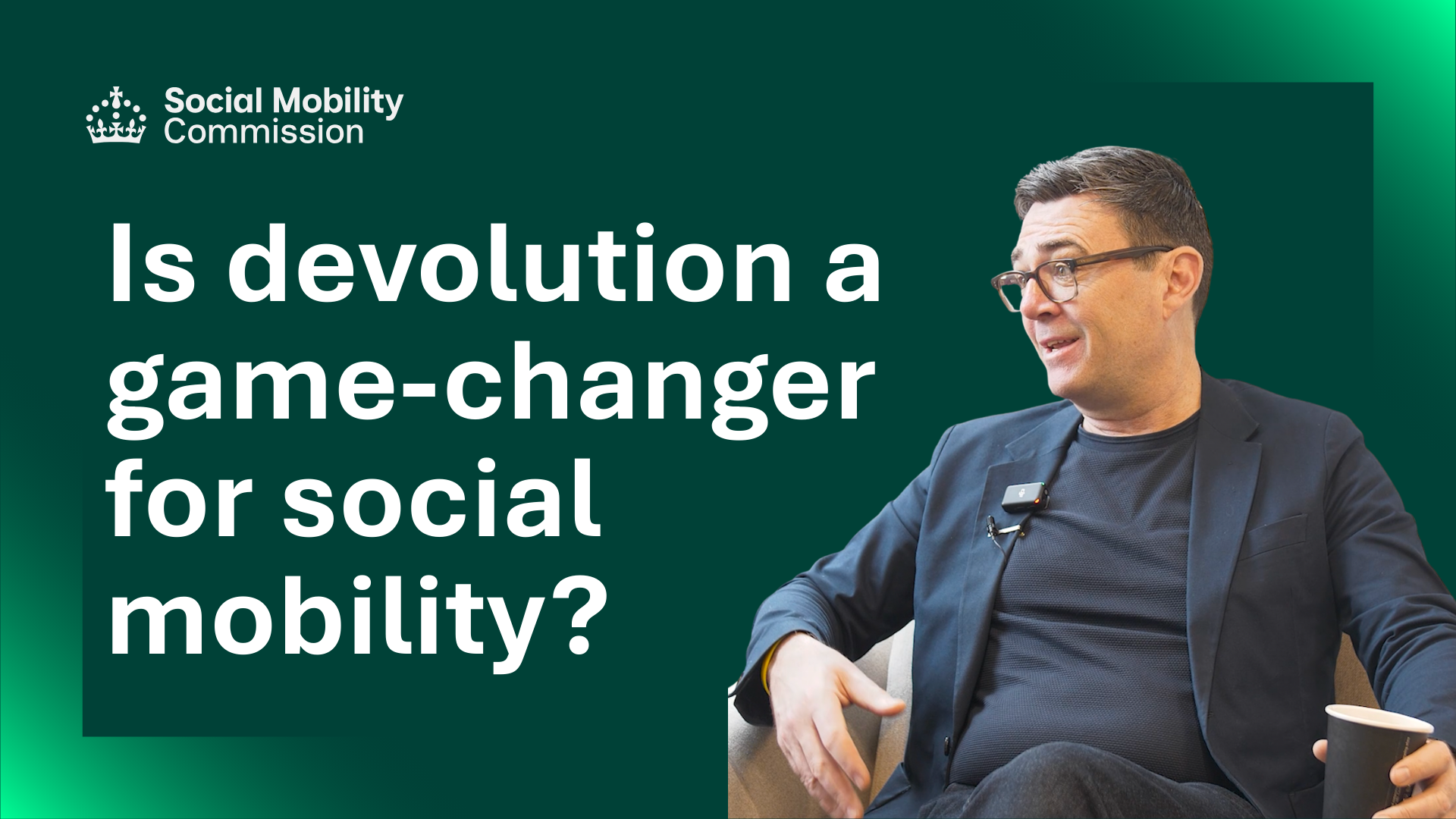
“Manchesterism”: Building the UK’s Leading Engine of Social Mobility – Andy Burnham joins Alun Francis for new podcast episode
Greater Manchester has become the trailblazer for English devolution, but what can other parts of the country learn from its experience? In the latest episode of Social Mobility Talks, Alun… read more
Topics

Who shapes the future? Women, Tech and AI
Right now only 1 in 4 tech workers are women and just 9% are from a low socio-economic background. What does it mean when the sector shaping the future doesn’t… read more
Topics
Who shapes the future? Women, Tech and AI – New Podcast Episode
Right now only 1 in 4 tech workers are women and just 9% are from a low socio-economic background. What does it mean when the sector shaping the future doesn’t… read more