Stepping Stone or Stumbling Block: Rethinking level 2 English and maths pathways
About the Commission
The Social Mobility Commission is an independent advisory non-departmental public body established under the Life Chances Act 2010 as modified by the Welfare Reform and Work Act 2016. It has a duty to assess progress in improving social mobility in the UK and to promote social mobility in England. The Commission board comprises:
Chair
Alun Francis OBE, Chief Executive of Blackpool and The Fylde College.
Deputy Chairs
Resham Kotecha, Head of Policy at the Open Data Institute.
Rob Wilson, Chair and Non-Executive Director across public, private and third sectors.
Commissioners
Dr Raghib Ali, Senior Clinical Research Associate at the Medical Research Council Epidemiology Unit at the University of Cambridge.
Ryan Henson, Chief Executive Officer at the Coalition for Global Prosperity.
Parminder Kohli, Chair Shell UK Ltd and Shell Group Executive Vice President Sustainability and Carbon.
Tina Stowell MBE, The Rt Hon Baroness Stowell of Beeston
This commentary was written by Andrew Otty. The author gratefully acknowledges the contributions from members of the SMC secretariat.
Foreword
Achievement in English and maths is widely recognised as a primary driver of positive life outcomes, a reality that led to their integration into GCSE school performance metrics in 2006. While the volume of “high grades” rose following this change, these gains were not distributed evenly across all groups. The metrics incentivised schools to focus on students at the grade D/C borderline (now grade 3/4), rather than addressing the fundamental issue of low basic literacy and numeracy for those who were below this point.
Arguably this strategy disproportionately affected disadvantaged pupils from lower socio-economic backgrounds (SEBs). The introduction of Progress and Attainment 8 measures in 2015/16 sought to rectify these imbalances, but recent data shows a widening gap. In the 2024/25 academic year, the proportion of disadvantaged students achieving a grade 4 in English and maths fell below 2018/19 levels, even as their non-disadvantaged peers saw gains.
Before the Wolf Review in 2011, very little concern was shown toward those who, by age 16 years, had not achieved high GCSE grades in English language and maths. It was assumed that they could carry on without it. But as the review pointed out, English and maths “are a necessary precondition for access to selective, demanding and desirable courses, whether these are ‘vocational’ or ‘academic’; and they are rewarded directly by the labour market throughout people’s careers.” By introducing the “condition of funding (CoF),” the review mandated that all young people aged 16 to 19 years who had not secured a grade 4 (previously C) should continue studying these subjects alongside their vocational or technical courses.
This is a very important commitment and affects well over 200,000 Key Stage 4 pupils a year. Although they are statistically more likely to originate from a “disadvantaged” background, the majority in this group do not. According to our calculations, around 121,000 were “not disadvantaged”, if we use the conventional definitions. Their lack of English and maths, however, suggests that they have become disadvantaged in the sense of their opportunities narrowing – and that this will continue over their life course. They are on a downward trajectory, and are likely to end up in the “sticky bottom” of low qualifications, low pay and least choice – along with the 99,000 of those with low English and maths grades who have been there all their lives. Ensuring that all young people have their options open as they enter adult life is a serious social mobility challenge. It is what the Wolf Review set out to rectify.
As with many aspects of UK public policy, the reforms which the Wolf Review introduced have not been independently evaluated. What we can say anecdotally, is that its implementation was not met with universal enthusiasm, nor was it an easy reform for providers to deliver. While the proportion of students attaining a grade 4 and above by age 19 years rose immediately, many institutions initially struggled to adapt, only slowly developing the expertise required to teach these subjects effectively in a post-16 context. Central to these growing pains is the ‘resitting’ cycle: a process of repeated exam attempts that has been under intense scrutiny since the CoF was first introduced.
Early guidance focused heavily on funding rules but offered limited direction on pedagogical practice. Over time, the Department for Education (DfE) guidance and Ofsted frameworks began to emphasise the necessity of sufficient curriculum time, stable teaching teams, and delaying exam entry until learners were truly prepared. However, “best practice”, including the specific criticism of repeated resitting, remained largely implied rather than directly addressed. It took over a decade for a concerted effort to emerge that distills comprehensive best practice for the sector.
By the time this guidance was published, the Curriculum and Assessment Review (CAR) had already concluded that the issue of premature and repeated GCSE resits required a more radical solution. The CAR argued that along with clunky performance measures, the condition of funding places undue pressure on providers to enter students for exams prematurely, resulting in low pass rates, student disengagement and wasted effort. And it recommended that, although students without a grade 4 in English and maths must continue their studies, there should be changes to the system. This includes a recommendation for a new “stepped” qualification and clearer expectations for teaching hours to prioritise learning and consolidation over immediate testing.
These structural proposals reflect an educational zeitgeist focused on supporting those the system currently leaves behind. Attention should be focused on these questions. But there is a perspective that it is based on an overly gloomy view of the impact of the CoF – that it advances remedies that may make the situation worse rather than better. This is the view of Andrew Otty, whose essay we produce here as a think piece.
Andrew Otty, a former DfE resit lead and further education (FE) English resit teacher, presents an optimistic assessment of the existing CoF. He restates the case for its impact, offering evidence that the policy has significantly improved outcomes for disadvantaged young people despite an unfavorable funding landscape and historical flaws in governance. Ultimately, Otty challenges the assumption that a new “stepped” qualification is the remedy the CAR envisions, suggesting instead that the current framework holds value that should not be overlooked. His argument is that the fundamental flaw in the CoF lies not with the qualification itself, but with a chaotic governance structure, inconsistent performance management and a chronic lack of resources.
We are publishing this think piece to provoke debate. Many practitioners will welcome the view that a new qualification is not going to answer the problem of English and maths achievement. The FE sector is weary of persistent curriculum reform. There is a clear case for breaking the cycle of short-term cramming combined with endless resits. But it is a moot point whether a new qualification will really make a substantial difference. Is there proof this approach will work? Do we have credible estimates of its impact? And are we really facing up to the size of the challenge?
We note that the government has recently taken steps to strengthen the current framework and support providers. These include the publication of the FE Commissioner’s Office’s Effective Practice Guide for Level 2 and below English and maths, and the development of a fully funded Continuing Professional Development (CPD) offer for teachers. Furthermore, the creation of Ofsted’s toolkit for FE Skills and the inclusion of English and maths within it represent progress. We also recognise the requirement that each student eligible for the CoF from the 2025 to 2026 academic year must be offered 100 hours each of English and/or maths teaching. This should be delivered at any point in the academic year as in-person, whole-class, stand-alone teaching.
However, there are bigger issues which need confronting if we want to get to the bottom of poor literacy and numeracy. A proper, independent evaluation of the Wolf Review reforms is long overdue. If this was undertaken, it would almost certainly go beyond the findings of the CAR.
It might point out that, if anything, the Wolf Review was too narrow in seeing the issues of deficient English and maths as just educational and labour market problems. In terms of social mobility, we should remember that, as many young people will become parents, their educational attainment is one of the strongest predictors of their child’s future academic success. And the benefits of good literacy and numeracy extend beyond the workplace, to mental wellbeing, civic participation and living a generally better life.
A good-quality evaluation might also point out that we have been slow to establish effective practice in post-16 English and maths teaching, that we still allocate too few hours to teaching these subjects, and we still invest far too little in tutors, not just in terms of CPD but also pay. And it would surely conclude that, if we are serious about ensuring that young people enter adult life with options on the table, then we need a more ambitious plan for English and maths.
Alun Francis
Chair, Social Mobility Commission
Executive summary
- English and maths are crucial for future study, employment, and earnings. This is why the condition of funding (CoF) was introduced in 2014. This policy required those who failed to obtain a Grade 4 (formerly Grade C) in either/both of these subjects to resit them.
- The majority of students who are required to retake English and maths come from disadvantaged backgrounds.
- Since its introduction, the CoF policy has enabled 500,000 students to successfully retake English and 350,000 to successfully resit maths. This has given these young people a crucial second chance.
- The 16–19 resit resit sector is currently the only educational stage where disadvantaged learners are actively catching up to their non-disadvantaged peers.
- The proposal of a new stepped level 1 qualification would require students who have already achieved level 1 at age 16 to repeat that level, creating a “stumbling block” rather than a path to level 2. This has serious implications for social mobility.
- The following piece proposes that rather than going through a process of structural overhaul, the government should instead build on what is already working. This includes mandating a minimum number of resit hours, providing more structural investment for 16-19 English and maths resits, and capturing and disseminating the teaching practices of the top performing colleges.
Introduction
For the past decade, the government’s CoF policy, commonly referred to as the ‘GCSE resit policy’, has served as a vital engine for social mobility, offering students a crucial second chance. However, the 2025 education and skills white paper risks reversing this progress by requiring lower attainers to repeat the level of qualification they have already achieved, rather than progressing toward level 2 GCSE grade 4+ (a grade C or higher).
By reopening the debate on continued study of Level 2 maths and English in the recent CAR, the focus has unfortunately shifted away from pedagogy and funding, the genuine drivers of improvement, toward unnecessary curriculum changes. While the post-16 sector has successfully narrowed the disadvantage gap, these new reforms threaten to institutionalise low expectations and dismantle a decade of hard-won progress for the most vulnerable learners.
Why are GCSE English and maths important?
According to the Organisation for Economic Co-operation and Development (OECD), low basic skills in literacy and numeracy limit an individual’s capacity to participate in a civic, working and personal life. They are key predictors of life satisfaction, financial security and physical and mental health. Achieving good results in GCSE English and maths (grade 4 or above, formerly grade C or above) is therefore not merely an academic benchmark; it shapes a young person’s future.
Falling short of this threshold significantly limits opportunities for further study. Missing a grade 4 GCSE in English reduces the probability of progressing to level 3 courses (A level or equivalent) or university. It also restricts alternate paths, including apprenticeships and vocational routes: only 5% of students without these grades successfully secure an apprenticeship by age 18 years.
The financial penalty for missing these qualifications is equally striking. The DfE estimates that a single grade improvement (for example, D to a C, C to a B) yields a lifetime earnings return of £7,266 in English and £14,579 in maths.
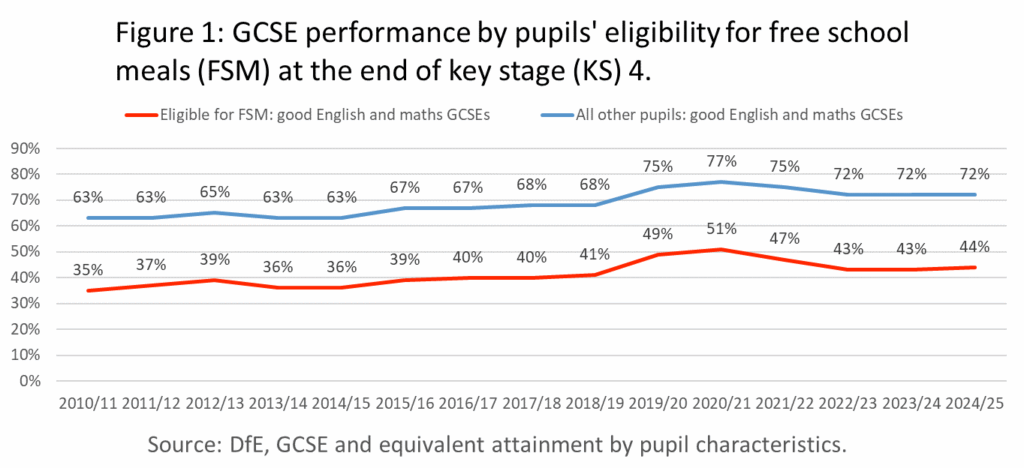
Crucially, this attainment is inextricably linked to SEB. As shown in figure 1, in the 2024/25 academic year, only 44% of free school meal (FSM)-eligible pupils earned a grade 4 in English and maths GCSE at 16 years, compared with 72% of pupils not eligible for FSM. The children most likely to miss out on these life-changing benefits are the most disadvantaged and they are the specific targets of the revised 16 to 19 policy discussed next.
16-19 condition of funding policy
Recognising the fundamental importance of these skills to life chances, the Wolf review of vocational qualifications led to the introduction of the existing CoF in 2014/15. The CoF requires that all students aged 16 to 19 years who have not yet achieved at least a grade 4 (C) in GCSE English and maths must continue to study these subjects. This requirement brings approximately 300,000 young people aged 16 to 19 years into scope annually. Consistent with the gaps in academic attainment in figure 1, this cohort is disproportionately drawn from lower SEBs.
Under the current regulations, the path a student takes is determined by their prior results. Students entering post-16 education with a grade 3 must retake the GCSE. Those with lower prior attainment may work towards either a GCSE or a functional skills qualification (level 2). In practice, however, this path is rarely chosen by the student and instead determined by the provider.
Impact of condition of funding policy
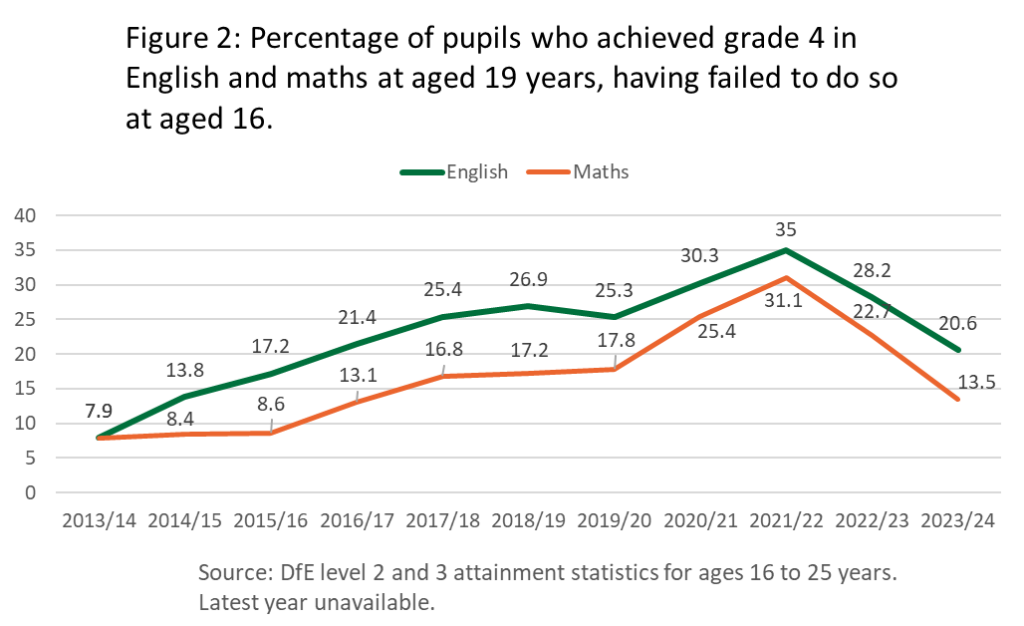
As shown in figure 2, success rates for learners resitting English and maths were on a consistent upward trajectory until the teacher-assessed grades of 2021/22. While results have subsequently dipped, due to more borderline attainers having been awarded grade 4 in the more generous grading of 2020/22, the long-term trend remains positive. The proportion of those achieving grade 4 in English and maths in 2023/24 remains 12.7 and 5.6 percentage points higher, respectively, than in 2013/14; the year before the policy was introduced. While these pass rates remain lower than many would like, they are consistent with other countries across the world which have introduced similar policies.
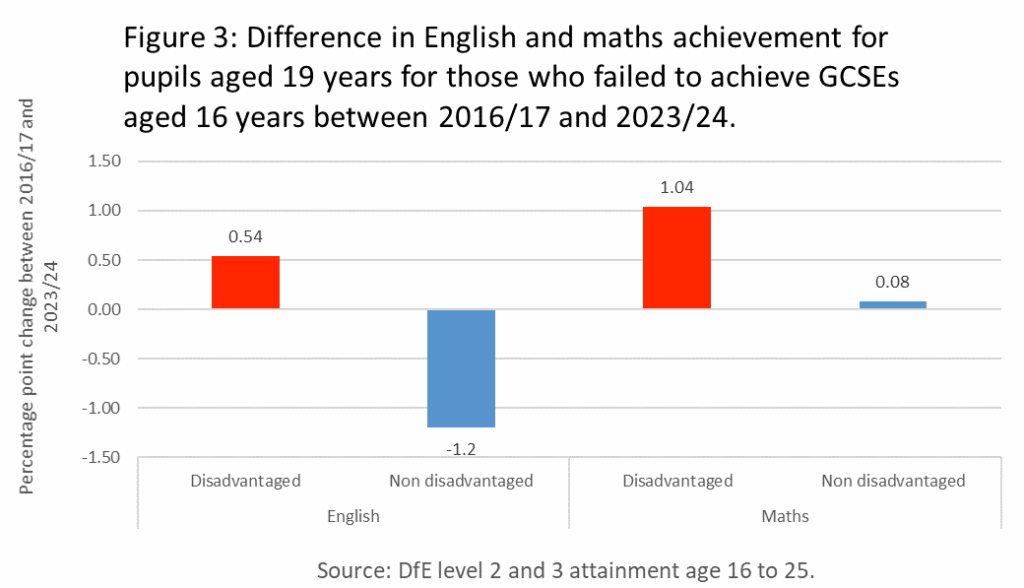
Beyond these general improvements, the policy has delivered disproportionate benefits to those from disadvantaged backgrounds. Figure 3 highlights the path of improvement between 2016/17 and 2023/24, revealing that success rates for disadvantaged students passing English and maths GCSEs by age 19 years have improved more than those of their non-disadvantaged peers.
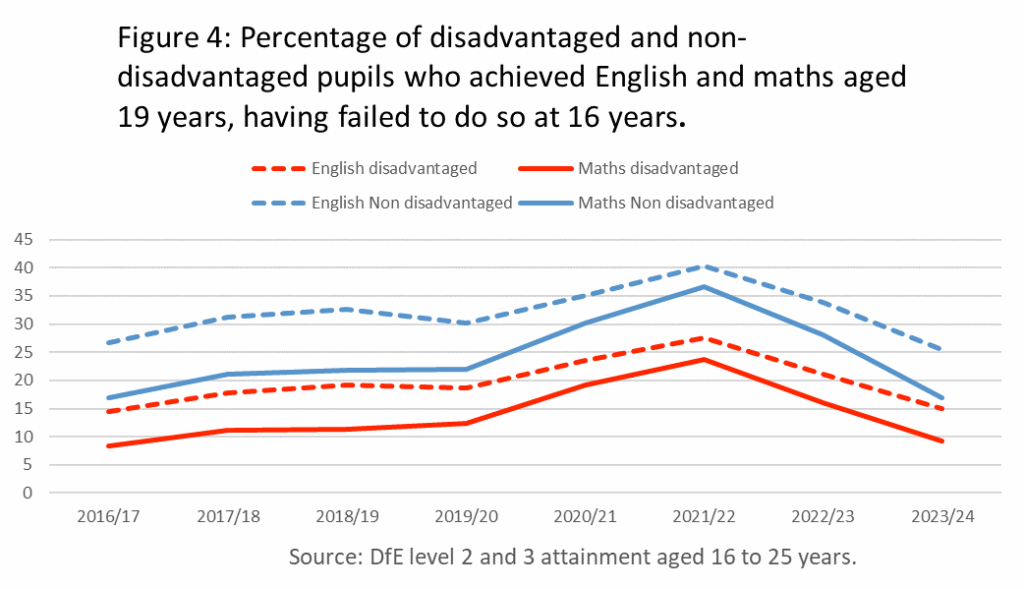
The progress in success rates is crucial: because disadvantaged students are improving more than non-disadvantaged students, it is a sign that the current framework is helping. However, figure 4 provides necessary context. Despite a greater improvement, disadvantaged students at age 19 years still trail their peers in absolute attainment, and remain less likely to pass English and maths than their non-disadvantaged peers.
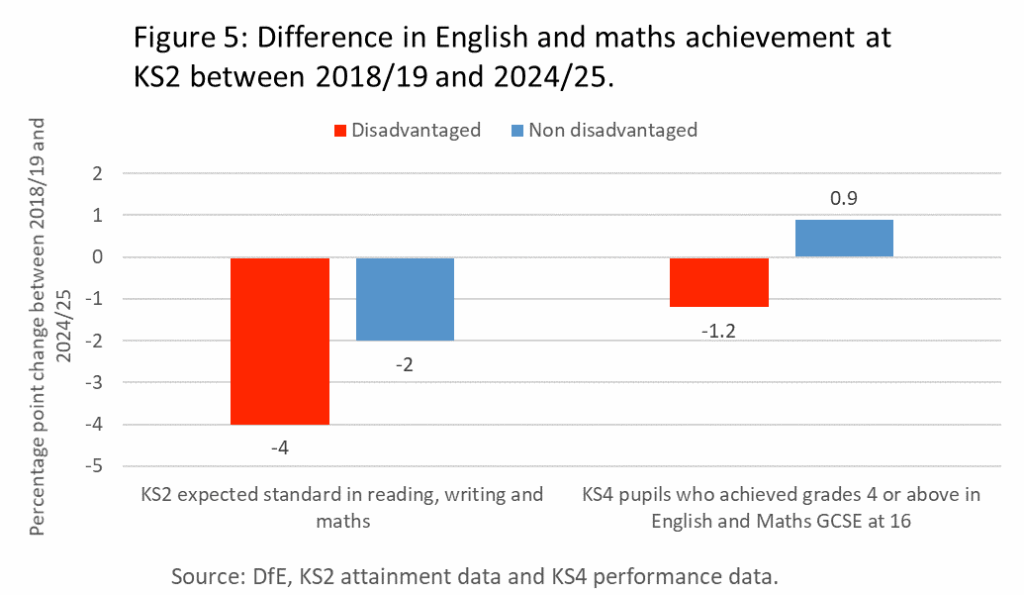
This success is unique within the current education landscape. As illustrated in figures 5 and 6, the 16–19 resit sector is the only stage where disadvantaged learners are actively catching up to their peers. In contrast, between 2018/19 and 2024/25, outcomes elsewhere have diverged. At KS2, attainment for disadvantaged pupils dropped by 4 percentage points; double the rate of decline seen in their non-disadvantaged counterparts. This trend is repeated at KS4 performance, where disadvantaged students are falling further behind.
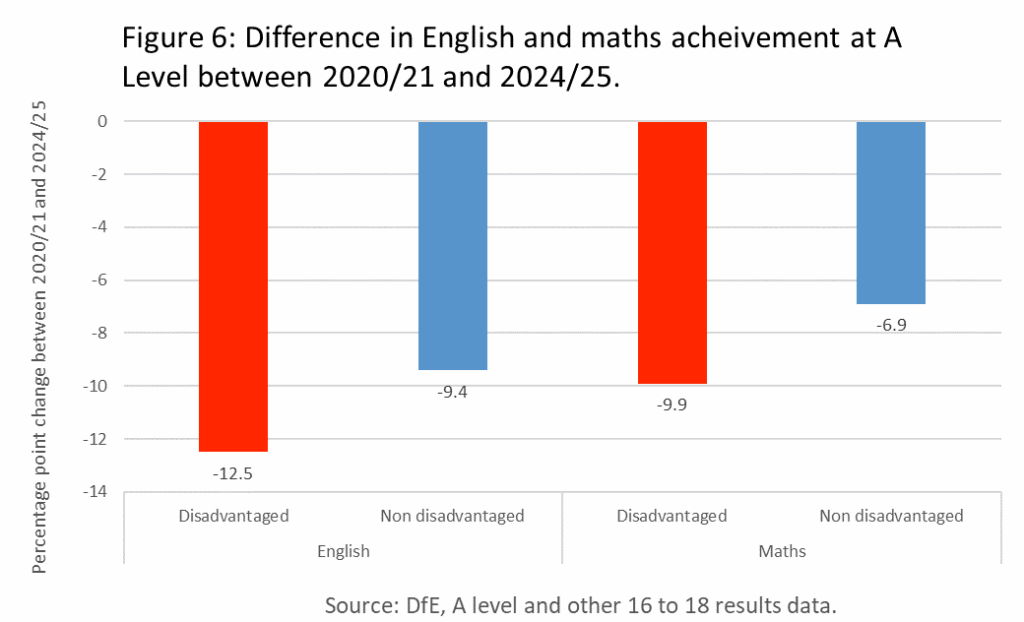
A growing disadvantage gap has also occurred in A level performance. Figure 6 follows the same approach as figures 3 and 5 and reveals that A level performance in English and maths has fallen for all students between 2020/21 and 2024/25. However, this decline is more pronounced for disadvantaged students.
This divergence from the national trend is driven by the resit policy’s ability to level the playing field. For many students, falling short at age 16 years is a consequence of unequal resources rather than a lack of potential. By mandating continued funded support, the policy provides the time and opportunity that disadvantaged students were previously denied. This acts as a structural corrective, converting potential into attainment. The scale of this success is significant: in the decade since its introduction, over 500,000 students have successfully retaken English and over 350,000 have done so in maths. Crucially, more than 245,000 of these passing grades were achieved by students from disadvantaged backgrounds.
During my years leading and teaching English in an FE college, I saw first hand the impact that a positive GCSE-resit experience can have for young people. Many arrived burdened with the erroneous label of failure but thrived when progress was prioritised and celebrated. I saw that the resit policy provided a space to re-engage students with the inherent joy of English through the freedom offered by the Language GCSE. The outcomes followed.
A few days after the release of the 2025 education and skills white paper, I bumped into one of my former students from the early years of the resit policy, and she proudly told me about her journey from resit student to becoming a band 5 nurse. I remembered that she had originally arrived at college with a grade 2 in English and a history of behavioural issues. She had enrolled on a Level 2 Health and Social Care programme while resitting her English and maths. “All I wanted was a fresh start,” she said.
Within one year of resiting English, she had progressed to a grade 5. “It was so different to school,” she reflected. “We enjoyed it and wanted to be there, so we got the work done and learned.”
Achieving English in the first year of college opened the door to level 3 Health and Social Care, facilitating the progression she has since achieved in her career. The education and skills white paper proposal would instead have forced her to repeat level 1 English, blocking progression to a level 3 study programme. I hope, in that scenario, she would have still found her way to where she is today, but at best the proposal to repeat level 1 is putting a stumbling block in the way of young people who deserve support. At worst we are limiting their futures.
Against the odds
It’s remarkable that the policy has achieved so much for so many, particularly given that the funding landscape often worked against the grain of the policy. The CoF mandates that providers deliver English and maths, but the financial mechanisms meant to support this work have often proven inefficient or poorly targeted.
First, disadvantage funding lacks necessary ring-fencing and targeting. Unlike the pupil premium, which is attached to specific students, 16–19 disadvantage funding flows into a provider’s general pot. This includes ‘disadvantage block 2’, a significant funding stream allocated on the basis of low prior attainment in English and maths as a proxy for socio-economic need. Yet, the DfE does not require this money to be spent on English and maths provision.
Temporary interventions have suffered from similar governance flaws. Between 2020/21 and 2023/24, £420 million was introduced as the 16-19 Tuition Fund to support catch-up. However, no baseline of English and maths delivery was established to ensure that tuition was additional to existing classroom hours, creating an opening for providers to cut core classroom delivery and replace it with tuition. Effectively, more funding was available for providing less. As the DfE’s resit lead, I spoke to colleges that cut their core teaching hours, reducing the size of teaching teams and shifting to externally-sourced tuition. When the Tuition Fund concluded and those additional hours fell away, government efforts to return to the pre-2019 average of 3 hours delivery suddenly exposed a staffing shortage. For example, at the end of the 2023/24 academic year there were 132 unfilled FE English teacher vacancies and 170 unfilled maths teacher vacancies. In my view, despite the obvious good intentions, the fund’s lack of governance wrought irreparable damage on resit delivery.
Efforts to structurally increase teaching time were also diluted. From 2022/23, an additional £260 million per year was allocated with the intention of increasing maths delivery by one hour per week. However, the accompanying guidance allowed providers to use these hours “flexibly” or for general “study skills,” rather than strictly prioritising maths. Consequently, few colleges utilised the funding to genuinely expand maths contact time and increase their maths resit delivery.
Finally, incentive structures have historically been misaligned with need. The ‘level 3 English and maths premium’ initially provided extra funding only for students on level 3 courses, meaning that a sixth-form A-level student who dropped one mark on their GCSE attracted additional cash, while a level 1 college student with no GCSEs and far greater needs attracted nothing. This was corrected in 2024/25 with an additional £75 million extending the premium to all resit students, largely benefitting the FE colleges that deliver to lower attainers. The additional hour of maths was once again attached as a requirement of the new funding when announced in early 2024, then quickly dropped again.
Curriculum and Assessment Review: what is proposed and what will it mean?
The hard-won progress achieved despite these financial, operational and accountability failings now faces a more fundamental threat from the curriculum review itself. The 2025 education and skills white paper outlines plans to introduce new “preparation for English and maths GCSEs” qualifications, specifically designed for students with low prior attainment (grade 2 or lower). The government intends for these courses to “consolidate foundational skills” before students are permitted to attempt the GCSE again. This has a range of social mobility implications, which are discussed next.
Impeding progress
This proposal structurally alters the progression route for lower attainers. Currently, the GCSE serves as a continuous ladder: a student can demonstrate valid, numerical progress (for example, moving from a grade 2 to a grade 3; level 1 pass) while remaining on a direct pathway to a level 2 pass (grade 4+). The new policy disrupts this continuity.
Instead of keeping the door to level 2 open, students will be diverted onto a qualification capped at level 1. This is problematic because all learners with prior grades of 1 to 2 will have already passed level 1 at age 16 years. Consequently, the policy effectively forces students to repeat a level they have already achieved. Rather than acting as a helpful “stepping stone,” this creates a stumbling block, impeding the progress of the students most in need of support.
Two-tier system
This proposal amounts to a new two-tier system for post-16 English and maths. This will force streaming by ability, with higher-achieving students taking the GCSE route and lower attainers taking the repeat of level 1. Research from the Education Endowment Foundation is clear that streaming by prior attainment is “not an effective way to raise attainment for most”. Furthermore, there is evidence that students who find themselves in the foundation tier experience a range of negative experiences as a result of being placed in the lower tier. These include lower self-esteem, feelings of being labelled and changing relationships with their peers.
Two-tier systems, whether within GCSE subjects that split by foundation and higher tier, or by running 2 different parallel routes such as the old O level and CSE pathways, invariably create segregation by social class. Poorer students end up funnelled onto less-academic pathways through the mistaken belief that their prior attainment represents an inherent limitation, rather than that they have lacked resource, support and opportunity. Two-tier systems exacerbate inequality. They are a vote of no confidence in the potential of young people from working-class backgrounds.
Aspirations
The proposed changes pose serious risks to learner aspiration. Evidence shows that students prioritise the GCSE for its currency in the labour market and higher education. Research indicates that 58% of vocational students prefer to take the GCSE (maths) compared to just 21% for functional skills and other stepping-stone qualifications. This preference is grounded in utility; students view the GCSE as opening doors, whereas being diverted onto a lower track is often perceived as a cap on potential. This mirrors the effect of ‘foundation tier’ groupings in schools, where restricting curriculum access can often lead to disengagement and a sense of lowered expectations.
This distinction is also recognised by high-performing FE providers. Unlike the binary pass/fail outcome of stepping-stone qualifications, the GCSE’s numerical grading system allows students to demonstrate incremental progress. This structural difference appears to drive results: The Education Policy Institute found that students enrolled directly on a GCSE track achieve better progress over their 16–19 study than those placed on lower-level alternatives, such as a Level 2 functional skills qualifications or existing stepping-stone qualifications.
This limit on aspiration affects not only students, but the teaching profession itself. Just as students aspire to qualifications with currency, teachers aspire to deliver them. The teacher labour market is anchored in the universality of the GCSE; with 3,500 secondary schools seeking this expertise compared to just 200 FE colleges, ambitious teachers view GCSE experience as essential for career mobility. Consequently, the Royal Society (the UK’s scientific academy) reports that maths specialists are often reluctant to teach functional skills, preferring the professional standing and academic rigour of the GCSE.
Introducing a niche level 1 qualification risks a compounding effect. It creates a curriculum that is less attractive to students, while simultaneously making the sector less attractive to the high-quality subject specialists needed to deliver it. Given that disadvantaged students are overrepresented in this cohort, this policy shift threatens to limit not only their academic ceiling but also their access to the most effective teaching.
The cost of reinvention
There is also a significant opportunity cost associated with ‘reinventing the wheel’. Developing new qualifications generates friction throughout the system. Awarding organisations inevitably pass these development and administration costs onto providers via higher exam fees, diverting budgets that could be spent on frontline delivery.
The operational burden is equally damaging. Introducing a new curriculum forces a diversion of skilled labour: teacher time is reallocated from refining classroom practice to administrative compliance. It requires adapting learning, creating new resources and standardising assessments for an untested specification. In a sector where contact time is already at a premium, diverting focus away from pedagogy to navigate bureaucratic change is a strategic error.
The sector is already suffering from reform fatigue. The Curriculum and Assessment Review marks the sixth overhaul of post-16 skills policy since 2010, confirming the Institute for Fiscal Studies’ (IFS) observation that “few areas of public policy have experienced as much change as skills policy”.
Evidence suggests that this constant structural churn rarely benefits the most vulnerable. The Sutton Trust found that the most recent GCSE reforms in 2015 actually widened the disadvantage gap, while Sam Freedman’s analysis of school reform over the last 2 decades concluded that there was no real impact on closing the disadvantaged gap. Similarly, since the introduction of the ‘Curriculum for Excellence’ in Scotland, the gap between the lowest and highest status groups has increased across reading, writing and science. Given this track record, it is unsurprising that the IFS has advised the Welsh government to delay similar reforms.
Building on success
Rather than risking further regression through unnecessary structural overhaul, policymakers should choose to build on what is demonstrably working. As this paper has outlined, the current CoF policy, despite its operational flaws, has achieved what other levels of education have not: driving better rates of improvement for disadvantaged students compared to their peers. The logical path forward, therefore, is optimisation, not revolution.
This process begins with resolving the funding crisis. English and maths resources for 16 to 19 year olds must be sufficient, ring-fenced and strictly conditional on a guaranteed minimum number of teaching hours per week. If the sector has achieved current progress levels with limited contact time, increasing this input through targeted, transparent funding could significantly accelerate gains for the most disadvantaged learners.
However, mandating minimum resit hours must come with more 16-19 funded hours. Structural investment is needed so that colleges can attract and retain the most-skilled professionals. While pre-16 schools are funded on an expectation of a 32.5-hour week, allowing them to offer teacher contracts of 1,265 hours or more. In contrast, 16-19 study programmes average just 19.5 hours per week, and FE teachers typically have contracts of under 900 hours. This has a detrimental effect on disadvantaged students, who are more likely to attend FE colleges. In the 2024/25 academic year, it is estimated that 20.4% and 22.8% of disadvantaged students who completed KS4 in the 2023/24 academic year were resitting English and maths in 2024/25. The corresponding figure for non-disadvantaged students was 12.2% (English) and 13.6% (maths). Of these resit students, 76.5% attended FE colleges, while only 18.8% attended schools. The investment in resources should be matched with more sophisticated accountability. The return of the suspended headline progress measures in 2026, alongside Ofsted’s new inspection framework, are positive steps towards this. The new inspection approach presents an opportunity to focus on progress and inclusion. If applied effectively, it will recognise and reward where providers support lower-attaining students to move up through GCSE grades. It should put an end to the gaming that sees tens of thousands of the most disadvantaged students denied post-16 English and maths support.
Finally, the central focus of improvement must shift from curriculum design to pedagogical quality. The most effective lever for raising standards is not a new syllabus, but a more skilled and supported workforce. Rather than diverting energy into a new qualification, the government should prioritise capturing and disseminating the teaching approaches of top-performing colleges identified through the returning headline progress measures.
Related content

Understanding the experiences of young people not in education, employment or training (NEET) in Blackpool
There has rightly been significant attention given to the nearly one million young people (aged 16 – 24) who are currently NEET, however there has been little work that speaks… read more
Topics

Conversations with NEETs: Research reveals daily lives and struggles of young people in Blackpool
Social Mobility Commission lifts the lid on the reality for young people not in education, employment or training (NEET) in Blackpool Report recommendations co-created with young people, not for them… read more
Topics

Young and NEET in Blackpool: upcoming research on their realities
Next week, the Social Mobility Commission will be releasing our in-depth research into the daily lives and experiences of young people not in education, employment or training (NEET) in Blackpool…. read more