Social Mobility Commission co-hosts roundtable on AI rewards vs risks with the Tony Blair Institute for Global Change
At Blackpool and The Fylde College, The Social Mobility Commission and Tony Blair Institute for Global Change co-chaired a roundtable with business leaders, community stakeholders, and education institutions to discuss the risks and benefits of AI within the social mobility debate.
Attendees shared insights on how AI can be utilised to accelerate local growth and skills plans, how Mayoral Combined Authorities and local governments can use AI to grow opportunity, how the government can help embed AI as a tool in the education system and what local employers in Blackpool can do to reap the rewards.
Alongside welcoming the rewards of AI – the group also acknowledged the perceived risks of AI having a negative impact on jobs for higher and lower skilled workforces.
Alun Francis OBE, Chair of the Social Mobility Commission and Ryan Wain, Executive Director of the Tony Blair Institute for Global Change co-chaired the discussion with:
-
- Chelsea Brown, Digital Project Lead, for ‘Pride of Place’ programme at Business in the Community (BiTC)
- Andy Charles, Director of Blackpool ‘Pride of Place’ programme at Business in the Community (BiTC)
- Tony Doyle, Head of IT Services at Blackpool Council
- Robyn Ellis, Executive Director of Transformation at Dixons Academies Trust
- Graham Cowley OBE, Chair at Blackpool Opportunity Area
- Ewan Bennie, Director of Communications and Influence at EY Foundation
- Camilla Drejer, Managing Director at Accenture
- Dr. Gemma Cassells, Head of Strategy of Data-Driven Initiative at the University of Edinburgh
- Bronagh Fletcher, VP of Delivery at Napier A.I.
- Marc Potter, Assistant Principal, Digital and Creative Innovation at Blackpool and the Fylde College
- Annie Kerfoot, Vice Principal Vocational Economy at Blackpool and the Fylde College
- Peter Greenall, Vice Principal for Higher Education and Frontier Economy at Blackpool and the Fylde College College
Alun Francis OBE, Chair of the Social Mobility Commission, said:
“AI presents a real opportunity to all of us, no matter what stage in life you are at. Local and national governments, schools and employers must work together to equip everyone with the skills and knowledge to harness the potential of AI and not leave any community behind.
“At the Social Mobility Commission, our research shows the impact of deindustrialisation was not felt equally across the country, the scars in some communities run deep and show little signs of healing even 50 years on. We must not make the same mistakes as we go through this technological transition.”
Ryan Wain, Executive Director of Policy and Politics at the Tony Blair Institute, said:
“The AI revolution is unfolding in real time around us. Its impact will be as profound as the Industrial Revolution. Britain must harness it, making sure it works for everyone – no matter what your background is.
“I loved being in Blackpool where we challenged the genesis of AI inequality. Whether it’s kids in private schools being more likely to learn about AI or those going without an internet connection, we committed to acting now to reduce inequality later – unlocking all the talent we can get.
“After all, artificial intelligence needs human intelligence. That’s evenly distributed but opportunity isn’t. After my experience in Blackpool, I’m more positive than ever that we can change that.”
Both the Social Mobility Commission and the Tony Blair Institute have made recommendations for harnessing the power of AI to the benefit of social mobility, some of these include:
- Closing the AI disadvantage gap – Ensuring widespread connectivity across all regions and equality in rolling out technology and training in schools to equip all young people not just those attending elite educational institutions.
- Supporting workers to transition and upskill – Encouraging and providing supportive funding for continuous upskilling for adults to ensure local people can adapt to labour market changes and move into newly created, higher-productivity roles.
- Closer collaboration between education and employers – Meaning young people from lower socio-economic backgrounds are not left behind as AI reshapes the economy, employer-education partnerships must be strengthened to ensure training reaches disadvantaged areas and curricula is co-designed with businesses to match local skills with emerging industry needs.
- The need for robust digital infrastructure – Across the country, from schools to businesses, poor infrastructure can delay and deter organisations from being able to deploy AI tools and create regional disadvantage.
- AI as a driver of regional growth, innovation and productivity – AI and technology are immense opportunities for solving systemic and entrenched regional disparity, provided they are supported by strategic investment beyond London and the South East. Tax incentives and funding will encourage businesses to upskill their workforce and attract new talent and startups to more regions.
The Social Mobility Commission and Tony Blair Institute for Global Change will be continuing to work together to promote opportunity through AI in Blackpool and advocating for a bottom-up approach to spread the benefits of AI.
The Social Mobility Commission previously published a think-piece from Philippe Aghion (College de France, INSEAD, and London School of Economics), Richard Blundell (University College London and Institute for Fiscal Studies) and Xavier Jaravel on innovation and social mobility, had Professor Nazrul present to the Employer Advisory Group and provided evidence to the Lords inquiry on AI’s impact on social mobility.
Related content
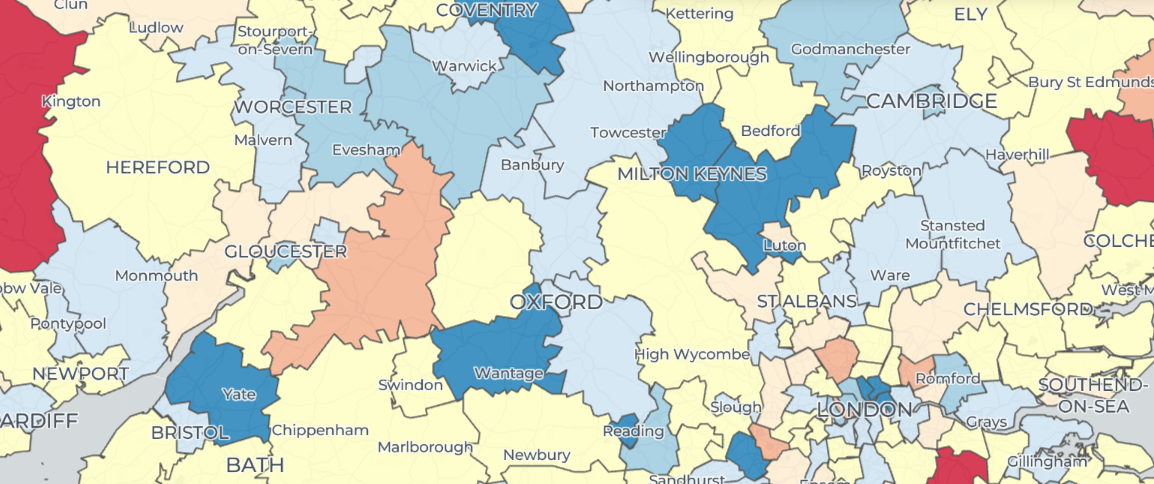
New data tool equips businesses and local leaders to tackle regional social mobility barriers
New tool helps understand the barriers to business entry, dynamism, and innovation across different parts of the UK. The Local Innovation and Economic Dynamism index equips policymakers and local leaders… read more
Topics

Do postcodes drive privilege?
There is frequent discussion of how your socio-economic background, parent’s occupation and school determine your academic achievements, job prospects and future income. But what happens when you keep climbing the… read more
Topics

Understanding the experiences of young people not in education, employment or training (NEET) in Blackpool
There has rightly been significant attention given to the nearly one million young people (aged 16 – 24) who are currently NEET, however there has been little work that speaks… read more